


Page 429 - Williams Hematology ( PDFDrive )
P. 429
404            Part V:  Therapeutic Principles                                                                                                                                     Chapter 25:  Antithrombotic Therapy             405


                                                                      lasted for several days. It was demonstrated that acetylation of COX
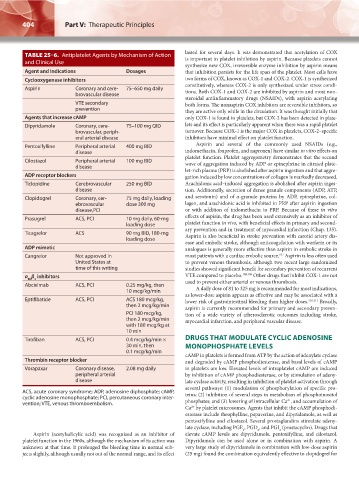
                TABLE 25–6.  Antiplatelet Agents by Mechanism of Action   is important in platelet inhibition by aspirin. Because platelets cannot
                and Clinical Use
                                                                      synthesize new COX, irreversible enzyme inhibition by aspirin means
                Agent and Indications             Dosages             that inhibition persists for the life span of the platelet. Most cells have
                Cyclooxygenase inhibitors                             two forms of COX, known as COX-1 and COX-2. COX-1 is synthesized
                Aspirin          Coronary and cere-  75–650 mg daily  constitutively, whereas COX-2 is only synthesized under stress condi-
                                                                      tions. Both COX-1 and COX-2 are inhibited by aspirin and most non-
                                 brovascular disease
                                                                      steroidal antiinflammatory drugs (NSAIDs), with aspirin acetylating
                                 VTE secondary                        both forms. The nonaspirin COX inhibitors are reversible inhibitors, so
                                 prevention                           they are active only while in the circulation. It was thought initially that
                Agents that increase cAMP                             only COX-1 is found in platelets, but COX-2 has been detected in plate-
                Dipyridamole     Coronary, cere-  75–100 mg QID       lets and its effect is particularly apparent when there was a rapid platelet
                                 brovascular, periph-                 turnover. Because COX-1 is the major COX in platelets, COX-2–specific
                                 eral arterial disease                inhibitors have minimal effect on platelet function.
                Pentoxifylline   Peripheral arterial   400 mg BID         Aspirin  and  several  of  the  commonly  used  NSAIDs  (e.g.,
                                 disease                              indomethacin, ibuprofen, and naproxen) have similar in vitro effects on
                                                                      platelet function. Platelet aggregometry demonstrates that the second
                Cilostazol       Peripheral arterial   100 mg BID     wave of aggregation induced by ADP or epinephrine in citrated plate-
                                 disease
                                                                      let-rich plasma (PRP) is abolished after aspirin ingestion and that aggre-
                ADP receptor blockers                                 gation induced by low concentrations of collagen is markedly decreased.
                Ticlopidine      Cerebrovascular   250 mg BID         Arachidonic acid–induced aggregation is abolished after aspirin inges-
                                 disease                              tion. Additionally, secretion of dense granule components (ADP, ATP,
                Clopidogrel      Coronary, cer-   75 mg daily, loading   and serotonin) and of  α-granule proteins by ADP, epinephrine, col-
                                 ebrovascular     dose 300 mg         lagen, and arachidonic acid is inhibited in PRP after aspirin ingestion
                                 disease,PCI                          or  with  addition  of  indomethacin  to  PRP.  Because  of  these  in vitro
                                                                      effects of aspirin, the drug has been used extensively as an inhibitor of
                Prasugrel        ACS, PCI         10 mg daily, 60-mg
                                                  loading dose        platelet function in vivo, with beneficial effects in primary and second-
                                                                      ary prevention and in treatment of myocardial infarction (Chap. 135).
                Ticagrelor       ACS              90 mg BID, 180-mg   Aspirin is also beneficial in stroke prevention with carotid artery dis-
                                                  loading dose
                                                                      ease and embolic stroke, although anticoagulation with warfarin or its
                ADP mimetic                                           analogues is generally more effective than aspirin in embolic stroke in
                                                                                                      107
                Cangrelor        Not approved in                      most patients with a cardiac embolic source.  Aspirin is less often used
                                 United States at                     to prevent venous thrombosis, although two recent large randomized
                                 time of this writing                 studies showed significant benefit for secondary prevention of recurrent
                α β  inhibitors                                       VTE compared to placebo. 108,109  Other drugs that inhibit COX-1 are not
                 IIb 3                                                used to prevent either arterial or venous thrombosis.
                Abciximab        ACS, PCI         0.25 mg/kg, then        A daily dose of 81 to 325 mg is recommended for most indications,
                                                  10 mcg/kg/min
                                                                      as lower-dose aspirin appears as effective and may be associated with a
                Eptifibatide     ACS, PCI         ACS 180 mcg/kg,     lower risk of gastrointestinal bleeding than higher doses. 110,111  Broadly,
                                                  then 2 mcg/kg/min   aspirin is currently recommended for primary and secondary preven-
                                                  PCI 180 mcg/kg,     tion  of  a  wide  variety of  atherosclerotic  outcomes  including  stroke,
                                                  then 2 mcg/kg/min   myocardial infarction, and peripheral vascular disease.
                                                  with 180 mcg/kg at
                                                  10 min
                Tirofiban        ACS, PCI         0.4 mcg/kg/min ×    DRUGS THAT MODULATE CYCLIC ADENOSINE
                                                  30 min, then        MONOPHOSPHATE LEVELS
                                                  0.1 mcg/kg/min      cAMP in platelets is formed from ATP by the action of adenylate cyclase
                Thrombin receptor blocker                             and degraded by cAMP phosphodiesterase, and basal levels of cAMP
                Vorapaxar        Coronary disease,   2.08 mg daily    in platelets are low. Elevated levels of intraplatelet cAMP are induced
                                 peripheral arterial                  by inhibition of cAMP phosphodiesterase, or by stimulation of adeny-
                                 disease                              late cyclase activity, resulting in inhibition of platelet activation through
                                                                      several pathways: (1) modulation of phosphorylation of specific pro-
               ACS, acute coronary syndrome; ADP, adenosine diphosphate; cAMP,   teins; (2) inhibition of several steps in metabolism of phosphoinositol
               cyclic adenosine monophosphate; PCI, percutaneous coronary inter-  phosphates; and (3) lowering of intracellular Ca , and accumulation of
                                                                                                        2+
               vention; VTE, venous thromboembolism.
                                                                      Ca  by platelet microsomes. Agents that inhibit the cAMP phosphodi-
                                                                        2+
                                                                      esterase include theophylline, papaverine, and dipyridamole, as well as
                                                                      pentoxifylline and cilostazol. Several prostaglandins stimulate adeny-
                                                                      late cyclase, including PGE , PGD , and PGI  (prostacyclin). Drugs that
                                                                                         1
                                                                                                      2
                                                                                              2
                   Aspirin (acetylsalicylic acid) was recognized as an inhibitor of   elevate cAMP levels are dipyridamole, pentoxifylline, and cilostazol.
               platelet function in the 1960s, although the mechanism of its action was   Dipyridamole can be used alone or in combination with aspirin. A
               unknown at that time. It prolonged the bleeding time in normal sub-  very large study of dipyridamole in combination with low-dose aspirin
               jects slightly, although usually not out of the normal range, and its effect   (25 mg) found the combination equivalently effective to clopidogrel for


          Kaushansky_chapter 25_p0393-0408.indd   404                                                                   9/19/15   12:20 AM

