


Page 425 - Williams Hematology ( PDFDrive )
P. 425
400            Part V:  Therapeutic Principles                                                                                                                                     Chapter 25:  Antithrombotic Therapy             401


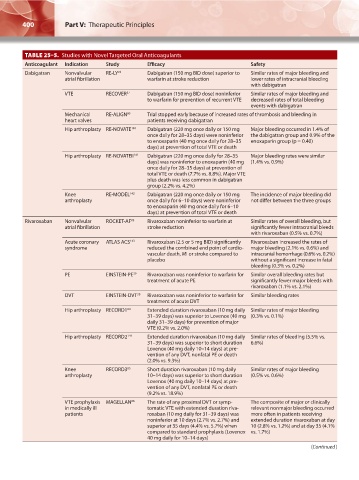
                TABLE 25–5.  Studies with Novel Targeted Oral Anticoagulants
                Anticoagulant  Indication  Study         Efficacy                           Safety
                Dabigatran    Nonvalvular   RE-LY 78     Dabigatran (150 mg BID dose) superior to   Similar rates of major bleeding and
                              atrial fibrillation        warfarin at stroke reduction       lower rates of intracranial bleeding
                                                                                            with dabigatran
                              VTE          RECOVER 37    Dabigatran (150 mg BID dose) noninferior   Similar rates of major bleeding and
                                                         to warfarin for prevention of recurrent VTE  decreased rates of total bleeding
                                                                                            events with dabigatran
                              Mechanical   RE-ALIGN 80   Trial stopped early because of increased rates of thrombosis and bleeding in
                              heart valves               patients receiving dabigatran
                              Hip arthroplasty RE-NOVATE 140  Dabigatran (220 mg once daily or 150 mg   Major bleeding occurred in 1.4% of
                                                         once daily for 28–35 days) were noninferior   the dabigatran group and 0.9% of the
                                                         to enoxaparin (40 mg once daily for 28–35   enoxaparin group (p = 0.40)
                                                         days) at prevention of total VTE or death
                              Hip arthroplasty RE-NOVATEII 141  Dabigatran (220 mg once daily for 28–35   Major bleeding rates were similar
                                                         days) was noninferior to enoxaparin (40 mg   (1.4% vs. 0.9%)
                                                         once daily for 28–35 days) at prevention of
                                                         total VTE or death (7.7% vs. 8.8%). Major VTE
                                                         plus death was less common in dabigatran
                                                         group (2.2% vs. 4.2%)
                              Knee         RE-MODEL 142  Dabigatran (220 mg once daily or 150 mg   The incidence of major bleeding did
                              arthroplasty               once daily for 6–10 days) were noninferior   not differ between the three groups
                                                         to enoxaparin (40 mg once daily for 6–10
                                                         days) at prevention of total VTE or death
                Rivaroxaban   Nonvalvular   ROCKET-AF 83  Rivaroxaban noninferior to warfarin at   Similar rates of overall bleeding, but
                              atrial fibrillation        stroke reduction                   significantly fewer intracranial bleeds
                                                                                            with rivaroxaban (0.5% vs. 0.7%)
                              Acute coronary   ATLAS ACS 143  Rivaroxaban (2.5 or 5 mg BID) significantly   Rivaroxaban increased the rates of
                              syndrome                   reduced the combined end point of cardio-  major bleeding (2.1% vs. 0.6%) and
                                                         vascular death, MI or stroke compared to   intracranial hemorrhage (0.6% vs. 0.2%)
                                                         placebo                            without a significant increase in fatal
                                                                                            bleeding (0.3% vs. 0.2%)
                              PE           EINSTEIN-PE 39  Rivaroxaban was noninferior to warfarin for   Similar overall bleeding rates but
                                                         treatment of acute PE              significantly fewer major bleeds with
                                                                                            rivaroxaban (1.1% vs. 2.1%)
                              DVT          EINSTEIN-DVT 38  Rivaroxaban was noninferior to warfarin for   Similar bleeding rates
                                                         treatment of acute DVT
                              Hip arthroplasty RECORD1 84  Extended duration rivaroxaban (10 mg daily  Similar rates of major bleeding
                                                         31–39 days) was superior to Lovenox (40 mg  (0.3% vs. 0.1%)
                                                         daily 31–39 days) for prevention of major
                                                         VTE (0.2% vs. 2.0%)
                              Hip arthroplasty RECORD2 144  Extended duration rivaroxaban (10 mg daily  Similar rates of bleeding (5.5% vs.
                                                         31–39 days) was superior to short duration   6.6%)
                                                         Lovenox (40 mg daily 10–14 days) at pre-
                                                         vention of any DVT, nonfatal PE or death
                                                         (2.0% vs. 9.3%)
                              Knee         RECORD3 85    Short duration rivaroxaban (10 mg daily   Similar rates of major bleeding
                              arthroplasty               10–14 days) was superior to short duration   (0.5% vs. 0.6%)
                                                         Lovenox (40 mg daily 10–14 days) at pre-
                                                         vention of any DVT, nonfatal PE or death
                                                         (9.2% vs. 18.9%)
                              VTE prophylaxis  MAGELLAN 86  The rate of any proximal DVT or symp-  The composite of major or clinically
                              in medically ill           tomatic VTE with extended duration riva-  relevant nonmajor bleeding occurred
                              patients                   roxaban (10 mg daily for 31–39 days) was   more often in patients receiving
                                                         noninferior at 10 days (2.7% vs. 2.7%) and   extended duration rivaroxaban at day
                                                         superior at 35 days (4.4% vs. 5.7%) when   10 (2.8% vs. 1.2%) and at day 35 (4.1%
                                                         compared to standard prophylaxis (Lovenox   vs. 1.7%)
                                                         40 mg daily for 10–14 days)
                                                                                                                (Continued )


          Kaushansky_chapter 25_p0393-0408.indd   400                                                                   9/19/15   12:19 AM

