


Page 463 - Williams Hematology ( PDFDrive )
P. 463
438            Part V:  Therapeutic Principles                                                                                                                      Chapter 29:  Gene Therapy for Hematologic Diseases             439


                                     Ex-vivo gene therapy                             In-vivo gene therapy
                                            1. HSC or T cells removed from patients


                                                                               1. Viral particles directly inject into
                                                                               the patient’s body


                2. The cells are                                                      2. The transduced
                transduced with                               4. The transduced       cells express
                transgene-containing                          cells express           therapeutic proteins
                engineering virus                             therapeutic
                                                              proteins
                                   3. The transduced cells
                                   are reintroduced into
                                   body
                A                                                              B

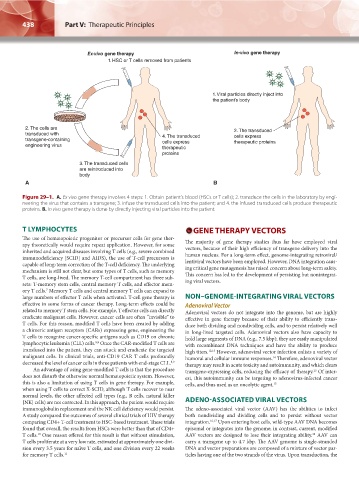
               Figure 29–1.  A. Ex vivo gene therapy involves 4 steps: 1. Obtain patient’s blood (HSCs or T cells); 2. transduce the cells in the laboratory by engi-
               neering the virus that contains a transgene; 3. infuse the transduced cells into the patient; and 4. the infused transduced cells produce therapeutic
               proteins. B. In vivo gene therapy is done by directly injecting viral particles into the patient.


               T LYMPHOCYTES                                             GENE THERAPY VECTORS
               The use of hematopoietic progenitor or precursor cells for gene ther-
               apy theoretically would require repeat application. However, for some   The majority of gene therapy studies thus far have employed viral
               inherited and acquired diseases involving T cells (e.g., severe combined   vectors, because of their high efficiency of transgene delivery into the
               immunodeficiency [SCID] and AIDS), the use of T-cell precursors is   human nucleus. For a long-term effect, genome-integrating retroviral/
               capable of long-term correction of the T-cell deficiency. The underlying   lentiviral vectors have been employed. However, DNA integration caus-
               mechanism is still not clear, but some types of T cells, such as memory   ing critical gene mutagenesis has raised concern about long-term safety.
               T cells, are long-lived. The memory T-cell compartment has three sub-  This concern has led to the development of persisting but nonintegrat-
               sets: T-memory stem cells, central memory T cells, and effector mem-  ing viral vectors.
               ory T cells.  Memory T cells and central memory T cells can expand to
                       7
               large numbers of effector T cells when activated. T-cell gene therapy is   NON–GENOME-INTEGRATING VIRAL VECTORS
               effective in some forms of cancer therapy. Long-term effects could be   Adenoviral Vector
               related to memory T stem cells. For example, T effector cells can directly   Adenoviral  vectors do not  integrate into  the genome, but are  highly
               eradicate malignant cells. However, cancer cells are often “invisible” to   effective in gene therapy because of their ability to efficiently trans-
               T cells. For this reason, modified T cells have been created by adding   duce both dividing and nondividing cells, and to persist relatively well
               a chimeric antigen receptors (CARs) expressing gene, engineering the   in long-lived targeted cells. Adenoviral vectors also have capacity to
               T cells to recognize cancer-specific antigens such as CD19 on chronic   hold large segments of DNA (e.g., 7.5 kbp); they are easily manipulated
               lymphocytic leukemia (CLL) cells.  Once the CAR-modified T cells are   with recombinant DNA techniques and have the ability to produce
                                        8,9
               transfused into the patient, they can attack and eradicate the targeted   high titers. 12,13  However, adenoviral vector infection enlists a variety of
               malignant cells. In clinical trials, anti-CD19 CAR T cells profoundly   humoral and cellular immune responses.  Therefore, adenoviral vector
                                                                                                   14
               decreased the level of cancer cells in three patients with end-stage CLL. 8,9  therapy may result in acute toxicity and autoimmunity, and which clears
                   An advantage of using gene-modified T cells is that the procedure   transgene-expressing cells, reducing the efficacy of therapy.  Of inter-
                                                                                                                 13
               does not disturb the otherwise normal hematopoietic system. However,   est, this autoimmunity can be targeting to adenovirus-infected cancer
               this is also a limitation of using T cells in gene therapy. For example,   cells, and thus used as an oncolytic agent. 15
               when using T cells to correct X-SCID, although T cells recover to near
               normal levels, the other affected cell types (e.g., B cells, natural killer
               [NK] cells) are not corrected. In this approach, the patient would require   ADENO-ASSOCIATED VIRAL VECTORS
               immunoglobulin replacement and the NK cell deficiency would persist.   The adeno-associated viral vector (AAV) has the abilities to infect
               A study compared the outcomes of several clinical trials of HIV therapy   both nondividing and dividing cells and to persist without vector
               comparing CD4+ T-cell treatment to HSC-based treatment. These trials   integration. 16,17  Upon entering host cells, wild-type AAV DNA becomes
               found that overall, the results from HSCs were better than that of CD4+   episomal or integrates into the genome; in contrast, current, modified
               T cells.  One reason offered for this result is that without stimulation,    AAV vectors are designed to lose their integrating ability.  AAV can
                                                                                                                 18
                     10
               T cells proliferate at a very low rate, estimated at approximately one divi-  carry a transgene up to 4.7 kbp. The AAV genome is single-stranded
               sion every 3.5 years for naïve T cells, and one division every 22 weeks   DNA and vector preparations are composed of a mixture of vector par-
               for memory T cells. 11                                 ticles having one of the two strands of the virus. Upon transduction, the


          Kaushansky_chapter 29_p0437-0446.indd   438                                                                   9/19/15   12:22 AM

