


Page 468 - Williams Hematology ( PDFDrive )
P. 468
442  Part V:  Therapeutic Principles                   Chapter 29:  Gene Therapy for Hematologic Diseases             443


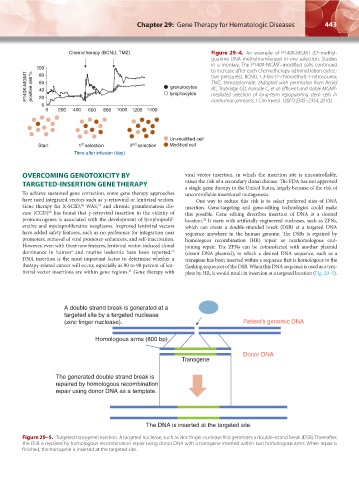
                                 Chemotherapy (BCNU, TMZ)                        Figure 29–4.  An example of P140K-MGMT (O -methyl-
                                                                                                                     6
                                                                                 guanine-DNA methyltransferase) in vivo selection. Studies
                                                                                 in a monkey. The P140K-MGMT–modified cells continued
                       100                                                       to increase after each chemotherapy administration (selec-
                   P140K-MGMT  positive cell %  60                 Iymphocytes   TMZ,  temozolomide.  (Adapted with permission from Beard
                       80
                                                                                 tive pressures). BCNU, 1,3-bis-(2-chloroethyl)-1-nitrosourea;
                                                                   granulocytes
                                                                                 BC, Trobridge GD, Ironside C, et al: Efficient and stable MGMT-
                       40
                                                                                 mediated selection of long-term repopulating stem cells in
                       20
                        0                                                        nonhuman primates. J Clin Invest 120(7):2345–2354, 2010.)
                          0   200  400  600  800  1000 1200 1400


                                                                   Un-modified cell
                                      st
                       Start         1 selection      2 nd  selection  Modified cell
                                   Time after infusion (day)


                  OVERCOMING GENOTOXICITY BY                            viral vector insertion, in which the insertion site is uncontrollable,
                  TARGETED-INSERTION GENE THERAPY                       raises the risk of a secondary clonal disease. The FDA has not approved
                                                                        a single-gene therapy in the United States, largely because of the risk of
                  To achieve sustained gene correction, some gene therapy approaches   uncontrollable insertional mutagenesis.
                  have used integrated vectors such as γ-retroviral or lentiviral vectors.   One way to reduce this risk is to select preferred sites of DNA
                  Gene therapy for X-SCID,  WAS,  and chronic granulomatous dis-  insertion. Gene-targeting and gene-editing technologies could make
                                     56
                                           57
                  ease (CGD)  has found that  γ-retroviral insertion in the vicinity of   this possible. Gene editing describes insertion of DNA at a desired
                           58
                  protooncogenes is associated with the development of lymphoprolif-  location.  It starts with artificially engineered nucleases, such as ZFNs,
                                                                              33
                  erative and myeloproliferative neoplasms. Improved lentiviral vectors   which can create a double-stranded break (DSB) at a targeted DNA
                  have added safety features, such as no preference for integration near   sequence  anywhere  in  the  human  genome.  The  DSBs  is  repaired  by
                  promoters, removal of viral promoter-enhancers, and self-inactivation.   homologous recombination (HR) repair or nonhomologous end-
                  However, even with these new features, lentiviral vector-induced clonal   joining repair. The ZFNs can be cotransfected with another plasmid
                  dominance in human  and murine leukemia have been reported.    (donor DNA plasmid), in which a desired DNA sequence, such as a
                                                                    59
                                  6
                  DNA insertion is the most important factor to determine whether a    transgene has been inserted within a sequence that is homologous to the
                  therapy-related cancer will occur, especially as 80 to 90 percent of len-  flanking sequences of the DSB. When this DNA sequence is used as a tem-
                  tiviral vector insertions are within gene regions.  Gene therapy with   plate by HR, it would result in insertion at a targeted location (Fig. 29–5).
                                                     21


                                A double strand break is generated at a
                                targeted site by a targeted nuclease
                                (zinc finger nuclease).                                     Patient’s genomic DNA

                                          Homologous arms (800 bp)


                                                                                            Donor DNA
                                                                       Transgene

                             The generated double strand break is
                             repaired by homologous recombination
                             repair using donor DNA as a template.


                                                           The DNA is inserted at the targeted site.

                  Figure 29–5.  Targeted transgene insertion. A targeted nuclease, such as zinc finger nuclease first generates a double-strand break (DSB). Thereafter,
                  the DSB is repaired by homologous recombination repair using donor DNA with a transgene inserted within two homologous arms. When repair is
                  finished, the transgene is inserted at the targeted site.


          Kaushansky_chapter 29_p0437-0446.indd   443                                                                   9/19/15   12:22 AM

