


Page 465 - Williams Hematology ( PDFDrive )
P. 465
440            Part V:  Therapeutic Principles                                                                                                                      Chapter 29:  Gene Therapy for Hematologic Diseases             441


                                                Adding prodrug: AP1903
                          Modified caspase-9  FK506                Dimerization and
                                                                   Caspase-9 activated


                                                                                                  Casepase 3 and 7
                                                                                                     activated


                                  The iCasp9 suicide gene system


                                                                                                     Apoptosis


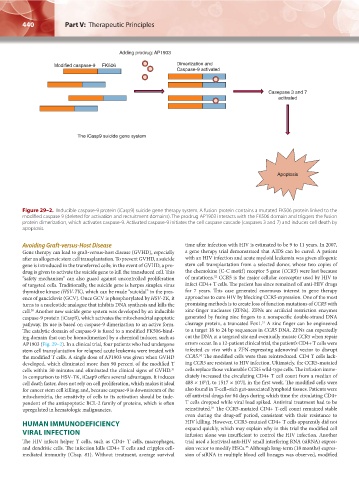
               Figure 29–2.  Inducible caspase-9 protein (iCasp9) suicide gene therapy system. A fusion protein contains a mutated FK506 protein linked to the
               modified caspase 9 (deleted for activation and recruitment domains). The prodrug AP1903 interacts with the FK506 domain and triggers the fusion
               protein dimerization, which activates caspase-9. Activated caspase-9 initiates the cell caspase cascade (caspases 3 and 7) and induces cell death by
               apoptosis.


               Avoiding Graft-versus-Host Disease                     time after infection with HIV is estimated to be 9 to 11 years. In 2007,
               Gene therapy can lead to graft-versus-host disease (GVHD), especially   a gene therapy trial demonstrated that AIDS can be cured. A patient
               after an allogeneic stem cell transplantation. To prevent GVHD, a suicide   with an HIV infection and acute myeloid leukemia was given allogenic
               gene is introduced in the transferred cells; in the event of GVHD, a pro-  stem cell transplantation from a selected donor, whose two copies of
               drug is given to activate the suicide gene to kill the transduced cell. This   the chemokine (C-C motif) receptor 5 gene (CCR5) were lost because
                                                                                32
               “safety mechanism” can also guard against uncontrolled proliferation   of mutations.  CCR5 is the major cellular coreceptor used by HIV to
               of targeted cells. Traditionally, the suicide gene is herpes simplex virus   infect CD4+ T cells. The patient has since remained off anti-HIV drugs
               thymidine kinase (HSV-TK), which can be made “suicidal” in the pres-  for 7  years. This  case  generated  enormous  interest in  gene therapy
               ence of ganciclovir (GCV). Once GCV is phosphorylated by HSV-TK, it   approaches to cure HIV by blocking CCR5 expression. One of the most
               turns to a nucleotide analogue that inhibits DNA synthesis and kills the   promising methods is to create loss of function mutations of CCR5 with
               cell.  Another new suicide gene system was developed by an inducible   zinc-finger nucleases (ZFNs). ZFNs are artificial restriction enzymes
                  30
               caspase-9 protein (iCasp9), which activates the mitochondrial apoptotic   generated by fusing zinc fingers to a nonspecific double-strand DNA
                                                                                                33
               pathway. Its use is based on caspase-9 dimerization to an active form.   cleavage protein, a truncated Fox1.  A zinc finger can be engineered
               The catalytic domain of caspase-9 is fused to a modified FK506-bind-  to a target 18 to 24 bp sequences in CCR5 DNA. ZFNs can repeatedly
               ing domain that can be homodimerized by a chemical inducer, such as   cut the DNA at a targeted site and eventually mutate CCR5 when repair
               AP1903 (Fig. 29–2). In a clinical trial, four patients who had undergone   errors occur. In a 12-patient clinical trial, the patient’s CD4+ T cells were
               stem cell transplantation for relapsed acute leukemia were treated with   infected  ex vivo with a  ZFN-expressing adenoviral vector to disrupt
                                                                           34
               the modified T cells. A single dose of AP1903 was given when GVHD   CCR5.  The modified cells were then reintroduced. CD4 T cells lack-
               developed, which eliminated more than 90 percent of the modified T   ing CCR5 are resistant to HIV infection. Ultimately, the CCR5-mutated
               cells within 30 minutes and eliminated the clinical signs of GVHD.    cells replace those vulnerable CCR5 wild-type cells. The infusion imme-
                                                                 31
               In comparison to HSV-TK, iCasp9 offers several advantages. It induces   diately increased the circulating CD4+ T cell count from a median of
                                                                            9
                                                                                        9
               cell death faster, does not rely on cell proliferation, which makes it ideal   488 × 10 /L to 1517 × 10 /L in the first week. The modified cells were
               for cancer stem cell killing; and, because caspase-9 is downstream of the   also found in T-cell–rich gut-associated lymphoid tissues. Patients were
               mitochondria, the sensitivity of cells to its activation should be inde-  off antiviral drugs for 84 days during which time the circulating CD4+
               pendent of the antiapoptotic BCL-2 family of proteins, which is often   T cells dropped while viral load spiked. Antiviral treatment had to be
                                                                               34
               upregulated in hematologic malignancies.               reinstituted.  The CCR5-mutated CD4+ T-cell count remained stable
                                                                      even during the drug-off period, consistent with their resistance to
               HUMAN IMMUNODEFICIENCY                                 HIV killing. However, CCR5-mutated CD4+ T cells apparently did not
               VIRAL INFECTION                                        expand quickly, which may explain why in this trial the modified cell
                                                                      infusion alone was insufficient to control the HIV infection. Another
               The HIV infects helper T cells, such as CD4+ T cells, macrophages,   trial used a lentiviral anti-HIV small interfering RNA (siRNA) expres-
               and dendritic cells. The infection kills CD4+ T cells and cripples cell-  sion vector to modify HSCs.  Although long-term (18 months) expres-
                                                                                          35
               mediated immunity (Chap. 81). Without treatment, average survival   sion of siRNA in multiple blood cell lineages was observed, modified


          Kaushansky_chapter 29_p0437-0446.indd   440                                                                   9/19/15   12:22 AM

