


Page 473 - Williams Hematology ( PDFDrive )
P. 473
448            Part V:  Therapeutic Principles                                                                                          Chapter 30:  Regenerative Medicine: Multipotential Cell Therapy for Tissue Repair          449


                                           Genome                          Systems
                                           •  Gene correction              biology
                                           •  Gene addition
                                           •  Epigenetic modification


                                                                          Cell


                                      Genome

                                                           Regenerative                 Cell
                         Synthetic                          medicine                    •  Quality of cells for specific task
                          biology                                                       •  Quantity of cells for specific task
                                                                                        •  Cell–cell interactions (3D tissues)
                                                                                        •  Cells engineered to:
                                                                                          –  Migrate to specific tissue
                                                                                          –  Destroy cells (cancer)
                                  Patient                                                 –  Deliver therapeutics
                                  •  Transplant biology            Patient              •  Cell banks
                                    –  Autologous
                                    –  Allogeneic
                                  •  Mode of delivery                         Personal
                                  •  Conditioning                            genomics
                                    –  Host
                                    –  Graft


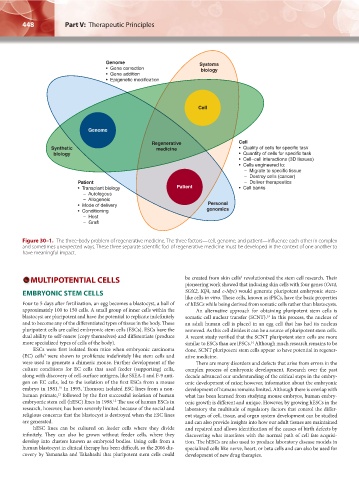
               Figure 30–1.  The three-body problem of regenerative medicine. The three factors—cell, genome, and patient—influence each other in complex
               and sometimes unexpected ways. These three separate scientific foci of regenerative medicine must be developed in the context of one another to
               have meaningful impact.


                    MULTIPOTENTIAL CELLS                              be created from skin cells  revolutionized the stem cell research. Their
                                                                                         6
                                                                      pioneering work showed that inducing skin cells with four genes (Oct4,
               EMBRYONIC STEM CELLS                                   SOX2, Klf4, and c-Myc) would generate pluripotent embryonic stem-
                                                                      like cells in vitro. These cells, known as iPSCs, have the basic properties
               Four to 5 days after fertilization, an egg becomes a blastocyst, a ball of   of hESCs while being derived from somatic cells rather than blastocysts.
               approximately 100 to 150 cells. A small group of inner cells within the   An alternative approach for obtaining pluripotent stem cells is
               blastocyst are pluripotent and have the potential to replicate indefinitely   somatic cell nuclear transfer (SCNT).  In this process, the nucleus of
                                                                                                 13
               and to become any of the differentiated types of tissue in the body. These   an adult human cell is placed in an egg cell that has had its nucleus
               pluripotent cells are called embryonic stem cells (ESCs). ESCs have the   removed. As this cell divides it can be a source of pluripotent stem cells.
               dual ability to self-renew (copy themselves) and differentiate (produce   A recent study verified that the SCNT pluripotent stem cells are more
               more specialized types of cells of the body).          similar to ESCs than are iPSCs.  Although much research remains to be
                                                                                            14
                   ESCs were first isolated from mice when embryonic carcinoma   done, SCNT pluripotent stem cells appear to have potential in regener-
               (EC) cells  were shown to proliferate indefinitely like stem cells and   ative medicine.
                       9
               were used to generate a chimeric mouse. Further development of the   There are many disorders and defects that arise from errors in the
               culture conditions for EC cells that used feeder (supporting) cells,   complex process of embryonic development. Research over the past
               along with discovery of cell-surface antigens, like SSEA-1 and F-9 anti-  decade advanced our understanding of the critical steps in the embry-
               gen on EC cells, led to the isolation of the first ESCs from a mouse   onic development of mice; however, information about the embryonic
               embryo in 1981.  In 1995, Thomson isolated ESC lines from a non-  development of humans remains limited. Although there is overlap with
                            10
               human primate,  followed by the first successful isolation of human   what has been learned from studying mouse embryos, human embry-
                           11
               embryonic stem cell (hESC) lines in 1998.  The use of human ESCs in   onic growth is different and unique. However, by growing hESCs in the
                                              12
               research, however, has been severely limited because of the social and   laboratory the multitude of regulatory factors that control the differ-
               religious concerns that the blastocyst is destroyed when the ESC lines   ent stages of cell, tissue, and organ system development can be studied
               are generated.                                         and can also provide insights into how our adult tissues are maintained
                   hESC lines can be cultured on feeder cells where they divide   and repaired and allows identification of the causes of birth defects by
               infinitely. They can also be grown without feeder cells, where they   discovering what interferes with the normal path of cell fate acquisi-
               develop  into clusters known  as embryoid  bodies.  Using  cells from a   tion. The hESCs are also used to produce laboratory disease models in
               human blastocyst in clinical therapy has been difficult, so the 2006 dis-  specialized cells like nerve, heart, or beta cells and can also be used for
               covery by Yamanaka and Takahashi that pluripotent stem cells could   development of new drug therapies.


          Kaushansky_chapter 30_p0447-0458.indd   448                                                                   9/17/15   6:07 PM

