


Page 566 - Williams Hematology ( PDFDrive )
P. 566
540  Part VI:  The Erythrocyte                                            Chapter 36:  Pure Red Cell Aplasia          541


                      TRANSIENT APLASTIC CRISIS AND                     tropic for erythroid progenitor cells,  mainly because of their P antigen
                                                                                                  70
                                                                                                                71,72
                                                                        or globoside, the receptor for entry of B19 into the cell
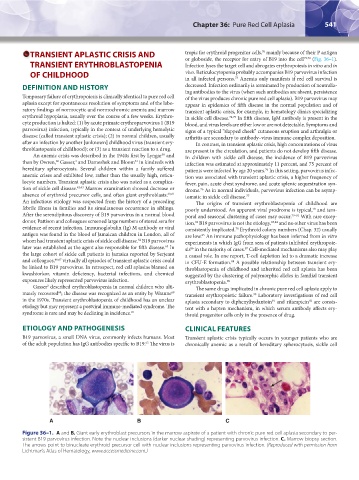
                                                                                                                    (Fig. 36–1).
                    TRANSIENT ERYTHROBLASTOPENIA                        Infection lyses the target cell and abrogates erythropoiesis in vitro and in
                    OF CHILDHOOD                                        vivo. Reticulocytopenia probably accompanies B19 parvovirus infection
                                                                                         73
                                                                        in all infected persons.  Anemia only manifests if red cell survival is
                  DEFINITION AND HISTORY                                decreased. Infection ordinarily is terminated by production of neutraliz-
                                                                        ing antibodies to the virus (when such antibodies are absent, persistence
                  Temporary failure of erythropoiesis is clinically identical to pure red cell   of the virus produces chronic pure red cell aplasia). B19 parvovirus may
                  aplasia except for spontaneous resolution of symptoms and of the labo-  appear in epidemics of fifth disease in the normal population and of
                  ratory findings of normocytic and normochromic anemia and marrow   transient aplastic crisis, for example, in hematology clinics specializing
                  erythroid hypoplasia, usually over the course of a few weeks. Erythro-  in sickle cell disease. 74,75  In fifth disease, IgM antibody is present in the
                  cyte production is halted: (1) by acute primate erythroparvovirus 1 (B19   blood, and virus levels are either low or are not detectable. Symptoms and
                  parvovirus) infection, typically in the context of underlying hemolytic   signs of a typical “slapped cheek” cutaneous eruption and arthralgia or
                  disease (called transient aplastic crisis); (2) in normal children, usually   arthritis are secondary to antibody–virus immune complex deposition.
                  after an infection by another [unknown] childhood virus (transient ery-  In contrast, in transient aplastic crisis, high concentrations of virus
                  throblastopenia of childhood); or (3) as a transient reaction to a drug.  are present in the circulation, and patients do not develop fifth disease.
                     An anemic crisis was described in the 1940s first by Lyngar  and   In children with sickle cell disease, the incidence of B19 parvovirus
                                                                 59
                  then by Owren,  Gasser,  and Dameshek and Bloom  in kindreds with   infection was estimated at approximately 11 percent, and 75 percent of
                             60
                                                        61
                                    3
                  hereditary spherocytosis. Several children within a family suffered   patients were infected by age 20 years.  In this setting, parvovirus infec-
                                                                                                   76
                  anemic crises and exhibited low, rather than the usually high, reticu-  tion was associated with transient aplastic crisis, a higher frequency of
                  locyte numbers. Transient aplastic crisis also was noted as a complica-  fever, pain, acute chest syndrome, and acute splenic sequestration syn-
                  tion of sickle cell disease. 62,63  Marrow examination showed decrease or   drome.  As in normal individuals, parvovirus infection can be asymp-
                                                                              76
                  absence of erythroid precursor cells, and often giant erythroblasts. 60,61    tomatic in sickle cell disease. 77
                  An infectious etiology was suspected from the history of a preceding   The origins of transient erythroblastopenia of childhood are
                  febrile illness in families and its simultaneous occurrence in siblings.   poorly understood. An apparent viral prodrome is typical,  and tem-
                                                                                                                   78
                  After the serendipitous discovery of B19 parvovirus in a normal blood   poral and seasonal clustering of cases may occur. 79–81  With rare excep-
                  donor, Pattison and colleagues screened large numbers of stored sera for   tion,  B19 parvovirus is not the etiology, 83,84  and no other virus has been
                                                                            82
                  evidence of recent infection. Immunoglobulin (Ig) M antibody or viral   consistently implicated.  Erythroid colony numbers (Chap. 32) usually
                                                                                         78
                  antigen was found in the blood of Jamaican children in London, all of   are low.  An immune pathophysiology has been inferred from in vitro
                                                                              85
                  whom had transient aplastic crisis of sickle cell disease.  B19 parvovirus   experiments in which IgG from sera of patients inhibited erythropoie-
                                                         64
                  later was established as the agent also responsible for fifth disease.  In   sis  in the majority of cases.  Cell-mediated mechanisms also may play
                                                                  65
                                                                                            87
                                                                          86
                  the large cohort of sickle cell patients in Jamaica reported by Serjeant   a causal role. In one report, T-cell depletion led to a dramatic increase
                  and colleagues, 66,67  virtually all episodes of transient aplastic crisis could   in CFU-E formation.  A possible relationship between transient ery-
                                                                                        88
                  be linked to B19 parvovirus. In retrospect, red cell aplasias blamed on   throblastopenia of childhood and inherited red cell aplasia has been
                  kwashiorkor, vitamin deficiency, bacterial infections, and chemical   suggested by the clustering of polymorphic alleles in familial transient
                  exposures likely represented parvovirus infection.    erythroblastopenia. 89
                     Gasser  described erythroblastopenia in normal children who ulti-  The same drugs implicated in chronic pure red cell aplasia apply to
                          3
                  mately recovered ; the disease was recognized as an entity by Wranne    transient erythropoietic failure.  Laboratory investigations of red cell
                              60
                                                                    68
                                                                                               90
                  in the 1970s. Transient erythroblastopenia of childhood has an unclear   aplasia secondary to diphenylhydantoin  and rifampicin  are consis-
                                                                                                                  92
                                                                                                      91
                  etiology but may represent a postviral immune-mediated syndrome. The   tent with a hapten mechanism, in which serum antibody affects ery-
                  syndrome is rare and may be declining in incidence. 69  throid progenitor cells only in the presence of drug.
                  ETIOLOGY AND PATHOGENESIS                             CLINICAL FEATURES
                  B19 parvovirus, a small DNA virus, commonly infects humans. Most   Transient aplastic crisis typically occurs in younger patients who are
                  of the adult population has IgG antibodies specific to B19.  The virus is   chronically anemic as a result of hereditary spherocytosis, sickle cell
                                                           65


                           A                            B                             C
                  Figure 36–1.  A and B. Giant early erythroblast precursors in the marrow aspirate of a patient with chronic pure red cell aplasia secondary to per-
                  sistent B19 parvovirus infection. Note the nuclear inclusions (darker nuclear shading) representing parvovirus infection. C. Marrow biopsy section.
                  The arrows point to binucleate erythroid precursor cell with nuclear inclusions representing parvovirus infection. (Reproduced with permission from
                  Lichtman’s Atlas of Hematology, www.accessmedicine.com.)


          Kaushansky_chapter 36_p0539-0548.indd   541                                                                   9/17/15   6:15 PM

