


Page 570 - Williams Hematology ( PDFDrive )
P. 570
544  Part VI:  The Erythrocyte                                            Chapter 36:  Pure Red Cell Aplasia          545


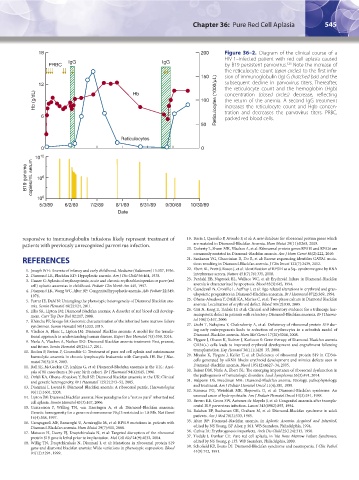
                       18                                                     200     Figure  36–2.  Diagram of the clinical course of a
                                                                                      HIV-1–infected patient with red cell aplasia caused
                                 IgG                             IgG                                       123
                           PRBC                                                       by B19 persistent parvovirus.  Note the increase of
                                                                                      the reticulocyte count (open circles) to the first infu-
                                                                              150     sion of immunoglobulin (Ig) G (hatched bar) and the
                       12                                                          µ  subsequent  decline  in  parvovirus  titers.  Thereafter,
                                                                                      the reticulocyte count and the hemoglobin (Hgb)
                      Hb (g/dL)                        Hb                     100  Reticulocytes (1000/  L)  concentration  (closed circles) decrease, reflecting
                                                                                      the  return  of  the  anemia.  A  second  IgG  treatment
                                                                                      increases  the  reticulocyte  count  and  Hgb  concen-
                        6                                                             tration and decreases the parvovirus titers. PRBC,
                                                                                      packed red blood cells.
                                                                              50

                                                   Reticulocytes
                        0                                                     0
                        12

                   B19 genome  copies/mL serum 10  6
                       10


                       10 0
                        5/3/89  6/2/89   7/2/89  8/1/89  8/31/89  9/30/89  10/30/89
                                                  Date


                  responsive to immunoglobulin infusions likely represent treatment of     19.  Boria I, Quarello P, Avondo F, et al: A new database for ribosomal protein genes which
                  patients with previously unrecognized parvovirus infection.  are mutated in Diamond-Blackfan Anemia. Hum Mutat 29(11):E263, 2008.
                                                                          20.  Doherty L, Sheen MR, Vlachos A, et al: Ribosomal protein genes RPS10 and RPS26 are
                                                                           commonly mutated in Diamond-Blackfan anemia. Am J Hum Genet 86(2):222, 2010.
                  REFERENCES                                              21.  Sankaran VG, Ghazvinian R, Do R, et al: Exome sequencing identifies GATA1 muta-
                                                                           tions resulting in Diamond-Blackfan anemia. J Clin Invest 122(7):2439, 2012.
                    1.  Joseph WH: Anemia of infancy and early childhood. Medicine (Baltimore) 15:307, 1936.    22.  Ebert BL, Pretz J, Bosco J, et al: Identification of RPS14 as a 5q− syndrome gene by RNA
                    2.  Diamond LK, Blackfan KD: Hypoplastic anemia. Am J Dis Child 56:464, 1938.  interference screen. Nature 451(7176):335, 2008.
                    3.  Gasser C: Aplasia of erythropoiesis; acute and chronic erythroblastopenias or pure (red     23.  Perdahl EB, Naprstek BL, Wallace WC, et al: Erythroid failure in Diamond-Blackfan
                     cell) aplastic anaemias in childhood. Pediatr Clin North Am 445, 1957.  anemia is characterized by apoptosis. Blood 83(3):645, 1994.
                    4.  Diamond LK, Wang WC, Alter BP: Congenital hypoplastic anemia. Adv Pediatr 22:349,     24.  Casadevall N, Croisille L, Auffray I, et al: Age-related alterations in erythroid and gran-
                     1976.                                                 ulopoietic progenitors in Diamond-Blackfan anaemia. Br J Haematol 87(2):369, 1994.
                    5.  Farrar JE, Dahl N: Untangling the phenotypic heterogeneity of Diamond Blackfan ane-    25.  Ohene-Abuakwa Y, Orfali KA, Marius C, et al: Two-phase culture in Diamond Blackfan
                     mia. Semin Hematol 48(2):124, 2011.                   anemia: Localization of erythroid defect. Blood 105(2):838, 2005.
                    6.  Ellis SR, Lipton JM: Diamond Blackfan anemia: A disorder of red blood cell develop-    26.  Giri N, Kang E, Tisdale JF, et al: Clinical and laboratory evidence for a trilineage hae-
                     ment. Curr Top Dev Biol 82:217, 2008.                 matopoietic defect in patients with refractory Diamond-Blackfan anaemia. Br J Haema-
                    7.  Khincha PP, Savage SA: Genomic characterization of the inherited bone marrow failure   tol 108(1):167, 2000.
                     syndromes. Semin Hematol 50(4):333, 2013.            27.  Uechi T, Nakajima Y, Chakraborty A, et al: Deficiency of ribosomal protein S19 dur-
                    8.  Vlachos A, Blanc L, Lipton JM: Diamond Blackfan anemia: A model for the transla-  ing early embryogenesis leads to reduction of erythrocytes in a zebrafish model of
                     tional approach to understanding human disease. Expert Rev Hematol 7(3):359, 2014.  Diamond-Blackfan anemia. Hum Mol Genet 17(20):3204, 2008.
                    9.  Narla A, Vlachos A, Nathan DG: Diamond Blackfan anemia treatment: Past, present,     28.  Flygare J, Olsson K, Richter J, Karlsson S: Gene therapy of Diamond Blackfan anemia
                     and future. Semin Hematol 48(2):117, 2011.            CD34(+) cells leads to improved erythroid development and engraftment following
                    10.  Rodon P, Breton P, Courouble G: Treatment of pure red cell aplasia and autoimmune   transplantation. Exp Hematol 36(11):1428–35, 2008.
                     haemolytic anaemia in chronic lymphocytic leukaemia with Campath-1H. Eur J Hae-    29.  Miyake K, Flygare J, Keifer T, et al: Deficiency of ribosomal protein S19 in CD34+
                     matol 70(5):319, 2003.                                cells generated by siRNA blocks erythroid development and mimics defects seen in
                    11.  Ball SE, McGuckin CP, Jenkins G, et al: Diamond-Blackfan anaemia in the U.K.: Anal-  Diamond-Blackfan anemia. Blood 105(12):4627–34, 2005.
                     ysis of 80 cases from a 20-year birth cohort. Br J Haematol 94(4):645, 1996.    30.  Raiser DM, Narla A, Ebert BL: The emerging importance of ribosomal dysfunction in
                    12.  Orfali KA, Ohene-Abuakwa Y, Ball SE: Diamond Blackfan anaemia in the UK: Clinical   the pathogenesis of hematologic disorders. Leuk Lymphoma 55(3):491, 2014.
                     and genetic heterogeneity. Br J Haematol 125(2):243–52, 2005.            31.  Halperin DS, Freedman MH: Diamond-Blackfan anemia: Etiology, pathophysiology,
                    13.  Dianzani I, Loreni F: Diamond-Blackfan anemia: A ribosomal puzzle. Haematologica   and treatment. Am J Pediatr Hematol Oncol 11(4):380, 1989.
                     93(11):1601, 2008.                                   32.  Scimeca PG, Weinblatt ME, Slepowitz G, et al: Diamond-Blackfan syndrome: An
                    14.  Lipton JM: Diamond blackfan anemia: New paradigms for a “not so pure” inherited red   unusual cause of hydrops fetalis. Am J Pediatr Hematol Oncol 10(3):241, 1988.
                     cell aplasia. Semin Hematol 43(3):167, 2006.         33.  Brown KE, Green SW, Antunez de Mayolo J, et al: Congenital anaemia after transpla-
                    15.  Gustavsson P, Willing TN, van Haeringen A, et al: Diamond-Blackfan anaemia:   cental B19 parvovirus infection. Lancet 343(8902):895, 1994.
                     Genetic homogeneity for a gene on chromosome 19q13 restricted to 1.8 Mb. Nat Genet     34.  Balaban EP, Buchanan GR, Graham M, et al: Diamond-Blackfan syndrome in adult
                     16(4):368, 1997.                                      patients. Am J Med 78(3):533, 1985.
                    16.  Campagnoli MF, Ramenghi U, Armiraglio M, et al: RPS19 mutations in patients with     35.  Alter BP: Diamond-Blackfan anemia, in  Aplastic Anemia, Acquired and Inherited,
                     Diamond-Blackfan anemia. Hum Mutat 29(7):911, 2008.   edited by NS Young, BP Alter, p 361. WB Saunders, Philadelphia, 1994.
                    17.  Matsson H, Davey EJ, Draptchinskaia N, et al: Targeted disruption of the ribosomal     36.  Cathie IA: Erythrogenesis imperfecta. Arch Dis Child 25(124):313, 1950.
                     protein S19 gene is lethal prior to implantation. Mol Cell Biol 24(9):4032, 2004.    37.  Tisdale J, Dunbar CE: Pure red cell aplasia, in The Bone Marrow Failure Syndromes,
                    18.  Willig TN, Draptchinskaia N, Dianzani I, et al: Mutations in ribosomal protein S19   edited by NS Young, p 135. WB Saunders, Philadelphia, 2000.
                     gene and diamond blackfan anemia: Wide variations in phenotypic expression. Blood     38.  Schofield KP, Evans DI: Diamond-Blackfan syndrome and neutropenia. J Clin Pathol
                     94(12):4294, 1999.                                    44(9):742, 1991.


          Kaushansky_chapter 36_p0539-0548.indd   545                                                                   9/17/15   6:15 PM

