


Page 567 - Williams Hematology ( PDFDrive )
P. 567
542            Part VI:  The Erythrocyte                                                                                                                                              Chapter 36:  Pure Red Cell Aplasia           543


               disease, or another hemolytic anemia. The decrease in erythropoiesis   Transient erythroblastopenia of childhood typically terminates
               results in more evident pallor, fatigue on exertion or at rest, lassitude,   after a few weeks, but anemia may persist occasionally for months.
                                                                                                                        98
               and dyspnea on exertion. Gastrointestinal complaints or headache may   Transfusions may be required during that interval. Overtreatment of a
                          93
               be associated.  Parvovirus infection can unmask previously undiag-  self-limited illness and misdiagnosis of a more serious disease are to be
               nosed underlying hemolytic anemia. Physical examination may reveal   avoided.
               signs of anemia, such as pallor, tachycardia, and a flow murmur. No rash   For drug-associated transient failure of erythropoiesis, the sus-
               or joint swelling is seen. Elevated serum bilirubin or overt icterus may   pected offending drug is discontinued and the diagnosis established
               be a clue to underlying hemolysis.                     from subsequent clinical improvement.
                   Transient erythroblastopenia of childhood presents as an acute
               anemia in a previously well child. The syndrome has an estimated inci-  ACQUIRED PURE RED CELL APLASIA
               dence rate of 4 to 5 cases per 1 million children. 94–96  Transient erythrob-
               lastopenia is a frequent diagnosis in children with severe anemia, 95,97    DEFINITION AND HISTORY
               and is the most common cause of acquired red cell aplasia in pediatric
               patients. 94,98  Most patients are 1 to 3 years old, 97,98  but transient erythrob-  Acquired pure red cell aplasia is an uncommon cause of anemia
               lastopenia of childhood can occur in the first year of life and through   that  occurs  principally  in  older  adults.  The  blood  counts  and  mar-
               adolescence. Rare complications include seizures and transient neuro-  row appearance are indistinguishable from the picture of Diamond-
               logic abnormalities. 99–101                            Blackfan anemia, that is, anemia, severe reticulocytopenia, and absent
                                                                      marrow  erythroid  precursor  cells.  The  nosologic  origins  of  acquired
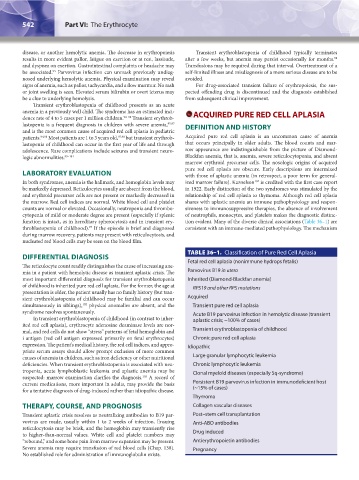
                                                                      pure red cell aplasia are obscure. Early descriptions are intermixed
               LABORATORY EVALUATION                                  with those of aplastic anemia (in retrospect, a poor term for general-
               In both syndromes, anemia is the hallmark, and hemoglobin levels may   ized marrow failure). Kaznelson  is credited with the first case report
                                                                                             104
               be markedly depressed. Reticulocytes usually are absent from the blood,   in 1922. Early distinction of the two syndromes was stimulated by the
               and erythroid precursor cells are not present or markedly decreased in   relationship of red cell aplasia to thymoma. Although red cell aplasia
               the marrow. Red cell indices are normal. White blood cell and platelet   shares with aplastic anemia an immune pathophysiology and respon-
               counts are normal or elevated. Occasionally, neutropenia and thrombo-  siveness to immunosuppressive therapies, the absence of involvement
               cytopenia of mild or moderate degree are present (especially if splenic   of neutrophils, monocytes, and platelets makes the diagnostic distinc-
               function is intact, as in hereditary spherocytosis and in transient ery-  tion evident. Many of the diverse clinical associations (Table 36–1) are
               throblastopenia of childhood).  If the episode is brief and diagnosed   consistent with an immune-mediated pathophysiology. The mechanism
                                      97
               during marrow recovery, patients may present with reticulocytosis, and
               nucleated red blood cells may be seen on the blood film.
                                                                       TABLE 36–1.  Classification of Pure Red Cell Aplasia
               DIFFERENTIAL DIAGNOSIS                                  Fetal red cell aplasia (nonimmune hydrops fetalis)
               The reticulocyte count readily distinguishes the cause of increasing ane-
               mia in a patient with hemolytic disease as transient aplastic crisis. The   Parvovirus B19 in utero
               most important differential diagnosis for transient erythroblastopenia   Inherited (Diamond-Blackfan anemia)
               of childhood is inherited pure red cell aplasia. For the former, the age at     RPS19 and other RPS mutations
               presentation is older, the patient usually has no family history (but tran-
               sient erythroblastopenia of childhood may be familial and can occur   Acquired
                                    102
               simultaneously in siblings),  physical anomalies are absent, and the     Transient pure red cell aplasia
               syndrome resolves spontaneously.                           Acute B19 parvovirus infection in hemolytic disease (transient
                   In transient erythroblastopenia of childhood (in contrast to inher-  aplastic crisis; ~100% of cases)
               ited red cell aplasia), erythrocyte adenosine deaminase levels are nor-
               mal, and red cells do not show “stress” patterns of fetal hemoglobin and     Transient erythroblastopenia of childhood
               i antigen (red cell antigen expressed primarily on feral erythrocytes)     Chronic pure red cell aplasia
               expression. The patient’s medical history, the red cell indices, and appro-  Idiopathic
               priate serum assays should allow prompt exclusion of more common
               causes of anemia in children, such as iron deficiency or other nutritional     Large granular lymphocytic leukemia
               deficiencies. When transient erythroblastopenia is associated with neu-    Chronic lymphocytic leukemia
               tropenia, acute lymphoblastic leukemia and aplastic anemia may be     Clonal myeloid diseases (especially 5q-syndrome)
               suspected: marrow examination clarifies the diagnosis.  A record of
                                                        103
               current medications, more important in adults, may provide the basis      Persistent B19 parvovirus infection in immunodeficient host
               for a tentative diagnosis of drug-induced rather than idiopathic disease.  (~15% of cases)
                                                                         Thymoma
               THERAPY, COURSE, AND PROGNOSIS                            Collagen vascular diseases
               Transient aplastic crisis resolves as neutralizing antibodies to B19 par-    Post–stem cell transplantation
               vovirus are made, usually within 1 to 2 weeks of infection. Ensuing     Anti-ABO antibodies
               reticulocytosis may be brisk, and the hemoglobin may transiently rise
               to higher-than-normal values. White cell and platelet numbers may     Drug induced
               “rebound,” and some bone pain from marrow expansion may be present.     Antierythropoietin antibodies
               Severe anemia may require transfusion of red blood cells (Chap. 138).     Pregnancy
               No established role for administration of immunoglobulin exists.


          Kaushansky_chapter 36_p0539-0548.indd   542                                                                   9/17/15   6:15 PM

