


Page 731 - Williams Hematology ( PDFDrive )
P. 731
706            Part VI:  The Erythrocyte                                                                                                                                     Chapter 47:  Erythrocyte Enzyme Disorders             707


                                                                      reported missense mutations affect residues of the catalytic site, suggest-
                                                                      ing that the reduced catalytic efficiency and/or instability result from
                                                                      secondary effects related to conformational changes. 248
                                                                          Acquired  deficiency  of P5′N1 may result from lead  poisoning.
                                                                                                  2+
                                                                      Structural studies have shown that Pb  specifically binds within the
                                                                                                    2+
                                                                      active site, in a different position than Mg  but with much higher affin-
                                                                        248
                                                                      ity.  Because simultaneous binding of Mg  and Pb  is not possible,
                                                                                                     2+
                                                                                                            2+
                                                                      Pb  outcompetes Mg , thereby preventing this essential cofactor from
                                                                        2+
                                                                                      2+
                                                                      binding, thus abolishing catalytic activity. P5′N1 activity is also inhib-
                                                                      ited in β-thalassemia and related disorders that result in excess α-globin
                                                                      chains, such as hemoglobin E, probably from oxidative damage induced
                                                                      by excess α-globin chains. 436,437
                                                                      MECHANISM OF HEMOLYSIS
                                                                      G6PD Deficiency
                                                                      The life span of G6PD-deficient red cells is shortened under many cir-
                                                                      cumstances, particularly during drug administration and infection. The
                                                                      exact reason for this is not known.

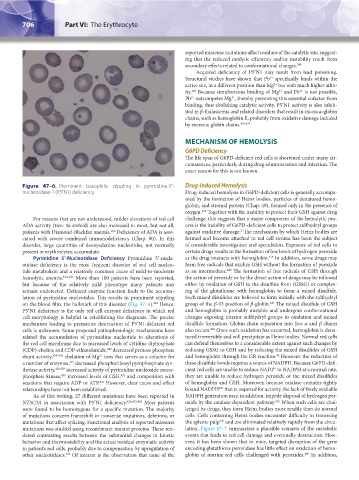
               Figure 47–6.  Prominent basophilic stippling in pyrimidine-5′-   Drug-Induced Hemolysis
               nucleotidase-1 (P5′N1) deficiency.                     Drug-induced hemolysis in G6PD-deficient cells is generally accompa-
                                                                      nied by the formation of Heinz bodies, particles of denatured hemo-
                                                                      globin, and stromal protein (Chap. 49), formed only in the presence of
                                                                      oxygen.  Together with the inability to protect their GSH against drug
                                                                            438
                   For reasons that are not understood, milder elevations of red cell   challenge, this suggests that a major component of the hemolytic pro-
               ADA activity (two- to sixfold) are also increased in most, but not all,   cess is the inability of G6PD-deficient cells to protect sulfhydryl groups
                                                                                         2
                                             186
               patients with Diamond-Blackfan anemia.  Deficiency of ADA is asso-  against oxidative damage.  The mechanism by which Heinz bodies are
               ciated with severe combined immunodeficiency (Chap. 80). In this   formed and become attached to red cell stroma has been the subject
               disorder, large quantities of deoxyadenine nucleotides, not normally   of considerable investigation and speculation. Exposure of red cells to
               present in erythrocytes, accumulate.                   certain drugs results in the formation of low levels of hydrogen peroxide
                                                                                                  439
                   Pyrimidine 5′-Nucleotidase Deficiency  Pyrimidine 5′-nucle-  as the drug interacts with hemoglobin.  In addition, some drugs may
               otidase deficiency is the most frequent disorder of red cell nucleo-  form free radicals that oxidize GSH without the formation of peroxide
                                                                                    440
               tide metabolism and a relatively common cause of mild-to-moderate   as an intermediate.  The formation of free radicals of GSH through
               hemolytic anemia. 420–422  More than 100 patients have been reported,   the action of peroxide or by the direct action of drugs may be followed
               but  because  of  the  relatively mild phenotype  many patients  may   either by oxidation of GSH to the disulfide form (GSSG) or complex-
               remain  undetected.  Deficient  enzyme  function  leads  to  the  accumu-  ing of the glutathione with hemoglobin to form a mixed disulfide.
               lation of pyrimidine nucleotides. This results in prominent stippling   Such mixed disulfides are believed to form initially with the sulfhydryl
                                                           244
               on the blood film, the hallmark of this disorder (Fig. 47–6).  Hence,   group of the β-93 position of β-globin.  The mixed disulfide of GSH
                                                                                                  441
               P5′N1 deficiency is the only red cell enzyme deficiency in which red   and hemoglobin is probably unstable and undergoes conformational
               cell morphology is helpful in establishing the diagnosis. The precise   changes exposing interior sulfhydryl groups to oxidation and mixed
               mechanism  leading  to  premature  destruction  of P5′N1-deficient red   disulfide formation. Globin chain separation into free α and β chains
               cells is unknown. Some proposed pathophysiologic mechanisms have   also occurs.  Once such oxidation has occurred, hemoglobin is dena-
                                                                              442
               related the accumulation of pyrimidine nucleotide to alterations of   tured irreversibly and will precipitate as Heinz bodies. Normal red cells
               the red cell membrane due to increased levels of cytidine diphosphate   can defend themselves to a considerable extent against such changes by
                                            423
               (CDP)-choline and CDP-ethanolamide,  decreased pentose phosphate   reducing GSSG to GSH and by reducing the mixed disulfides of GSH
                                                                                                     42
                                         2+
               shunt activity, 424–426  chelation of Mg  ions that serves as a cofactor for   and hemoglobin through the GR reaction.  However, the reduction of
               a number of enzymes,  decreased phosphoribosyl pyrophosphate syn-  these disulfide bonds requires a source of NADPH. Because G6PD-defi-
                               427
                                                                                                    +
               thetase activity, 428,429  increased activity of pyrimidine nucleoside mono-  cient red cells are unable to reduce NADP  to NADPH at a normal rate,
               phosphate kinase,  increased levels of GSH,  and competition with   they are unable to reduce hydrogen peroxide or the mixed disulfides
                            430
                                                431
               reactions that require ADP or ATP.  However, clear cause-and-effect   of hemoglobin and GSH. Moreover, because catalase contains tightly
                                         432
                                                                                 443
               relationships have not been established.               bound NADPH  that is required for activity, the lack of freely available
                   As of this writing, 27 different mutations have been reported in   NADPH generation may, in addition, impede disposal of hydrogen per-
               NT5C3A  in  association  with  P5′N1  deficiency. 420,433,434   Most  patients   oxide by the catalase-dependent pathway.  When such cells are chal-
                                                                                                    444
               were found to be homozygous for a specific mutation. The majority   lenged by drugs, they form Heinz bodies more readily than do normal
               of mutations concern frameshift or nonsense mutations, deletions, or   cells. Cells containing Heinz bodies encounter difficulty in traversing
                                                                                  445
               mutations that affect splicing. Functional analysis of reported missense   the splenic pulp  and are eliminated relatively rapidly from the circu-
               mutations was studied using recombinant mutant proteins. These ren-  lation. Figure 47–7 summarizes a plausible scenario of the metabolic
               dered contrasting results between the substantial changes in kinetic   events that leads to red cell damage and eventually destruction. How-
               behavior and thermostability and the actual residual enzymatic activity   ever, it has been shown that in mice, targeted disruption of the gene
               in patient’s red cells, probably due to compensation by upregulation of   encoding glutathione peroxidase has little effect on oxidation of hemo-
                                                                                                              199
                              435
               other nucleotidases.  Of interest is the observation that none of the   globin of murine red cells challenged with peroxides.  In addition,
          Kaushansky_chapter 47_p0689-0724.indd   706                                                                   9/17/15   6:44 PM

