


Page 835 - Williams Hematology ( PDFDrive )
P. 835
810            Part VI:  The Erythrocyte                                                                                                  Chapter 52:  Erythrocyte Disorders as a Result of Chemical and Physical Agents           811


                         A                            B                             C
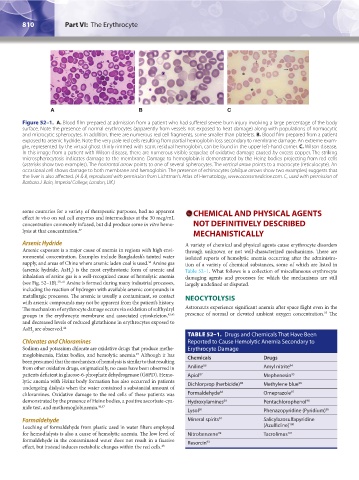
               Figure 52–1.  A. Blood film prepared at admission from a patient who had suffered severe burn injury involving a large percentage of the body
               surface. Note the presence of normal erythrocytes (apparently from vessels not exposed to heat damage) along with populations of normocytic
               and microcytic spherocytes. In addition, there are numerous red cell fragments, some smaller than platelets. B. Blood film prepared from a patient
               exposed to arsenic hydride. Note the very pale red cells resulting from partial hemoglobin loss secondary to membrane damage. An extreme exam-
               ple, represented by the virtual ghost thinly rimmed with scant residual hemoglobin, can be found in the upper left-hand corner. C. Wilson disease.
               In this image from a patient with Wilson disease, there are numerous visible sequelae of oxidative damage caused by excess copper. The striking
               microspherocytosis indicates damage to the membrane. Damage to hemoglobin is demonstrated by the Heinz bodies projecting from red cells
               (asterisks show two examples). The horizontal arrow points to one of several spherocytes. The vertical arrow points to a macrocyte (reticulocyte). An
               occasional cell shows damage to both membrane and hemoglobin. The presence of echinocytes (oblique arrows show two examples) suggests that
               the liver is also affected. (A & B, reproduced with permission from Lichtman’s Atlas of Hematology, www.accessmedicine.com. C, used with permission of
               Barbara J. Bain, Imperial College, London, UK.)


               some countries for a variety of therapeutic purposes, had no apparent     CHEMICAL AND PHYSICAL AGENTS
               effect in vivo on red cell enzymes and intermediates at the 30 mcg/mL
               concentration commonly infused, but did produce some in vitro hemo-  NOT DEFINITIVELY DESCRIBED
               lysis at that concentration. 37                           MECHANISTICALLY
               Arsenic Hydride                                        A variety of chemical and physical agents cause erythrocyte disorders
               Arsenic exposure is a major cause of anemia in regions with high envi-  through unknown or not well-characterized mechanisms. There are
               ronmental concentration. Examples include Bangladesh’s tainted water   isolated reports of hemolytic anemia occurring after the administra-
               supply, and areas of China where arsenic laden coal is used.  Arsine gas   tion of a variety of chemical substances, some of which are listed in
                                                          38
               (arsenic hydride, AsH ) is the most erythrotoxic form of arsenic and   Table 52–1. What follows is a collection of miscellaneous erythrocyte
                                3
               inhalation of arsine gas is a well-recognized cause of hemolytic anemia   damaging  agents  and  processes  for which  the  mechanisms  are  still
               (see Fig. 52–1B). 39–41  Arsine is formed during many industrial processes,   largely undefined or disputed.
               including the reaction of hydrogen with available arsenic compounds in
               metallurgic processes. The arsenic is usually a contaminant, so contact   NEOCYTOLYSIS
               with arsenic compounds may not be apparent from the patient’s history.
               The mechanism of erythrocyte damage occurs via oxidation of sulfhydryl   Astronauts experience significant anemia after space flight even in the
                                                                                                                     35
               groups in the erythrocyte membrane and associated cytoskeleton, 42,43    presence of normal or  elevated ambient oxygen concentration.  The
               and decreased levels of reduced glutathione in erythrocytes exposed to
               AsH  are observed. 44
                   3
                                                                       TABLE 52–1.  Drugs and Chemicals That Have Been
               Chlorates and Chloramines                               Reported to Cause Hemolytic Anemia Secondary to
               Sodium and potassium chlorate are oxidative drugs that produce methe-  Erythrocyte Damage
               moglobinemia, Heinz bodies, and hemolytic anemia.  Although it has   Chemicals   Drugs
                                                     45
               been presumed that the mechanism of hemolysis is similar to that resulting
               from other oxidative drugs, enigmatically, no cases have been observed in   Aniline 86  Amyl nitrite 94
               patients deficient in glucose-6-phosphate dehydrogenase (G6PD). Hemo-  Apiol 87  Mephenesin 95
               lytic anemia with Heinz body formation has also occurred in patients   Dichlorprop (herbicide) 88  Methylene blue 96
               undergoing dialysis when the water contained a substantial amount of
               chloramines. Oxidative damage to the red cells of these patients was   Formaldehyde 48  Omeprazole 97
               demonstrated by the presence of Heinz bodies, a positive ascorbate-cya-  Hydroxylamines 89  Pentachlorophenol 98
               nide test, and methemoglobinemia. 46,47
                                                                       Lysol 90                 Phenazopyridine (Pyridium) 99
               Formaldehyde                                            Mineral spirits 91       Salicylazosulfapyridine
               Leaching of formaldehyde from plastic used in water filters employed             (Azulfidine) 100
               for hemodialysis is also a cause of hemolytic anemia. The low level of   Nitrobenzene 92  Tacrolimus 101
               formaldehyde in the contaminated water does not result in a fixative   Resorcin 93
               effect, but instead induces metabolic changes within the red cells. 48


          Kaushansky_chapter 52_p0809-0814.indd   810                                                                   9/17/15   2:53 PM

