


Page 841 - Williams Hematology ( PDFDrive )
P. 841
816            Part VI:  The Erythrocyte                                                                                                  Chapter 53:  Hemolytic Anemia Resulting from Infections with Microorganisms              817


                                                                                                                64
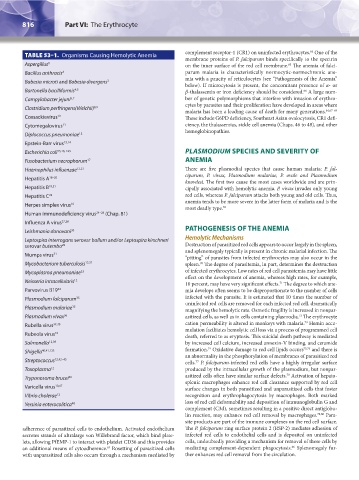
                TABLE 53–1.  Organisms Causing Hemolytic Anemia       complement receptor-1 (CR1) on uninfected erythrocytes.  One of the
                                                                      membrane proteins of P. falciparum binds specifically to the spectrin
                Aspergillus 1                                         on the inner surface of the red cell membrane.  The anemia of falci-
                                                                                                         65
                Bacillus anthracis 2                                  parum malaria is characteristically normocytic-normochromic ane-
                                                                      mia with a paucity of reticulocytes (see “Pathogenesis of the Anemia”
                Babesia microti and Babesia divergens 3
                                                                      below). If microcytosis is present, the concomitant presence of α- or
                Bartonella bacilliformis 4,5                          β-thalassemia or iron deficiency should be considered.  A large num-
                                                                                                              66
                Campylobacter jejuni 6,7                              ber of genetic polymorphisms that interfere with invasion of erythro-
                                                                      cytes by parasites and their proliferation have developed in areas where
                Clostridium perfringens(Welchii) 8,9
                                                                      malaria has been a leading cause of death for many generations. 64,67–69
                Coxsackievirus 10                                     These include G6PD deficiency, Southeast Asian ovalocytosis, CR1 defi-
                Cytomegalovirus 11                                    ciency, the thalassemias, sickle cell anemia (Chaps. 46 to 48), and other
                                                                      hemoglobinopathies.
                Diplococcus pneumoniae 12
                Epstein-Barr virus 13,14
                Escherichia coli 15,16, 123                           PLASMODIUM SPECIES AND SEVERITY OF
                Fusobacterium necrophorum 17                          ANEMIA
                Haemophilus influenzae 12,23                          There are five plasmodial species that cause human malaria:  P. fal-
                                                                      ciparum, P. vivax, Plasmodium malariae, P. ovale and Plasmodium
                Hepatitis A 18–20
                                                                      knowlesi. The first two cause the most cases worldwide and are prin-
                Hepatitis B 19,21                                     cipally associated with hemolytic anemia. P. vivax invades only young
                Hepatitis C 22                                        red cells, whereas P. falciparum attacks both young and old cells. Thus,
                                                                      anemia tends to be more severe in the latter form of malaria and is the
                Herpes simplex virus 10
                                                                      most deadly type. 35
                Human immunodeficiency virus 24–26  (Chap. 81)
                Influenza A virus 27,28
                Leishmania donovani 30                                PATHOGENESIS OF THE ANEMIA
                Leptospira interrogans serovar ballum and/or Leptospira kirschneri   Hemolytic Mechanisms
                serovar butembo 29                                    Destruction of parasitized red cells appears to occur largely in the spleen,
                                                                      and splenomegaly typically is present in chronic malarial infection. The
                Mumps virus 31
                                                                      “pitting” of parasites from infected erythrocytes may also occur in the
                Mycobacterium tuberculosis 12,32                      spleen.  The degree of parasitemia, in part, determines the destruction
                                                                           70
                Mycoplasma pneumoniae 33                              of infected erythrocytes. Low rates of red cell parasitemia may have little
                                                                      effect on the development of anemia, whereas high rates, for example,
                Neisseria intracellularis 12
                                                                                                      71
                                                                      10 percent, may have very significant effects.  The degree to which ane-
                Parvovirus B19 34                                     mia develops often seems to be disproportionate to the number of cells
                Plasmodium falciparum 35                              infected with the parasite. It is estimated that 10 times the number of
                                                                      uninfected red cells are removed for each infected red cell, dramatically
                Plasmodium malariae 35
                                                                      magnifying the hemolytic rate. Osmotic fragility is increased in nonpar-
                                                                                                            72
                Plasmodium vivax 36                                   asitized cells, as well as in cells containing plasmodia.  The erythrocyte
                                                                                                              73
                Rubella virus 37,38                                   cation permeability is altered in monkeys with malaria.  Hemin accu-
                                                                      mulation facilitates hemolytic cell loss via a process of programmed cell
                Rubeola virus 10                                      death, referred to as eryptosis. This suicidal death pathway is mediated
                Salmonella 12,39                                      by increased cell calcium, increased annexin-V binding, and ceramide
                                                                              74
                Shigella 40,41,123                                    formation.  Oxidative damage to red cell lipids occurs 75,76  and there is
                                                                      an abnormality in the phosphorylation of membranes of parasitized red
                Streptococcus 12,42–45                                cells.  P. falciparum-infected red cells have a highly irregular surface
                                                                          77
                Toxoplasma 12                                         produced by the intracellular growth of the plasmodium, but nonpar-
                                                                                                        78
                Trypanosoma brucei 46                                 asitized cells often have similar surface defects.  Activation of hepato-
                                                                      splenic macrophages enhance red cell clearance supported by red cell
                Varicella virus 10,47                                 surface changes in both parasitized and unparasitized cells that foster
                Vibrio cholerae 12                                    recognition and erythrophagocytosis by macrophages. Both marked
                Yersinia enterocolitica 48                            loss of red cell deformability and deposition of immunoglobulin G and
                                                                      complement (C3d), sometimes resulting in a positive direct antiglobu-
                                                                      lin reaction, may enhance red cell removal by macrophages. 79,80  Para-
                                                                      site products are part of the immune complexes on the red cell surface.
               adherence of parasitized cells to endothelium. Activated endothelium   The P. falciparum ring surface protein 2 (RSP-2) mediates adhesion of
               secretes strands of ultralarge von Willebrand factor, which bind plate-  infected red cells to endothelial cells and is deposited on uninfected
               lets, allowing PfEMP-1 to interact with platelet CD36 and this provides   cells, undoubtedly providing a mechanism for removal of these cells by
                                                                                                          66
                                            63
               an additional means of cytoadherence.  Rosetting of parasitized cells   mediating complement-dependent phagocytosis.  Splenomegaly fur-
               with unparasitized cells also occurs through a mechanism mediated by   ther enhances red cell removal from the circulation.


          Kaushansky_chapter 53_p0815-0822.indd   816                                                                   9/17/15   2:55 PM

