


Page 842 - Williams Hematology ( PDFDrive )
P. 842
816  Part VI:  The Erythrocyte  Chapter 53:  Hemolytic Anemia Resulting from Infections with Microorganisms           817


                  Decrease in Erythropoiesis                            hemolysis, hemoglobinemia, hemoglobinuria, and the passage of dark,
                  P. falciparum also decreases the erythropoietin response, resulting in   almost black, urine. This disorder, also called blackwater fever, is no lon-
                  less erythropoiesis than expected for the degree of anemia, reticulocy-  ger common. At one time it was seen frequently among Europeans in
                  topenia, and coincidentally striking dyserythropoiesis with stippling,   Africa and in India, usually after quinine was given to treat malaria. The
                  cytoplasmic vacuolization, nuclear fragmentation and multinuclearity.    event seems to be related to the intermittent use of antimalarials. 81
                                                                    66
                  The inhibition of the erythroid response (anemia of chronic disease) is
                  secondary to release of the cytokines interferon-γ and tumor necrosis   DIAGNOSTIC METHODS
                  factor-α, and the interleukin-10–to–tumor-necrosis-factor ratio, which
                  when low correlates with severe malarial anemia in children (Chap. 37). 66  Diagnosis of malaria depends upon demonstration of the parasites on
                                                                        the blood film, or the presence of antigenic parasite proteins using rapid
                                                                        detection tests (RDTs).  Alternative techniques involve polymerase
                                                                                          82
                  BLACKWATER FEVER                                      chain reaction (PCR) to demonstrate the appropriate DNA sequences
                  The fever associated with malaria, accompanied by rigors, headache,   in the blood 83,84  or the use of automated hematology analyzers to iden-
                  abdominal pain, nausea and vomiting, and extreme fatigue, is charac-  tify parasites as part of a routine complete blood count (CBC) investi-
                  teristically cyclic, varying in frequency according to the malaria type.   gation.  The morphologic differentiation of P. falciparum from other
                                                                             85
                  Although classic periodicity is often absent, febrile paroxysms of  P.   forms of malaria, principally P. vivax, is clinically important as P. fal-
                  vivax malaria tend to occur every 48 hours; those of P. malariae infec-  ciparum infection may constitute a clinical emergency. If more than
                  tion occur each 72 hours; and those of  P.  falciparum malaria, daily.   5 percent of the red cells infected contain parasites, the infection is
                  In the latter cases, the periodicity is the result the synchronization of   almost certainly with P. falciparum. In an infection with this organism,
                  schizogony with schizont rupture occurring at regular intervals. It is   rings are practically the only form of parasite evident on the blood film.
                  schizont rupture that accounts for the fever and associated symptoms.   The finding of two or more rings within the same red cells is regarded
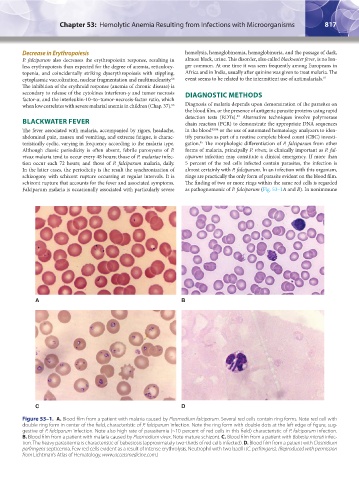
                  Falciparum malaria is occasionally associated with particularly severe   as pathognomonic of P. falciparum (Fig. 53–1A and B). In nonimmune


                      A                                                B


                      C                                                D
                  Figure 53–1.  A. Blood film from a patient with malaria caused by Plasmodium falciparum. Several red cells contain ring forms. Note red cell with
                  double ring form in center of the field, characteristic of P. falciparum infection. Note the ring form with double dots at the left edge of figure, sug-
                  gestive of P. falciparum infection. Note also high rate of parasitemia (~10 percent of red cells in this field) characteristic of P. falciparum infection.
                  B. Blood film from a patient with malaria caused by Plasmodium vivax. Note mature schizont. C. Blood film from a patient with Babesia microti infec-
                  tion. The heavy parasitemia is characteristic of babesiosis (approximately two-thirds of red cells infected). D. Blood film from a patient with Clostridium
                  perfringens septicemia. Few red cells evident as a result of intense erythrolysis. Neutrophil with two bacilli (C. perfringens). (Reproduced with permission
                  from Lichtman’s Atlas of Hematology, www.accessmedicine.com.)


          Kaushansky_chapter 53_p0815-0822.indd   817                                                                   9/17/15   2:55 PM

