


Page 859 - Williams Hematology ( PDFDrive )
P. 859
834            Part VI:  The Erythrocyte                                                                                                                  Chapter 54:  Hemolytic Anemia Resulting from Immune Injury               835


                TABLE 54–4.  Major Reaction Patterns of the Direct    Quantity, Affinity, and Isotype of Red Blood Cell–Bound
                                                                      Autoantibody
                Antiglobulin Test and Associated Types of Immune Injury
                                                                      Direct Antiglobulin Test–Negative Autoimmune Hemolytic Anemia
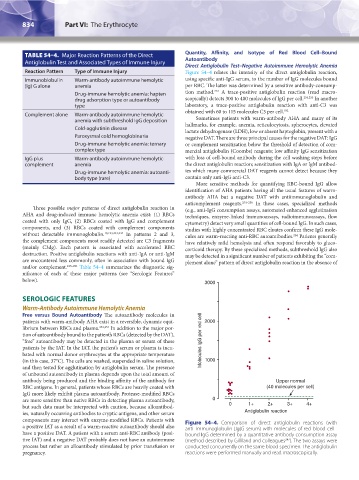
                Reaction Pattern  Type of Immune Injury               Figure  54–4  relates  the  intensity  of the direct  antiglobulin  reaction,
                Immunoblobulin   Warm-antibody autoimmune hemolytic   using specific anti-IgG serum, to the number of IgG molecules bound
                (Ig) G alone     anemia                               per RBC. The latter was determined by a sensitive antibody-consump-
                                                                                254
                                 Drug-immune hemolytic anemia: hapten   tion method.  A trace-positive antiglobulin reaction (read macro-
                                 drug adsorption type or autoantibody    scopically) detects 300 to 400 molecules of IgG per cell. 254,255  In another
                                 type                                 laboratory, a trace-positive antiglobulin reaction with anti-C3 was
                                                                      obtained with 60 to 115 molecules C3 per cell. 182
                Complement alone  Warm-antibody autoimmune hemolytic
                                 anemia with subthreshold IgG deposition  Sometimes  patients  with  warm-antibody  AHA  and  many  of  its
                                 Cold-agglutinin disease              hallmarks, for example, anemia, reticulocytosis, spherocytes, elevated
                                                                      lactate dehydrogenase (LDH), low or absent haptoglobin, present with a
                                 Paroxysmal cold hemoglobinuria       negative DAT. There are three principal causes for the negative DAT: IgG
                                 Drug-immune hemolytic anemia: ternary   or complement sensitization below the threshold of detection of com-
                                 complex type                         mercial antiglobulin (Coombs) reagents; low affinity IgG sensitization
                IgG plus         Warm-antibody autoimmune hemolytic   with loss of cell-bound antibody during the cell washing steps before
                complement       anemia                               the direct antiglobulin reaction; sensitization with IgA or IgM antibod-
                                 Drug-immune hemolytic anemia: autoanti-  ies which many commercial DAT reagents cannot detect because they
                                 body type (rare)                     contain only anti-IgG anti-C3.
                                                                          More  sensitive  methods  for quantifying  RBC-bound IgG  allow
                                                                      identification of AHA patients having all the usual features of warm-
                                                                      antibody  AHA  but  a  negative  DAT  with  antiimmunoglobulin  and
                                                                      anticomplement reagents. 254–256  In these cases, specialized methods
                   Three possible  major patterns of direct antiglobulin reaction in   (e.g., anti-IgG consumption assays, automated enhanced agglutination
               AHA and drug-induced immune hemolytic anemia  exist: (1) RBCs   techniques, enzyme-linked immunoassays, radioimmunoassays, flow
               coated with only  IgG, (2)  RBCs coated with  IgG and complement   cytometry) detect very small quantities of cell-bound IgG. In such cases,
               components, and (3) RBCs coated with complement components   studies with highly concentrated RBC eluates confirm these IgG mole-
               without detectable immunoglobulin. 10,123,243,244  In patterns 2 and 3,   cules are warm-reacting anti-RBC autoantibodies.  Patients generally
                                                                                                          254
               the complement components most readily detected are C3 fragments   have relatively mild hemolysis and often respond favorably to gluco-
               (mainly C3dg).  Each pattern is associated with accelerated RBC   corticoid therapy. By these specialized methods, subthreshold IgG also
               destruction. Positive antiglobulin reactions with anti-IgA or anti-IgM   may be detected in a significant number of patients exhibiting the “com-
               are encountered less commonly, often in association with bound IgG   plement alone” pattern of direct antiglobulin reaction in the absence of
               and/or complement. 245–251   Table 54–4 summarizes the diagnostic sig-
               nificance of each of these major patterns (see “Serologic Features”
               below).
                                                                             3000

               SEROLOGIC FEATURES
               Warm-Antibody Autoimmune Hemolytic Anemia
               Free versus Bound Autoantibody  The autoantibody molecules in
               patients with warm-antibody AHA exist in a reversible, dynamic equi-  2000
               librium between RBCs and plasma. 252,253  In addition to the major por-
               tion of autoantibody bound to the patient’s RBCs (detected by the DAT),
               “free” autoantibody may be detected in the plasma or serum of these   Molecules lgG per red cell
               patients by the IAT. In the IAT, the patient’s serum or plasma is incu-
               bated with normal donor erythrocytes at the appropriate temperature
               (in this case, 37°C). The cells are washed, suspended in saline solution,   1000
               and then tested for agglutination by antiglobulin serum. The presence
               of unbound autoantibody in plasma depends upon the total amount of
               antibody being produced and the binding affinity of the antibody for                 Upper normal
               RBC antigens. In general, patients whose RBCs are heavily coated with             (40 molecules per cell)
               IgG more likely exhibit plasma autoantibody. Protease-modified RBCs
               are more sensitive than native RBCs in detecting plasma autoantibody,   0
               but such data must be interpreted with caution, because alloantibod-  0     1+     2+    3+     4+
               ies, naturally occurring antibodies to cryptic antigens, and other serum   Antiglobulin reaction
               components may interact with enzyme-modified RBCs. Patients with   Figure 54–4.  Comparison of direct antiglobulin reactions (with
               a positive IAT as a result of a warm-reactive autoantibody should also   anti–immunoglobulin [Ig]G serum) with molecules of red blood cell–
               have a positive DAT. A patient with a serum anti-RBC antibody (posi-  bound IgG determined by a quantitative antibody consumption assay
               tive IAT) and a negative DAT probably does not have an autoimmune   (method described by Gilliland and colleagues ). The two assays were
                                                                                                        247
               process but rather an alloantibody stimulated by prior transfusion or   conducted concurrently on the same blood specimen. The antiglobulin
               pregnancy.                                             reactions were performed manually and read macroscopically.


          Kaushansky_chapter 54_p0823-0846.indd   834                                                                   9/19/15   12:27 AM

