


Page 855 - Williams Hematology ( PDFDrive )
P. 855
830            Part VI:  The Erythrocyte                                                                                                                  Chapter 54:  Hemolytic Anemia Resulting from Immune Injury               831


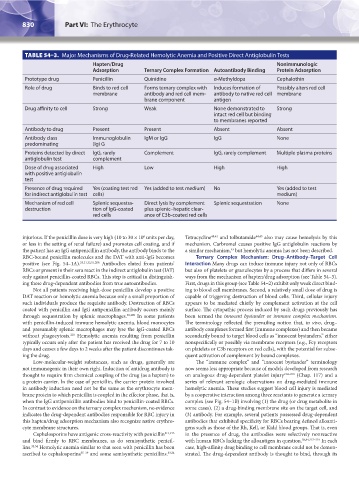
                TABLE 54–3.  Major Mechanisms of Drug-Related Hemolytic Anemia and Positive Direct Antiglobulin Tests
                                       Hapten/Drug                                                   Nonimmunologic
                                       Adsorption       Ternary Complex Formation Autoantibody Binding  Protein Adsorption
                Prototype drug         Penicillin       Quinidine               α-Methyldopa         Cephalothin
                Role of drug           Binds to red cell   Forms ternary complex with   Induces formation of   Possibly alters red cell
                                       membrane         antibody and red cell mem-  antibody to native red cell  membrane
                                                        brane component         antigen
                Drug affinity to cell  Strong           Weak                    None demonstrated to   Strong
                                                                                intact red cell but binding
                                                                                to membranes reported
                Antibody to drug       Present          Present                 Absent               Absent
                Antibody class         Immunoglobulin   IgM or IgG              IgG                  None
                predominating          (Ig) G
                Proteins detected by direct   IgG, rarely   Complement          IgG, rarely complement  Multiple plasma proteins
                antiglobulin test      complement
                Dose of drug associated   High          Low                     High                 High
                with positive antiglobulin
                test
                Presence of drug required   Yes (coating test red   Yes (added to test medium)  No   Yes (added to test
                for indirect antiglobulin test  cells)                                               medium)
                Mechanism of red cell   Splenic sequestra-  Direct lysis by complement   Splenic sequestration  None
                destruction            tion of IgG-coated   plus splenic–hepatic clear-
                                       red cells        ance of C3b-coated red cells


               injurious. If the penicillin dose is very high (10 to 30 × 10  units per day,   Tetracycline 40,41  and tolbutamide 44,45  also may cause hemolysis by this
                                                        6
               or less in the setting of renal failure) and promotes cell coating, and if   mechanism. Carbromal causes positive IgG antiglobulin reactions by
                                                                                     43
               the patient has an IgG antipenicillin antibody, the antibody binds to the   a similar mechanism,  but hemolytic anemia has not been described.
               RBC-bound penicillin molecules and the DAT with anti-IgG becomes   Ternary Complex Mechanism: Drug–Antibody–Target Cell
               positive (see Fig. 54–1A). 29,31,32,51,208  Antibodies eluted from patients’   Interaction Many drugs can induce immune injury not only of RBCs
               RBCs or present in their sera react in the indirect antiglobulin test (IAT)   but also of platelets or granulocytes by a process that differs in several
               only against penicillin-coated RBCs. This step is critical in distinguish-  ways from the mechanism of hapten/drug adsorption (see Table  54–3).
               ing these drug-dependent antibodies from true autoantibodies.  First, drugs in this group (see Table  54–2) exhibit only weak direct bind-
                   Not all patients receiving high-dose penicillin develop a positive   ing to blood cell membranes. Second, a relatively small dose of drug is
               DAT reaction or hemolytic anemia because only a small proportion of   capable of triggering destruction of blood cells. Third, cellular injury
               such individuals produce the requisite antibody. Destruction of RBCs   appears to be mediated chiefly by complement activation at the cell
               coated with penicillin and IgG antipenicillin antibody occurs mainly   surface. The cytopathic process induced by such drugs previously has
               through  sequestration  by  splenic  macrophages. 30,209   In  some  patients   been termed the  innocent  bystander or  immune  complex  mechanism.
               with penicillin-induced immune hemolytic anemia, blood monocytes   The terminology reflected the prevailing notion that,  in vivo, drug–
               and presumably splenic macrophages may lyse the IgG-coated RBCs   antibody complexes formed first (immune complexes) and then became
                               210
               without phagocytosis.  Hemolytic anemia resulting from penicillin   secondarily bound to target blood cells as “innocent bystanders,” either
               typically occurs only after the patient has received the drug for 7 to 10   nonspecifically or possibly via membrane receptors (e.g., Fcγ receptors
               days and ceases a few days to 2 weeks after the patient discontinues tak-  on platelets or C3b receptors on red cells), with the potential for subse-
               ing the drug.                                          quent activation of complement by bound complexes.
                   Low-molecular-weight  substances,  such  as  drugs,  generally  are   The “immune complex” and “innocent bystander” terminology
               not immunogenic in their own right. Induction of antidrug antibody is   now seems less appropriate because of models developed from research
               thought to require firm chemical coupling of the drug (as a hapten) to   on analogous drug-dependent platelet injury 214–216  (Chap. 117) and a
               a protein carrier. In the case of penicillin, the carrier protein involved   series of relevant serologic observations on drug-mediated immune
               in antibody induction need not be the same as the erythrocyte mem-  hemolytic anemia. These studies suggest blood cell injury is mediated
               brane protein to which penicillin is coupled in the effector phase, that is,   by a cooperative interaction among three reactants to generate a ternary
               when the IgG antipenicillin antibodies bind to penicillin-coated RBCs.   complex (see Fig. 54–1B) involving (1) the drug (or drug metabolite in
               In contrast to evidence on the ternary complex mechanism, no evidence   some cases), (2) a drug-binding membrane site on the target cell, and
               indicates the drug-dependent antibodies responsible for RBC injury in   (3) antibody. For example, several patients possessed drug-dependent
               this hapten/drug adsorption mechanism also recognize native erythro-  antibodies that exhibited specificity for RBCs bearing defined alloanti-
               cyte membrane structures.                              gens such as those of the Rh, Kell, or Kidd blood groups. That is, even
                   Cephalosporins have antigenic cross-reactivity with penicillin 211,213    in the presence of drug, the antibodies were selectively nonreactive
               and bind firmly to RBC membranes, as do semisynthetic penicil-  with human RBCs lacking the alloantigen in question. 58,84,217–219  In each
               lins. 33,34  Hemolytic anemia similar to that seen with penicillin has been   case, high-affinity drug binding to cell membrane could not be demon-
               ascribed to cephalosporins 35–39  and some semisynthetic penicillins. 33,34    strated. The drug-dependent antibody is thought to bind, through its


          Kaushansky_chapter 54_p0823-0846.indd   830                                                                   9/19/15   12:27 AM

