


Page 884 - Williams Hematology ( PDFDrive )
P. 884
858  Part VI:  The Erythrocyte       Chapter 55:  Alloimmune Hemolytic Disease of the Fetus and Newborn               859


                  including two preparations that may be administered intravenously.  A   CONCLUSIONS
                                                                  131
                  300 mcg (1500 IU) dose of RhIg affords protection against a fetomater-
                  nal transfusion of 15 mL of Rh-positive RBCs or 30 mL of Rh-positive   HDFN is a clinically significant problem that may potentially affect
                  WB. However, FMH in excess of 30 mL may occur in women without   any pregnancy. Although a number of strategies are in place to prevent
                  predisposing risk factors. 42,43  The blood of all Rh-negative nonimmu-  RhD HDFN, few options exist to prevent the development of non-D
                  nized women should be tested for FMH approximately 1 hour after   HDFN. Researchers continue to investigate strategies to prevent pri-
                  delivery of an Rh-positive baby. 57,129  During the antenatal period, testing   mary maternal RBC alloimmunization to RhD and to non-D antigens,
                  is indicated after 20 weeks’ gestation if clinical circumstances suggest   as well as strategies to mitigate the dangers of existing maternal RBC
                  the possibility of excessive transplacental hemorrhage (e.g., abdominal   alloantibodies. Over the past decade, the ability to identify pregnancies/
                  trauma or abruptio placentae). Screening for FMH can be performed   fetuses “at risk” because of maternal RBC alloimmunization has signifi-
                  by the rosette test, which detects as little as 2.5 mL of WB. If the rosette   cantly improved. In particular, the use of noninvasive investigations,
                  test result is positive, the number of fetal red cells in the maternal circu-  such as evaluation of fetal RBC antigen zygosity by circulating cell free
                  lation is quantified more accurately by the Kleihauer-Betke test, which   fetal DNA testing and the evaluation of fetal anemia by middle cerebral
                  is based on the resistance of fetal hemoglobin to acid elution, unlike   artery Doppler ultrasonography, have advanced the care of fetuses at
                                        132
                  adult hemoglobin (Fig. 55–5).  False-positive results can be obtained   risk for HDFN. Through the continued combined efforts of maternal–
                  in maternal conditions associated with increased fetal hemoglobin,   fetal medicine specialists, hematologists, transfusion medicine phy-
                  such as hereditary persistence of fetal hemoglobin, sickle cell disease, or   sicians,  radiologists,  neonatologists,  and  researchers,  in  combination
                  sickle cell trait. Flow cytometric methods are used in some laboratories   with advancements in basic science research involving alloimmuniza-
                  for both screening and quantification of fetal red cells.  tion, the care for infants at risk for HDFN, and their mothers, will likely
                     RhIg should be administered as soon as possible, within 72 hours   continue to improve in the years to come.
                  of delivery of an Rh-positive baby. RhIg is thought to be ineffective
                  once alloimmunization to RhD antigen has occurred. RhIg is also indi-
                  cated following pregnancy termination, miscarriage, amniocentesis,   REFERENCES
                  chorionic villus sampling, or other manipulation during pregnancy. A
                  smaller 50-mcg dose is adequate if pregnancy is terminated at less than     1.  Diamond L, Blackfan K, Baty J: Erythroblastosis fetalis and its association with univer-
                                                                           sal edema of the fetus, icterus gravis neonatorum and anemia of the newborn. J Pediatr
                                129
                  12 weeks’ gestation.  If therapeutic or spontaneous abortion occurs   1932(1):269.
                  after the first trimester, the standard 300-mcg dose is recommended.      2.  Darrow R: Icterus gravis (erythroblastosis neonatorum, examination of etiologic con-
                                                                   129
                                                                           siderations). Arch Pathol 1938(25):378.
                  If a woman was exposed to more than 30 mL of D-positive blood, the     3.  Levine P, Katzin E, Burnham L: Isoimmunization in pregnancy: Its possible bearing on
                  dose of RhIg should be calculated to cover the volume of D-positive   the etiology of erythroblastosis fetalis. JAMA 116(9):825, 1941.
                  cells to prevent immunization (20 mcg of RhIg for 1 mL of D+ RBCs     4.  Diamond LK, Allen FH Jr, Thomas WO Jr: Erythroblastosis fetalis. VII. Treatment with
                  or 2 mL of WB). 57,131,133  Despite the efficacy of RhIg, RhD alloimmuni-  exchange transfusion. N Engl J Med 244(2):39, 1951.
                  zation occurs despite recommended prophylaxis in 0.1 percent of preg-    5.  Liley AW: The use of amniocentesis and fetal transfusion in erythroblastosis fetalis.
                                                                           Pediatrics 35:836, 1965.
                  nancies, but many cases of preventable Rh alloimmunization continue     6.  Bowman J: Thirty-five years of Rh prophylaxis. Transfusion 43(12):1661, 2003.
                  to occur because of failure to seek medical care or because of failure to     7.  Poole J, Daniels G: Blood group antibodies and their significance in transfusion medi-
                                                                           cine. Transfus Med Rev 21(1):58, 2007.
                  implement immunoprophylaxis protocols.                  8.  Geifman-Holtzman O, et al: Female alloimmunization with antibodies known to cause
                                                                           hemolytic disease. Obstet Gynecol 89(2):272, 1997.
                                                                          9.  Gottvall T, Filbey D: Alloimmunization in pregnancy during the years 1992-2005 in the
                                                                           central west region of Sweden. Acta Obstet Gynecol Scand 87(8):843, 2008.
                                                                          10.  Koelewijn JM, Vrijkotte TG, van der Schoot CE, et al: Effect of screening for red cell
                                                                           antibodies, other than anti-D, to detect hemolytic disease of the fetus and newborn: A
                                                                           population study in the Netherlands. Transfusion 48(5):941, 2008.
                                                                          11.  Lee CK, Ma ES, Tang M, et al: Prevalence and specificity of clinically significant red cell
                                                                           alloantibodies in Chinese women during pregnancy—A review of cases from 1997 to
                                                                           2001. Transfus Med 13(4):227, 2003.
                                                                          12.  Zipursky A, Paul VK: The global burden of Rh disease. Arch Dis Child Fetal Neonatal Ed
                                                                           96(2):F84, 2011.
                                                                          13.  Moise KJ: Fetal anemia due to non-Rhesus-D red-cell alloimmunization. Semin Fetal
                                                                           Neonatal Med 13(4):207, 2008.
                                                                          14.  Garratty G, Glynn SA, McEntire R: ABO and Rh(D) phenotype frequencies of different
                                                                           racial/ethnic groups in the United States. Transfusion 44(5):703, 2004.
                                                                          15.  Joseph KS: Controlling Rh haemolytic disease of the newborn in India. Br J Obstet
                                                                           Gynaecol 98(4):369, 1991.
                                                                          16.  Mak KH, Yan KF, Cheng SS, Yuen MY: Rh phenotypes of Chinese blood donors in
                                                                           Hong Kong, with special reference to weak D antigens. Transfusion 33(4):348, 1993.
                                                                          17.  Ziprin JH, Payne E, Hamidi L, et al: ABO incompatibility due to immunoglobulin G
                                                                           anti-B antibodies presenting with severe fetal anaemia. Transfus Med 15(1):57, 2005.
                                                                          18.  Thilaganathan B, Salvesen DR, Abbas A, et al: Fetal plasma erythropoietin concentra-
                                                                           tion in red blood cell-isoimmunized pregnancies. Am J Obstet Gynecol 167(5):1292,
                                                                           1992.
                                                                          19.  Koenig JM, Christensen RD: Neutropenia and thrombocytopenia in infants with Rh
                                                                           hemolytic disease. J Pediatr 114(4 Pt 1):625, 1989.
                                                                          20.  Hayde M, Widness JA, Pollak A, et al: Rhesus isoimmunization: increased hemolysis
                                                                           during early infancy. Pediatr Res 41(5):716, 1997.
                                                                          21.  al-Alaiyan S, al Omran A: Late hyporegenerative anemia in neonates with rhesus hemo-
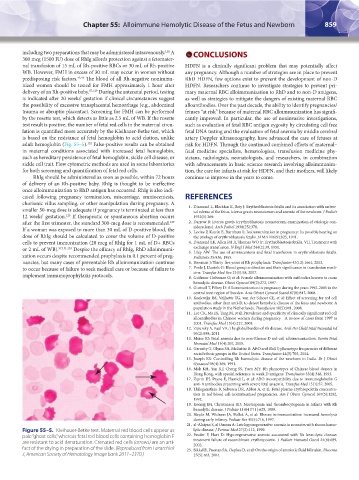
                  Figure 55–5.  Kleihauer-Betke test. Maternal red blood cells appear as   lytic disease. J Perinat Med 27(2):112, 1999.
                  pale “ghost cells,” whereas fetal red blood cells containing hemoglobin F     22.  Pessler F, Hart D: Hyporegenerative anemia associated with Rh hemolytic disease:
                  are resistant to acid denaturation. Crenated red cells (arrows) are an arti-  treatment failure of recombinant erythropoietin. J Pediatr Hematol Oncol 24(8):689,
                                                                           2002.
                  fact of the drying in preparation of the slide. (Reproduced from Lazarchick     23.  Sikkel E, Pasman SA, Oepkes D, et al: On the origin of amniotic fluid bilirubin. Placenta
                  J, American Society of Hematology Image bank 2011–2370.)  25(5):463, 2004.


          Kaushansky_chapter 55_p0847-0862.indd   859                                                                   9/18/15   11:53 PM

