


Page 880 - Williams Hematology ( PDFDrive )
P. 880
854  Part VI:  The Erythrocyte       Chapter 55:  Alloimmune Hemolytic Disease of the Fetus and Newborn               855


                                                                         80
                                                                                                              A  1.5 MOM
                                                                         70                                   B  1.29 MOM
                                                                       MCA peak velocity  50                     Median
                                                                         60


                                                                         40
                                                                         30

                                                                         20
                                                                               20          25         30          35
                                                                                        Gestational age (wk)
                      A                                               B
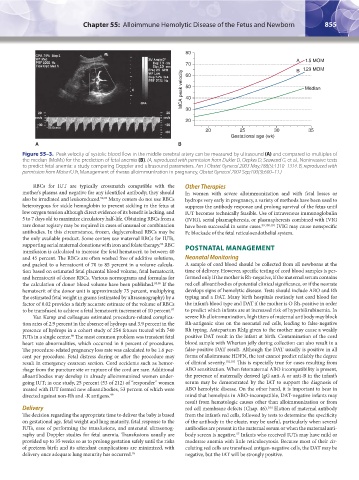
                  Figure 55–3.  Peak velocity of systolic blood flow in the middle cerebral artery can be measured by ultrasound (A) and compared to multiples of
                  the median (MoMs) for the prediction of fetal anemia (B). (A, reproduced with permission from Dukler D, Oepkes D, Seaward G, et al., Noninvasive tests
                  to predict fetal anemia: a study comparing Doppler and ultrasound parameters. Am J Obstet Gynecol 2003 May;188(5):1310–1314. B, reproduced with
                  permission from Moise KJ Jr, Management of rhesus alloimmunization in pregnancy, Obstet Gynecol 2002 Sep;100(3):600–11.)
                     RBCs for IUT are typically crossmatch compatible with the     Other Therapies
                  mother’s plasma and negative for any identified antibody; they should   In women with severe alloimmunization and with fetal losses or
                  also be irradiated and leukoreduced. 92,93  Many centers do not use RBCs   hydrops very early in pregnancy, a variety of methods have been used to
                  heterozygous for sickle hemoglobin to prevent sickling in the fetus at   suppress the antibody response and prolong survival of the fetus until
                  low oxygen tension although direct evidence of its benefit is lacking, and   IUT becomes technically feasible. Use of intravenous immunoglobulin
                  5 to 7 days old to maximize circulatory half-life. Obtaining RBCs from a   (IVIG), serial plasmapheresis, or plasmapheresis combined with IVIG
                  rare donor registry may be required in cases of unusual or combination   have been successful in some cases. 89,100,101  IVIG may cause nonspecific
                  antibodies. In this circumstance, frozen, deglycerolized RBCs may be   Fc blockade of the fetal reticuloendothelial system.
                  the only available product. Some centers use maternal RBCs for IUTs,
                  supporting serial maternal donations with iron and folate therapy.  RBC
                                                                94
                  transfusion is calculated to increase the fetal hematocrit to between 40   POSTNATAL MANAGEMENT
                  and 45 percent. The RBCs are often washed free of additive solutions,   Neonatal Monitoring
                  and packed to a hematocrit of 70 to 85 percent in a volume calcula-  A sample of cord blood should be collected from all newborns at the
                  tion based on estimated fetal placental blood volume, fetal hematocrit,   time of delivery. However, specific testing of cord blood samples is per-
                  and hematocrit of donor RBCs. Various normograms and formulas for   formed only if the mother is Rh-negative, if the maternal serum contains
                  the calculation of donor blood volume have been published. 95,96  If the   red cell alloantibodies of potential clinical significance, or if the neonate
                  hematocrit of the donor unit is approximately 75 percent, multiplying   develops signs of hemolytic disease. Tests should include ABO and Rh
                  the estimated fetal weight in grams (estimated by ultrasonography) by a   typing and a DAT. Many birth hospitals routinely test cord blood for
                  factor of 0.02 provides a fairly accurate estimate of the volume of RBCs   the infant’s blood type and DAT if the mother is O Rh-positive in order
                  to be transfused to achieve a fetal hematocrit increment of 10 percent. 97  to predict which infants are at increased risk of hyperbilirubinemia. In
                     Van Kamp and colleagues estimated procedure-related complica-  severe Rh alloimmunization, high titers of maternal antibody may block
                  tion rates of 2.9 percent in the absence of hydrops and 3.9 percent in the   Rh-antigenic sites on the neonatal red cells, leading to false-negative
                  presence of hydrops in a cohort study of 254 fetuses treated with 740   Rh typing. Antepartum RhIg given to the mother may cause a weakly
                  IUTs in a single center.  The most common problem was transient fetal   positive DAT result in the infant at birth. Contamination of the cord
                                  98
                  heart rate abnormalities, which occurred in 8 percent of procedures.   blood sample with Wharton jelly during collection can also result in a
                  The procedure-related pregnancy loss rate was calculated to be 1.6 per-  false-positive DAT result. Although the DAT usually is positive in all
                  cent per procedure. Fetal distress during or after the procedure may   forms of alloimmune HDFN, the test cannot predict reliably the degree
                  result in emergency cesarean section. Cord accidents such as hemor-  of clinical severity. 102,103  This is especially true for cases resulting from
                  rhage from the puncture site or rupture of the cord are rare. Additional   ABO sensitization. When fetomaternal ABO incompatibility is present,
                  alloantibodies may develop in already alloimmunized women under-  the presence of maternally derived IgG anti-A or anti-B in the infant’s
                  going IUT; in one study, 25 percent (53 of 212) of “responder” women   serum may be demonstrated by the IAT to support the diagnosis of
                  treated with IUT formed new alloantibodies, 53 percent of which were   ABO hemolytic disease. On the other hand, it is important to bear in
                  directed against non-Rh and -K antigens. 99           mind that hemolysis in ABO-incompatible, DAT-negative infants may
                                                                        result from hematologic causes other than alloimmunization or from
                  Delivery                                              red cell membrane defects (Chap. 46).  Elution of maternal antibody
                                                                                                    104
                  The decision regarding the appropriate time to deliver the baby is based   from the infant’s red cells, followed by tests to determine the specificity
                  on gestational age, fetal weight and lung maturity, fetal response to the   of the antibody in the eluate, may be useful, particularly when several
                  IUTs, ease of performing the transfusions, and antenatal ultrasonog-  antibodies are present in the maternal serum or when the maternal anti-
                  raphy and Doppler studies for fetal anemia. Transfusions usually are   body screen is negative.  Infants who received IUTs may have mild or
                                                                                          57
                  provided up to 35 weeks so as to prolong gestation safely until the risks   moderate anemia with little reticulocytosis. Because most of their cir-
                  of preterm birth and its attendant complications are minimized, with   culating red cells are transfused antigen-negative cells, the DAT may be
                  delivery once adequate lung maturity has occurred. 76  negative, but the IAT will be strongly positive.


          Kaushansky_chapter 55_p0847-0862.indd   855                                                                   9/18/15   11:52 PM

