


Page 881 - Williams Hematology ( PDFDrive )
P. 881
856            Part VI:  The Erythrocyte                                                                                                          Chapter 55:  Alloimmune Hemolytic Disease of the Fetus and Newborn               857


                A                                                    B

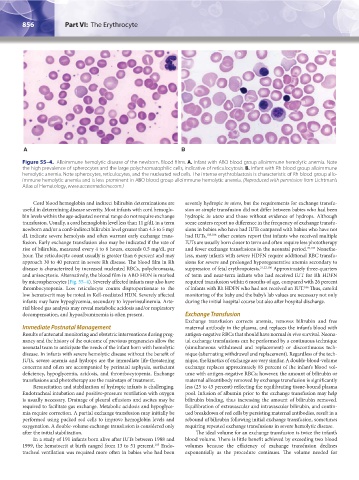
               Figure 55–4.  Alloimmune hemolytic disease of the newborn. Blood films. A. Infant with ABO blood group alloimmune hemolytic anemia. Note
               the high prevalence of spherocytes and the large polychromatophilic cells, indicative of reticulocytosis. B. Infant with Rh blood group alloimmune
               hemolytic anemia. Note spherocytes, reticulocytes, and the nucleated red cells. The intense erythroblastosis is characteristic of Rh blood group allo-
               immune hemolytic anemia and is less prominent in ABO blood group alloimmune hemolytic anemia. (Reproduced with permission from Lichtman’s
               Atlas of Hematology, www.accessmedicine.com.)

                   Cord blood hemoglobin and indirect bilirubin determinations are   severely hydropic in utero, but the requirements for exchange transfu-
               useful in determining disease severity. Most infants with cord hemoglo-  sion or simple transfusion did not differ between babies who had been
               bin levels within the age-adjusted normal range do not require exchange   hydropic  in  utero and those without evidence of hydrops. Although
               transfusion. Usually, a cord hemoglobin level less than 11 g/dL in a term   some centers report no difference in the frequency of exchange transfu-
               newborn and/or a cord-indirect bilirubin level greater than 4.5 to 5 mg/  sions in babies who have had IUTs compared with babies who have not
               dL indicate severe hemolysis and often warrant early exchange trans-  had IUTs, 105,106  other centers report that infants who received multiple
               fusion. Early exchange transfusion also may be indicated if the rate of   IUTs are usually born closer to term and often require less phototherapy
               rise of bilirubin, measured every 4 to 6 hours, exceeds 0.5 mg/dL per   and fewer exchange transfusions in the neonatal period. 25,107  Nonethe-
               hour. The reticulocyte count usually is greater than 6 percent and may   less, many infants with severe HDFN require additional RBC transfu-
               approach 30 to 40 percent in severe Rh disease. The blood film in Rh   sions for severe and prolonged hyporegenerative anemia secondary to
               disease is characterized by increased nucleated RBCs, polychromasia,   suppression of fetal erythropoiesis. 21,22,106  Approximately three-quarters
               and anisocytosis. Alternatively, the blood film in ABO HDN is marked   of term and near-term infants who had received IUT for Rh HDFN
               by microspherocytes (Fig. 55–4). Severely affected infants may also have   required transfusion within 6 months of age, compared with 26 percent
               thrombocytopenia. Low reticulocyte counts disproportionate to the   of infants with Rh HDFN who had not received an IUT.  Thus, careful
                                                                                                              106
               low hematocrit may be noted in Kell-mediated HDN. Severely affected   monitoring of the baby and the baby’s lab values are necessary not only
               infants may have hypoglycemia, secondary to hyperinsulinemia. Arte-  during the initial hospital course but also after hospital discharge.
               rial blood gas analysis may reveal metabolic acidosis and/or respiratory
               decompensation, and hypoalbuminemia is often present.  Exchange Transfusion
                                                                      Exchange transfusion corrects anemia, removes bilirubin and free
               Immediate Postnatal Management                         maternal antibody in the plasma, and replaces the infant’s blood with
               Results of antenatal monitoring and obstetric interventions during preg-  antigen-negative RBCs that should have normal in vivo survival. Neona-
               nancy and the history of the outcome of previous pregnancies allow the   tal exchange transfusions can be performed by a continuous technique
               neonatal team to anticipate the needs of the infant born with hemolytic   (simultaneous  withdrawal  and  replacement)  or  discontinuous  tech-
               disease. In infants with severe hemolytic disease without the benefit of   nique (alternating withdrawal and replacement). Regardless of the tech-
               IUTs,  severe  anemia  and  hydrops  are  the  immediate  life-threatening   nique, the kinetics of exchange are very similar. A double-blood-volume
               concerns and often are accompanied by perinatal asphyxia, surfactant   exchange replaces approximately 85 percent of the infant’s blood vol-
               deficiency, hypoglycemia, acidosis, and thrombocytopenia. Exchange   ume with antigen-negative RBCs; however, the amount of bilirubin or
               transfusions and phototherapy are the mainstays of treatment.  maternal alloantibody removed by exchange transfusion is significantly
                   Resuscitation and stabilization of hydropic infants is challenging.   less (25 to 45 percent) reflecting the equilibrating tissue-bound plasma
               Endotracheal intubation and positive-pressure ventilation with oxygen   pool. Infusion of albumin prior to the exchange transfusion may help
               is usually necessary. Drainage of pleural effusions and ascites may be   bilirubin binding, thus increasing the amount of bilirubin removed.
               required to facilitate gas exchange. Metabolic acidosis and hypoglyce-  Equilibration of extravascular and intravascular bilirubin, and contin-
               mia require correction. A partial exchange transfusion may initially be   ued breakdown of red cells by persisting maternal antibodies, result in a
               performed using packed red cells to improve hemoglobin levels and   rebound of bilirubin following initial exchange transfusion, sometimes
               oxygenation. A double-volume exchange transfusion is considered only   requiring repeated exchange transfusions in severe hemolytic disease.
               after the initial stabilization.                           The ideal volume for an exchange transfusion is twice the infant’s
                   In a study of 191 infants born alive after IUTs between 1988 and   blood volume. There is little benefit achieved by exceeding two blood
               1999, the hematocrit at birth ranged from 13 to 51 percent.  Endo-  volumes because the efficiency of exchange transfusion declines
                                                            105
               tracheal ventilation was required more often in babies who had been   exponentially as the procedure continues. The volume needed for


          Kaushansky_chapter 55_p0847-0862.indd   856                                                                   9/18/15   11:52 PM

