


Page 915 - Williams Hematology ( PDFDrive )
P. 915
890            Part VI:  The Erythrocyte                                                                                                                                                    Chapter 58:  The Porphyrias            891


                                                                                                 1,2
                   Porphyrias are classified as either erythropoietic or hepatic, depend-  and brown-colored bones at autopsy.  In 1898, T. McCall Anderson
               ing on the principal site of accumulation of pathway intermediates.   described  two  brothers  (ages  23  and  26  years)  who  most  likely  had
                                                                         3
               The erythropoietic porphyrias are congenital erythropoietic porphyria   CEP,  and suffered from hydroa aestivale, with red urine, pruritus and
               (CEP), which is very rare, erythropoietic protoporphyria (EPP), the   blistering of sun-exposed skin, especially in summer, leading to exten-
               third most common porphyria and the most common in children, and   sive scarring and mutilation of the ears and nose (see Chap. 58, Fig.
               X-linked protoporphyria (XLP), which has the same phenotype as EPP   58–5). Using available methods, their urine was also demonstrated to
               but is less common. Hepatic porphyrias include the acute porphyrias,   contain a substance related to hematoporphyrin.  In 1889, Stokvis first
                                                                                                         4
               which cause neurologic symptoms usually in the form of acute attacks,   described a case of acute porphyria in an elderly woman who developed
               and porphyria cutanea tarda (PCT), which is the most common of the   dark-red urine and later died after taking sulphonal, a drug related to
               porphyrias, and causes chronic blistering lesions on sun-exposed areas   the barbiturates. 5
               of the skin. The acute porphyrias include ALA dehydratase deficiency   Hans Günther  published a monograph on porphyrins in 1911 and
                                                                                    6
               porphyria (ADP), acute intermittent porphyria (AIP), hereditary copro-  classified porphyrias into four groups: (1) those that have an acute onset
               porphyria (HCP), and variegate porphyria (VP). VP, and less commonly   without association with drug ingestion, (2) those that are caused by
               HCP, can also cause skin manifestations identical to those in PCT.  sulphonal or trional, (3) hematoporphyria congenita, and (4) chronic
                   A type of porphyria is associated with loss-of-function muta-  hematoporphyria. The first two groups correspond to the acute porphy-
               tions of seven of the eight enzymes in the heme biosynthetic pathway    rias, which may present with attacks sometimes related to ingestion of
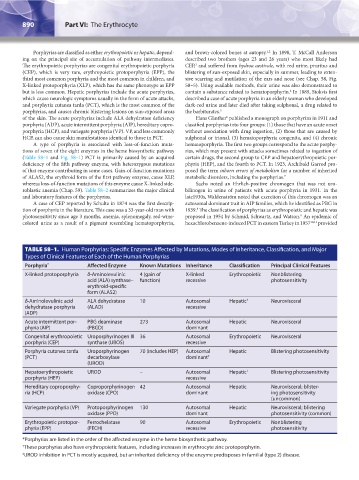
               (Table 58–1 and  Fig. 58–1) PCT is primarily caused by an acquired   certain drugs, the second group to CEP and hepatoerythropoietic por-
               deficiency of the fifth pathway enzyme, with heterozygous mutations   phyria (HEP), and the fourth to PCT. In 1923, Archibald Garrod pro-
               of that enzyme contributing in some cases. Gain-of-function mutations   posed the term inborn errors of metabolism for a number of inherited
               of ALAS2, the erythroid form of the first pathway enzyme, cause XLP,   metabolic disorders, including the porphyrias. 7
               whereas loss-of-function mutations of this enzyme cause X-linked side-  Sachs noted an Ehrlich-positive chromogen that was not uro-
               roblastic anemia (Chap. 59). Table 58–2 summarizes the major clinical   bilinogen in urine of patients with acute porphyria in 1931. In the
               and laboratory features of the porphyrias.             late1930s, Waldenström noted that excretion of this chromogen was an
                   A case of CEP reported by Schultz in 1874 was the first descrip-  autosomal dominant trait in AIP families, which he identified as PBG in
                                                                          8
               tion of porphyria in the literature. This case was a 33-year-old man with   1939.  The classification of porphyrias as erythropoietic and hepatic was
               photosensitivity since age 3 months, anemia, splenomegaly, red-wine-  proposed in 1954 by Schmid, Schwartz, and Watson.  An epidemic of
                                                                                                             9
               colored urine as a result of a pigment resembling hematoporphyrin,   hexachlorobenzene-induced PCT in eastern Turkey in 1957 10,11  provided


                TABLE 58–1.  Human Porphyrias: Specific Enzymes Affected by Mutations, Modes of Inheritance, Classification, and Major
                Types of Clinical Features of Each of the Human Porphyrias
                Porphyria *          Affected Enzyme   Known Mutations Inheritance   Classification  Principal Clinical Features
                X-linked protoporphyria  δ-Aminolevulinic   4 (gain of   X-linked    Erythropoietic  Nonblistering
                                     acid (ALA) synthase–  function)  recessive                    photosensitivity
                                     erythroid-specific
                                     form (ALAS2)
                δ-Aminolevulinic acid   ALA dehydratase   10          Autosomal      Hepatic †     Neurovisceral
                dehydratase porphyria   (ALAD)                        recessive
                (ADP)
                Acute intermittent por-  PBG deaminase   273          Autosomal      Hepatic       Neurovisceral
                phyria (AIP)         (PBGD)                           dominant
                Congenital erythropoietic  Uroporphyrinogen III  36   Autosomal      Erythropoietic  Neurovisceral
                porphyria (CEP)      synthase (UROS)                  recessive
                Porphyria cutanea tarda   Uroporphyrinogen   70 (includes HEP)  Autosomal   Hepatic  Blistering photosensitivity
                (PCT)                decarboxylase                    dominant ‡
                                     (UROD)
                Hepatoerythropoietic   UROD            –              Autosomal      Hepatic †     Blistering photosensitivity
                porphyria (HEP)                                       recessive
                Hereditary coproporphy-  Coproporphyrinogen  42       Autosomal      Hepatic       Neurovisceral; blister-
                ria (HCP)            oxidase (CPO)                    dominant                     ing photosensitivity
                                                                                                   (uncommon)
                Variegate porphyria (VP)  Protoporphyrinogen  130     Autosomal      Hepatic       Neurovisceral; blistering
                                     oxidase (PPO)                    dominant                     photosensitivity (common)
                Erythropoietic protopor-  Ferrochelatase   90         Autosomal      Erythropoietic  Nonblistering
                phyria (EPP)         (FECH)                           recessive                    photosensitivity

               *Porphyrias are listed in the order of the affected enzyme in the heme biosynthetic pathway.
               † These porphyrias also have erythropoietic features, including increases in erythrocyte zinc protoporphyrin.
               ‡ UROD inhibition in PCT is mostly acquired, but an inherited deficiency of the enzyme predisposes in familial (type 2) disease.


          Kaushansky_chapter 58_p0889-0914.indd   890                                                                   9/18/15   5:57 PM

