


Page 917 - Williams Hematology ( PDFDrive )
P. 917
892            Part VI:  The Erythrocyte                                                                                                                                                    Chapter 58:  The Porphyrias            893


               the foundation for the development of animal models of this disorder
               using halogenated polyaromatic hydrocarbons. 12,13  Strand and cowork-
               ers described the enzyme deficiency in AIP for the first time in 1970,    N  N  HO   Cl          N
                                                                 14
               and Bonkovsky and coworkers first reported treatment of a porphyria    N    N      N    N     N     N
                                    15
               patient with hemin in 1971.  In the past several decades, the enzymes   Fe 2+  Fe 3+  Fe 3+     Fe 2+
               of the heme biosynthetic pathway have been defined in terms of their   N  N
               amino acid composition, genomic and complementary DNA (cDNA)           N    N     N     N     N  N  N
               sequences, and crystal structures. Erythroid-specific and housekeeping
               transcripts have been described for at least four enzymes in the pathway,
               and progress made in understanding the regulation of heme synthesis
               in specific tissues, especially the marrow and liver. Multiple mutations                       Pyridine
               have been described in each of the human porphyrias, and some specific   Hemin  Hematin  Hemin-HCl  hemochrome
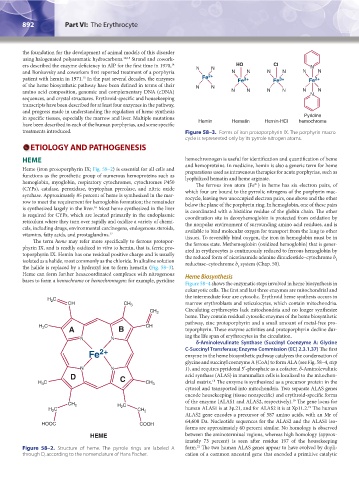
               treatments introduced.                                 Figure 58–3.  Forms of iron protoporphyrin IX. The porphyrin macro-
                                                                      cycle is represented only by its pyrrole nitrogen atoms.
                  ETIOLOGY AND PATHOGENESIS

               HEME                                                   hemochromogen is useful for identification and quantification of heme
               Heme (iron protoporphyrin IX; Fig. 58–2) is essential for all cells and   and hemoproteins. In medicine, hemin is also a generic term for heme
                                                                      preparations used as intravenous therapies for acute porphyrias, such as
               functions as the prosthetic group of numerous hemoproteins such as   lyophilized hematin and heme arginate.
               hemoglobin, myoglobin, respiratory cytochromes, cytochromes P450   The ferrous iron atom (Fe ) in heme has six electron pairs, of
                                                                                             2+
               (CYPs),  catalase,  peroxidase, tryptophan pyrrolase, and  nitric  oxide   which four are bound to the pyrrolic nitrogens of the porphyrin mac-
               synthase. Approximately 85 percent of heme is synthesized in the mar-  rocycle, leaving two unoccupied electron pairs, one above and the other
               row to meet the requirement for hemoglobin formation; the remainder   below the plane of the porphyrin ring. In hemoglobin, one of these pairs
               is synthesized largely in the liver.  Most heme synthesized in the liver   is coordinated with a histidine residue of the globin chain. The other
                                       16
               is required for CYPs, which are located primarily in the endoplasmic   coordination site in deoxyhemoglobin is protected from oxidation by
               reticulum where they turn over rapidly and oxidize a variety of chemi-  the nonpolar environment of surrounding amino acid residues, and is
               cals, including drugs, environmental carcinogens, endogenous steroids,   available to bind molecular oxygen for transport from the lung to other
               vitamins, fatty acids, and prostaglandins. 17          tissues. To reversibly bind oxygen, the iron in hemoglobin must be in
                   The term heme may refer more specifically to ferrous protopor-  the ferrous state. Methemoglobin (oxidized hemoglobin) that is gener-
               phyrin IX, and is readily oxidized in vitro to hemin, that is, ferric pro-  ated in erythrocytes is continuously reduced to ferrous hemoglobin by
               toporphyrin IX. Hemin has one residual positive charge and is usually   the reduced form of nicotinamide adenine dinucleotide–cytochrome b
               isolated as a halide, most commonly as the chloride. In alkaline solution   reductase–cytochrome b  system (Chap. 50).  5
               the halide is replaced by a hydroxyl ion to form hematin (Fig. 58–3).    5
               Heme can form further hexacoordinated complexes with nitrogenous   Heme Biosynthesis
               bases to form a hemochrome or hemochromogen; for example, pyridine
                                                                      Figure 58–4 shows the enzymatic steps involved in heme biosynthesis in
                                                                      eukaryotic cells. The first and last three enzymes are mitochondrial and
                                                                      the intermediate four are cytosolic. Erythroid heme synthesis occurs in
                        H C
                         2
                               CH                CH 3                 marrow erythroblasts and reticulocytes, which contain mitochondria.
                                                          CH 2        Circulating erythrocytes lack mitochondria and no longer synthesize
                                                                      heme. They contain residual cytosolic enzymes of the heme biosynthetic
                                                                      pathway, zinc protoporphyrin and a small amount of metal-free pro-
                     H C       A                B        CH           toporphyrin. These enzyme activities and protoporphyrin decline dur-
                      3
                                   N         N                        ing the life span of erythrocytes in the circulation.
                                                                          δ-Aminolevulinate Synthase (Succinyl Coenzyme A: Glycine
                                      Fe 2+                           C-Succinyl Transferase; Enzyme Commission (EC) 2.3.1.37) The first
                                                                      enzyme in the heme biosynthetic pathway catalyzes the condensation of
                                                                      glycine and succinyl coenzyme A (CoA) to form ALA (see Fig. 58–4, step
                                   N         N                        1), and requires pyridoxal 5′-phosphate as a cofactor. δ-Aminolevulinic
                               D                C                     acid synthase (ALAS) in mammalian cells is localized to the mitochon-
                                                                               18
                     H C                                 CH 3         drial matrix.  The enzyme is synthesized as a precursor protein in the
                      3
                                                                      cytosol and transported into mitochondria. Two separate ALAS genes
                                                                      encode housekeeping (tissue nonspecific) and erythroid-specific forms
                                                                      of the enzyme (ALAS1 and ALAS2, respectively).  The gene locus for
                                                                                                          19
                               CH 2            H C
                                                                                                               19
                        H C                     2     CH 2            human ALAS1 is at 3p.21, and for ALAS2 it is at Xp11.2.  The human
                         2
                                                                      ALAS2 gene encodes a precursor of 587 amino acids, with an Mr of
                                                                      64,600 Da. Nucleotide sequences for the ALAS2 and the ALAS1 iso-
                      HOOC                             COOH
                                                                      forms are approximately 60 percent similar. No homology is observed
                                      HEME                            between the aminoterminal regions, whereas high homology (approx-
                                                                      imately 73 percent) is seen after residue 197 of the housekeeping
                                                                          21
               Figure 58–2.  Structure of heme.  The pyrrole rings are labeled A   form.  The two human ALAS genes appear to have evolved by dupli-
               through D, according to the nomenclature of Hans Fischer.  cation of a common ancestral gene that encoded a primitive catalytic


          Kaushansky_chapter 58_p0889-0914.indd   892                                                                   9/18/15   5:58 PM

