


Page 932 - Williams Hematology ( PDFDrive )
P. 932
906  Part VI:  The Erythrocyte                                                  Chapter 58:  The Porphyrias           907


                     Iron and HFE Mutations Mild to moderate iron overload is found   in cases with the C282Y/C282Y HFE genotype.  Fluid-filled vesicles
                                                                                                           286
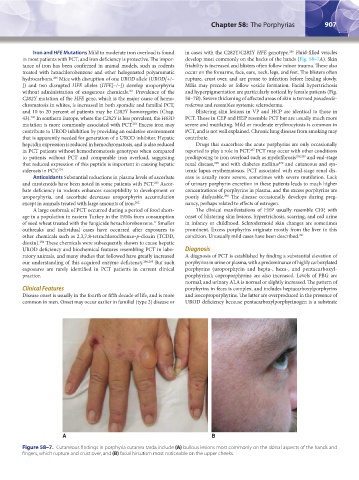
                  in most patients with PCT, and iron deficiency is protective. The impor-  develop most commonly on the backs of the hands (Fig. 58–7A). Skin
                  tance of iron has been confirmed in animal models, such as rodents   friability is increased and blisters often follow minor trauma. These also
                  treated with hexachlorobenzene and other halogenated polyaromatic   occur on the forearms, face, ears, neck, legs, and feet. The blisters often
                  hydrocarbons.  Mice with disruption of one UROD allele (UROD[+/–  rupture, crust over, and are prone to infection before healing slowly.
                            266
                  ]) and two disrupted  HFE alleles (HFE[–/–]) develop uroporphyria   Milia may precede or follow vesicle formation. Facial hypertrichosis
                  without administration of exogenous chemicals.  Prevalence of the   and hyperpigmentation are particularly noticed by female patients (Fig.
                                                      261
                  C282Y mutation of the HFE gene, which is the major cause of hemo-  58–7B). Severe thickening of affected areas of skin is termed pseudoscle-
                  chromatosis in whites, is increased in both sporadic and familial PCT,   roderma and resembles systemic scleroderma.
                  and 10 to 20 percent of patients may be C282Y homozygotes (Chap.   Blistering skin lesions in VP and HCP are identical to those in
                  43).  In southern Europe, where the C282Y is less prevalent, the H63D   PCT. Those in CEP and HEP resemble PCT but are usually much more
                     282
                  mutation is more commonly associated with PCT.  Excess iron may   severe and mutilating. Mild or moderate erythrocytosis is common in
                                                       283
                  contribute to UROD inhibition by providing an oxidative environment   PCT, and is not well explained. Chronic lung disease from smoking may
                  that is apparently needed for generation of a UROD inhibitor. Hepatic   contribute.
                  hepcidin expression is reduced in hemochromatosis, and is also reduced   Drugs that exacerbate the acute porphyrias are only occasionally
                                                                                              287
                  in PCT patients without hemochromatosis genotypes when compared   reported to play a role in PCT.  PCT may occur with other conditions
                  to patients without PCT and comparable iron overload, suggesting   predisposing to iron overload such as myelofibrosis 288,289  and end-stage
                                                                                                        270
                  that reduced expression of this peptide is important in causing hepatic   renal disease,  and with diabetes mellitus  and cutaneous and sys-
                                                                                  290
                  siderosis in PCT. 274                                 temic lupus erythematosus. PCT associated with end-stage renal dis-
                     Antioxidants Substantial reductions in plasma levels of ascorbate   ease is usually more severe, sometimes with severe mutilation. Lack
                  and carotenoids have been noted in some patients with PCT.  Ascor-  of urinary porphyrin excretion in these patients leads to much higher
                                                              263
                  bate deficiency in rodents enhances susceptibility to development or   concentrations of porphyrins in plasma, and the excess porphyrins are
                  uroporphyria, and ascorbate decreases uroporphyrin accumulation   poorly dialyzable.  The disease occasionally develops during preg-
                                                                                     290
                  except in animals treated with large amounts of iron. 262  nancy, perhaps related to effects of estrogen.
                     A large outbreak of PCT occurred during a period of food short-  The clinical manifestations of HEP usually resemble CEP, with
                  age in a population in eastern Turkey in the 1950s from consumption   onset of blistering skin lesions, hypertrichosis, scarring, and red urine
                  of seed wheat treated with the fungicide hexachlorobenzene.  Smaller   in infancy or childhood. Sclerodermoid skin changes are sometimes
                                                              11
                  outbreaks  and  individual  cases  have  occurred  after  exposures  to   prominent. Excess porphyrins originate mostly from the liver in this
                  other chemicals such as 2,3,7,8-tetrachlorodibenzo-p-dioxin (TCDD,   condition. Unusually mild cases have been described. 291
                  dioxin).  These chemicals were subsequently shown to cause hepatic
                        284
                  UROD deficiency and biochemical features resembling PCT in labo-  Diagnosis
                  ratory animals, and many studies that followed have greatly increased   A diagnosis of PCT is established by finding a substantial elevation of
                  our understanding of this acquired enzyme deficiency. 266,285  But such   porphyrins in urine or plasma, with a predominance of highly carboxylated
                  exposures are rarely identified in PCT patients in current clinical   porphyrins (uroporphyrin and hepta-, hexa-, and pentacarboxyl-
                  practice.                                             porphyrins); coproporphyrins are also increased. Levels of PBG are
                                                                        normal, and urinary ALA is normal or slightly increased. The pattern of
                  Clinical Features                                     porphyrins in feces is complex, and includes heptacarboxylporphyrins
                  Disease onset is usually in the fourth or fifth decade of life, and is more   and isocoproporphyrins. The latter are overproduced in the presence of
                  common in men. Onset may occur earlier in familial (type 2) disease or   UROD deficiency because pentacarboxylporphyrinogen is a substrate


                               A                                                 B
                  Figure 58–7.  Cutaneous findings in porphyria cutanea tarda include (A) bullous lesions most commonly on the dorsal aspects of the hands and
                  fingers, which rupture and crust over, and (B) facial hirsutism most noticeable on the upper cheeks.


          Kaushansky_chapter 58_p0889-0914.indd   907                                                                   9/18/15   5:58 PM

