


Page 928 - Williams Hematology ( PDFDrive )
P. 928
902  Part VI:  The Erythrocyte                                                  Chapter 58:  The Porphyrias           903


                  Diagnosis                                             acute attack may be increased compared to baseline levels, which fluctu-
                  A high index of suspicion and knowing when to suspect these diseases   ate considerably and can be difficult to establish between attacks. Intra-
                  contributes to making an initial diagnosis of acute porphyria. Because the   venous hemin causes dramatic, rapid but often transient decreases in
                  disease so often remains latent, there is often no family history of porphy-  these levels.
                  ria. Acute porphyria should be considered in patients with unexplained   Urinary porphyrins are increased in AIP, are predominantly uro-
                  abdominal pain or other characteristic symptoms when initial evalua-  porphyrin and account for reddish urine (ALA and PBG are colorless).
                  tion does not suggest another more common explanation, and ruled in   Uroporphyrin  can  form  nonenzymatically  from  PBG  in  urine  even
                  or out by rapid assessment of urinary PBG, which is both sensitive and   prior to excretion. However, there is evidence that porphyrins in this
                  specific. A substantial increase in PBG, which can be determined rap-  condition are predominantly type III, which may be formed enzymati-
                                                                            228
                                                                                                                          194
                  idly by a commercial kit,  establishes that a patient has either AIP, HCP,   cally,  perhaps from ALA transported to tissues other than the liver.
                                   227
                  or VP. Consensus recommendations are that all major medical centers   Total fecal porphyrins and plasma porphyrins are normal or slightly
                  should retain the capacity for rapid urinary PBG testing on single-void   increased in AIP, and erythrocyte zinc protoporphyrin concentrations
                  urine specimens, as collection of 24 hour urines and reliance on outside   may be nonspecifically increased.
                  laboratories for screening can greatly delay diagnosis and treatment. The   Erythrocyte PBGD activity is approximately half-normal in most
                  urine specimen should be saved for later quantitative measurement of   (70 to 80 percent) patients with AIP. However, this measurement is not
                  PBG, ALA, and total porphyrin levels. If PBG is substantially increased,   definitive for confirming or excluding the diagnosis. As described ear-
                  samples of plasma, erythrocytes and feces should also be obtained prior   lier, some PBGD mutations cause the enzyme to be deficient only in
                  to treatment with hemin. This approach provides for rapid initial diagno-  nonerythroid tissues. Moreover, the ranges of activity for normals and
                  sis of AIP, HCP, and VP, subsequent biochemical differentiation of these   AIP are wide and overlapping, and the erythrocyte enzyme is highly
                  conditions and diagnosis of ADP. In patients with renal failure, PBG can   age-dependent, such that an increase in the proportion of younger
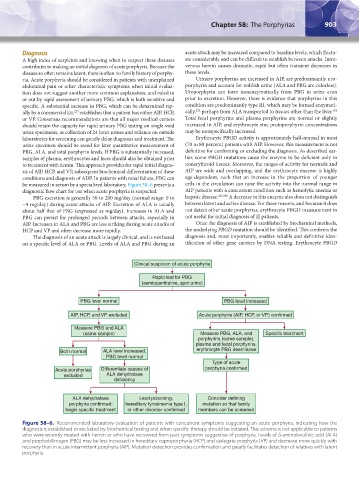
                  be measured in serum by a specialized laboratory. Figure 58–6 presents a   cells in the circulation can raise the activity into the normal range in
                  diagnostic flow chart for use when acute porphyria is suspected.  AIP patients with a concurrent condition such as hemolytic anemia or
                     PBG excretion is generally 50 to 200 mg/day (normal range: 0 to   hepatic disease. 229,230  A decrease in this enzyme also does not distinguish
                  ~4 mg/day) during acute attacks of AIP. Excretion of ALA is usually   between latent and active disease. For these reasons, and because it does
                  about half that of PBG (expressed as mg/day). Increases in ALA and   not detect other acute porphyrias, erythrocyte PBGD measurement in
                  PBG can persist for prolonged periods between attacks, especially in   not useful for initial diagnosis of ill patients.
                  AIP. Increases in ALA and PBG are less striking during acute attacks of   Once the diagnosis of AIP is established by biochemical methods,
                  HCP and VP and often decrease more rapidly.           the underlying PBGD mutation should be identified. This confirms the
                     The diagnosis of an acute attack is largely clinical, and is not based   diagnosis and, most importantly, enables reliable and definitive iden-
                  on a specific level of ALA or PBG. Levels of ALA and PBG during an   tification of other gene carriers by DNA testing. Erythrocyte PBGD


                                                       Clinical suspicion of acute porphyria

                                                             Rapid test for PBG
                                                          (semiquantitative, spot urine)


                                     PBG level normal                                PBG level increased

                                  AIP, HCP, and VP excluded                  Acute porphyria (AIP, HCP, or VP) confirmed
                                   Measure PBG and ALA
                                      (same sample)                          Measure PBG, ALA, and  Specific treatment
                                                                             porphyrins (same sample),
                                                                            plasma and fecal porphyrins,
                              Both normal    ALA level increased,           erythrocyte PBG deaminase
                                              PBG level normal
                                                                                 Type of acute
                             Acute porphyrlas  Differentiate causes of         porphyria confirmed
                                excluded      ALA dehydratase
                                                 deficiency


                                   ALA dehydratase       Lead poisoning,        Consider defining
                                 porphyria confirmed:  hereditary tyrosinemia type I,  mutation so that family
                                begin specific treatment  or other disorder confirmed  members can be screened
                  Figure 58–6.  Recommended laboratory evaluation of patients with concurrent symptoms suggesting an acute porphyria, indicating how the
                  diagnosis is established or excluded by biochemical testing and when specific therapy should be initiated. This schema is not applicable to patients
                  who were recently treated with hemin or who have recovered from past symptoms suggestive of porphyria. Levels of δ-aminolevulinic acid (ALA)
                  and porphobilinogen (PBG) may be less increased in hereditary coproporphyria (HCP) and variegate porphyria (VP) and decrease more quickly with
                  recovery than in acute intermittent porphyria (AIP). Mutation detection provides confirmation and greatly facilitates detection of relatives with latent
                  porphyria.


          Kaushansky_chapter 58_p0889-0914.indd   903                                                                   9/18/15   5:58 PM

