


Page 967 - Williams Hematology ( PDFDrive )
P. 967
942            Part VII:  Neutrophils, Eosinophils, Basophils, and Mast Cells                                                                              Chapter 61:  Production, Distribution, and Fate of Neutrophils          943


               contains approximately 50-fold more neutrophils and even more lym-  TABLE 61–3.  Definitions and Calculations Relating to
               phocytes and monocytes.  Videomicroscopic study of these vessels
                                  70
               in animal models has revealed the transit of neutrophils through this   Blood Neutrophil Kinetics
               network required a median time of 26 seconds and mean time of 6.1   Circulating neutrophil pool (CNP) =  Blood neutrophil concentration
               seconds. 71,72  In contrast, the transit times of red blood cells ranges from    × blood volume
               1.4 to 4.2 seconds. The increased transit time results primarily from the   Total blood neutrophil pool (TBNP) =  All neutrophils in the circulation
               time neutrophils are stopped within this vascular network. The longer   Marginal neutrophil pool (MNP) = TBNP – CNP
               time required for the neutrophils to pass through this bed apparently
               accounts for their increased concentration.             Blood clearance half-time (T ) =  Disappearance time of half
                                                                                            1/2
                   Recruitment of neutrophils into the lungs through the alveolar               the labeled neutrophils from
               capillary network contrasts with the recruitment of neutrophils through          circulation
               postcapillary venules at sites of inflammation in a number of important   Neutrophil turnover rate (NTR) =  0.693 × TBNP
               ways. The tethering mechanisms required to capture neutrophils from                  T
               flowing blood in larger vessels apparently are not necessary in the alve-            1/2
               olar capillary bed. The diameters of spherical neutrophils (6 to 8 µm)
               are larger than the diameters of many capillary segments (2 to 15 µm).
               Approximately 50 percent of the capillary segments would require neu-
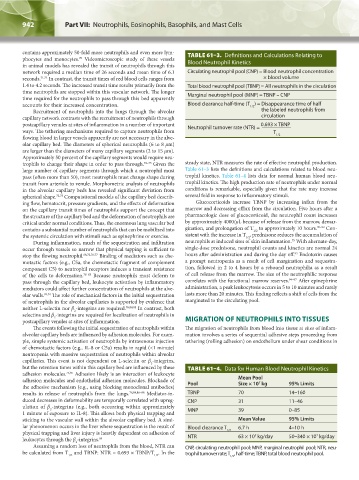
               trophils to change their shape in order to pass through. 72–75  Given the   steady state, NTR measures the rate of effective neutrophil production.
               large number of capillary segments through which a neutrophil must   Table 61–3 lists the definitions and calculations related to blood neu-
               pass (often more than 50), most neutrophils must change shape during   trophil kinetics.  Table 61–4 lists data for normal human blood neu-
               transit from arteriole to venule. Morphometric analysis of neutrophils   trophil kinetics. The high production rate of neutrophils under normal
               in the alveolar capillary beds has revealed significant deviation from   conditions is remarkable, especially given that the rate may increase
               spherical shape. 72,73  Computational models of the capillary bed describ-  several fold in response to inflammatory stimuli.
               ing flow, hematocrit, pressure gradients, and the effects of deformation   Glucocorticoids increase TBNP by increasing influx from the
               on the capillary transit times of neutrophils support the concept that   marrow and decreasing efflux from the circulation. Five hours after a
               the structure of the capillary bed and the deformation of neutrophils are   pharmacologic dose of glucocorticoid, the neutrophil count increases
               critical under normal conditions. Thus, the enormous lung vascular bed   by approximately 4000/µL because of release from the marrow, demar-
               contains a substantial number of neutrophils that can be mobilized into   gination, and prolongation of T  to approximately 10 hours. 90–92  Con-
                                                                                             1/2
               the systemic circulation with stimuli such as epinephrine or exercise.  sistent with the increase in T , prednisone reduces the accumulation of
                                                                                          1/2
                                                                                                          75
                   During inflammation, much of the sequestration and infiltration   neutrophils at induced sites of skin inflammation.  With alternate-day,
               occur through vessels so narrow that physical tapping is sufficient to   single-dose prednisone, neutrophil counts and kinetics are normal 24
                                                                                                           93
               stop the flowing neutrophil. 68,72,76,77  Binding of mediators such as che-  hours after administration and during the day off.  Endotoxin causes
               motactic factors (e.g., C5a, the chemotactic fragment of complement   a prompt neutropenia as a result of cell margination and sequestra-
               component C5) to neutrophil receptors induces a transient resistance   tion, followed in 2 to 4 hours by a rebound neutrophilia as a result
               of the cells to deformation. 78–83  Because neutrophils must deform to   of cell release from the marrow. The size of the neutrophilic response
               pass through the capillary bed, leukocyte activation by inflammatory   correlates with the functional marrow reserves. 94–97  After epinephrine
               mediators could affect further concentration of neutrophils at the alve-  administration, a peak leukocytosis occurs in 5 to 10 minutes and rarely
               olar walls. 65,76  The role of mechanical factors in the initial sequestration   lasts more than 20 minutes. This finding reflects a shift of cells from the
               of neutrophils in the alveolar capillaries is supported by evidence that   marginated to the circulating pool.
               neither L-selectin nor β -integrins are required. 76,84,85  In contrast, both
                                 2
               selectins and β -integrins are required for localization of neutrophils in
                          2
               postcapillary venules at sites of inflammation.        MIGRATION OF NEUTROPHILS INTO TISSUES
                   The events following the initial sequestration of neutrophils within   The migration of neutrophils from blood into tissue at sites of inflam-
               alveolar capillary beds are influenced by adhesion molecules. For exam-  mation involves a series of sequential adhesive steps proceeding from
               ple, simple systemic activation of neutrophils by intravenous injection   tethering (rolling adhesion) on endothelium under shear conditions in
               of chemotactic factors (e.g., IL-8 or C5a) results in rapid (<1 minute)
               neutropenia with massive sequestration of neutrophils within alveolar
               capillaries. This event is not dependent on L-selectin or β -integrins,
                                                          2
               but the retention times within this capillary bed are influenced by these   TABLE 61–4.  Data for Human Blood Neutrophil Kinetics
               adhesion molecules. 76,85  Adhesion likely is an interaction of leukocyte
               adhesion molecules and endothelial adhesion molecules. Blockade of   Pool  Mean Pool      95% Limits
                                                                                        Size × 10  kg
                                                                                               7
               the adhesive mechanism (e.g., using blocking monoclonal antibodies)
               results in release of neutrophils from the lungs. 76,84,86–88  Mediator-in-  TBNP  70     14–160
               duced decreases in deformability are temporally correlated with upreg-  CNP  31           11–46
               ulation of  β -integrins (e.g., both occurring within approximately
                         2
               1 minute of exposure to IL-8). This allows both physical trapping and   MNP  39           0–85
               sticking to the vascular wall within the alveolar capillary bed. A simi-  Mean Value      95% Limits
               lar phenomenon occurs in the liver where sequestration is the result of   Blood clearance T  6.7 h  4–10 h
               physical trapping and liver injury is heavily dependent on adhesion of   1/2  7                    7
               leukocytes through the β -integrins. 89                 NTR              63 × 10  kg/day  50–340 × 10  kg/day
                                 2
                   Assuming a random loss of neutrophils from the blood, NTR can   CNP, circulating neutrophil pool; MNP, marginal neutrophil pool; NTR, neu-
               be calculated from T  and TBNP: NTR = 0.693 × TBNP/T . In the   trophil turnover rate; T , half-time; TBNP, total blood neutrophil pool.
                               1/2
                                                            1/2
                                                                                     1/2


          Kaushansky_chapter 61_p0939-0946.indd   942                                                                   9/18/15   9:41 AM

