


Page 965 - Williams Hematology ( PDFDrive )
P. 965
940            Part VII:  Neutrophils, Eosinophils, Basophils, and Mast Cells                                                                              Chapter 61:  Production, Distribution, and Fate of Neutrophils          941


               22,000 relative molecular mass (Mr) glycoprotein that stimulates the   NEUTROPHIL KINETICS
               production of neutrophils, monocytes, and eosinophils. Granulocyte   Methods used to study granulocyte kinetics can be categorized as fol-
               colony-stimulating factor (G-CSF) has a Mr of 20,000 and stimulates   lows: (1) neutrophil depletion or destruction to determine the size and
               exclusively the production of neutrophils. IL-3, or multi-CSF, also   rate of mobilization of reserves and the level of compensatory neu-
               has a Mr of 20,000 and acts relatively early in hematopoiesis, affect-  trophil production; (2) use of radioactive tracers to study neutrophil
               ing pluripotential stem cells. Finally, stem cell factor (also known as   distribution, production rates, and survival times; (3) mitotic indices of
               c-kit ligand or steel factor), with a Mr of 28,000, acts in combination   marrow granulocytic cells to assess proliferative activity and cell cycle
               with IL-3 and/or GM-CSF to stimulate the proliferation of the early   times; and (4) induced inflammatory lesions to study cell movement
               hematopoietic progenitor cells, basophils and mast cells.  into the tissues. Of these categories, the most popular has been the use
                   In addition to their effects on neutrophil precursors, G-CSF and   of radioactive tracers.
               GM-CSF act directly on the neutrophil, enhancing its function. These   Neutrophil  production  and neutrophil  kinetics  usually  are ana-
               cytokines regulate the production, survival, and functional activity of   lyzed by describing neutrophil movement through a number of inter-
               neutrophils. 21,22,26,27  In a murine model of severe bacterial infection,   connected compartments. These compartments can be arranged into
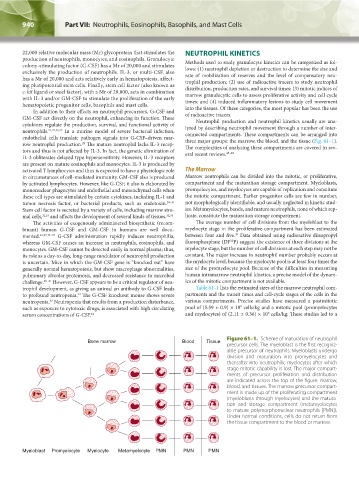
               endothelial cells translate pathogen signals into G-CSF–driven mar-  three major groups: the marrow, the blood, and the tissue (Fig. 61–1).
                                   28
               row neutrophil production.  The mature neutrophil lacks IL-3 recep-  The complexities of analyzing these compartments are covered in sev-
               tors and thus is not affected by IL-3. In fact, the genetic elimination of   eral recent reviews. 45–48
               IL-3 obliterates delayed type hypersensitivity. However, IL-3 receptors
               are present on mature eosinophils and monocytes. IL-3 is produced by
               activated T lymphocytes and thus is expected to have a physiologic role   The Marrow
               in circumstances of cell-mediated immunity. GM-CSF also is produced   Marrow neutrophils can be divided into the mitotic, or proliferative,
               by activated lymphocytes. However, like G-CSF, it also is elaborated by   compartment and the maturation storage compartment. Myeloblasts,
               mononuclear phagocytes and endothelial and mesenchymal cells when   promyelocytes, and myelocytes are capable of replication and constitute
               these cell types are stimulated by certain cytokines, including IL-1 and   the mitotic compartment. Earlier progenitor cells are few in number,
               tumor  necrosis factor, or bacterial  products, such as  endotoxin. 29–31    not morphologically identifiable, and usually neglected in kinetic stud-
               Stem cell factor is secreted by a variety of cells, including marrow stro-  ies. Metamyelocytes, bands, and mature neutrophils, none of which rep-
               mal cells, 32,33  and affects the development of several kinds of tissues. 32,34  licate, constitute the maturation storage compartment.
                   The activities of exogenously administered biosynthetic (recom-  The average number of cell divisions from the myeloblast to the
               binant) human G-CSF and GM-CSF in humans are well docu-  myelocyte stage in the proliferative compartment has been estimated
                                                                                       49
               mented. 22,27,35–37  G-CSF administration rapidly induces neutrophilia,   between four and five.  Data obtained using radioactive diisopropyl
                                                                                     32
               whereas GM-CSF causes an increase in neutrophils, eosinophils, and   fluorophosphate (DF P) suggest the existence of three divisions at the
               monocytes. GM-CSF cannot be detected easily in normal plasma; thus,   myelocyte stage, but the number of cell divisions at each step may not be
               its role as a day-to-day, long-range modulator of neutrophil production   constant. The major increase in neutrophil number probably occurs at
               is uncertain. Mice in which the GM-CSF gene is “knocked out” have   the myelocyte level, because the myelocyte pool is at least four times the
               generally normal hematopoiesis, but show macrophage abnormalities,   size of the promyelocyte pool. Because of the difficulties in measuring
               pulmonary alveolar proteinosis, and decreased resistance to microbial   human intramarrow neutrophil kinetics, a precise model of the dynam-
               challenge. 38–41  However, G-CSF appears to be a critical regulator of neu-  ics of the mitotic compartment is not available.
               trophil development, as giving an animal an antibody to G-CSF leads   Table 61–1 lists the estimated sizes of the marrow neutrophil com-
               to profound neutropenia.  The G-CSF knockout mouse shows severe   partments and the transit times and cell-cycle stages of the cells in the
                                  42
                         43
               neutropenia.  Neutropenia that results from a production disturbance,   various compartments. Precise studies have measured a postmitotic
                                                                                        9
               such as exposure to cytotoxic drugs, is associated with high circulating   pool of (5.59 ± 0.9) × 10  cells/kg and a mitotic pool (promyelocytes
                                                                                                  9
               serum concentrations of G-CSF. 44                      and myelocytes) of (2.11 ± 0.36) × 10  cells/kg. These studies led to a
                                                                                    Figure 61–1.  Scheme of maturation of neutrophil
                                     Bone marrow                     Blood   Tissue
                                                                                    precursor cells. The myeloblast is the first recogniz-
                                                                                    able precursor of neutrophils. Myeloblasts undergo
                                                                                    division and maturation into promyelocytes and
                                                                                    thereafter into neutrophilic myelocytes after which
                                                                                    stage mitotic capability is lost. The major compart-
                                                                                    ments of precursor proliferation and distribution
                                                                                    are indicated across the top of the figure: marrow,
                                                                                    blood, and tissues. The marrow precursor compart-
                                                                                    ment is made up of the proliferating compartment
                                                                                    (myeloblasts through myelocytes) and the matura-
                                                                                    tion and storage compartment (metamyelocytes
                                                                                    to mature polymorphonuclear neutrophils [PMN]).
                                                                                    Under normal conditions, cells do not return from
                                                                                    the tissue compartment to the blood or marrow.


               Myeloblast  Promyelocyte  Myelocyte  Metamyelocyte  PMN  PMN   PMN


          Kaushansky_chapter 61_p0939-0946.indd   940                                                                   9/18/15   9:41 AM

