


Page 966 - Williams Hematology ( PDFDrive )
P. 966
940  Part VII:  Neutrophils, Eosinophils, Basophils, and Mast Cells  Chapter 61:  Production, Distribution, and Fate of Neutrophils   941


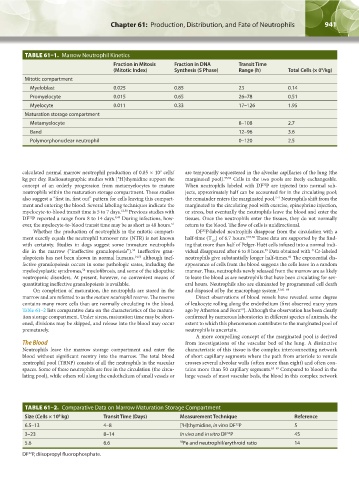
                   TABLE 61–1.  Marrow Neutrophil Kinetics
                                                Fraction in Mitosis   Fraction in DNA     Transit Time
                                                (Mitotic Index)      Synthesis (S Phase)  Range (h)        Total Cells (× 0 /kg)
                                                                                                                      9
                   Mitotic compartment
                    Myeloblast                  0.025                0.85                 23               0.14
                    Promyelocyte                0.015                0.65                 26–78            0.51
                    Myelocyte                   0.011                0.33                 17–126           1.95
                   Maturation storage compartment
                    Metamyelocyte                                                         8–108            2.7
                    Band                                                                  12–96            3.6
                    Polymorphonuclear neutrophil                                          0–120            2.5


                  calculated normal marrow neutrophil production of 0.85 × 10  cells/  are temporarily sequestered in the alveolar capillaries of the lung (the
                                                                9
                  kg per day. Radioautographic studies with [ H]thymidine support the   marginated  pool). 55,56   Cells  in  the  two  pools  are  freely  exchangeable.
                                                  3
                  concept  of an orderly progression from  metamyelocytes to mature   When neutrophils labeled with DF P are injected into normal sub-
                                                                                                   32
                  neutrophils within the maturation storage compartment. These studies   jects, approximately half can be accounted for in the circulating pool;
                  also suggest a “first in, first out” pattern for cells leaving this compart-  the remainder enters the marginated pool.  Neutrophils shift from the
                                                                                                       5–7
                  ment and entering the blood. Several labeling techniques indicate the   marginated to the circulating pool with exercise, epinephrine injection,
                  myelocyte-to-blood transit time is 5 to 7 days. 12,50  Previous studies with   or stress, but eventually the neutrophils leave the blood and enter the
                  DF P reported a range from 8 to 14 days.  During infections, how-  tissues. Once the neutrophils enter the tissues, they do not normally
                                                 9,49
                    32
                  ever, the myelocyte-to-blood transit time may be as short as 48 hours. 51  return to the blood. The flow of cells is unidirectional.
                     Whether the production of neutrophils in the mitotic compart-  DF P-labeled neutrophils disappear from the circulation with a
                                                                              32
                  ment exactly equals the neutrophil turnover rate (NTR) is not known   half-time (T ) of 6.7 hours. 7,57,58  These data are supported by the find-
                                                                                 1/2
                  with certainty. Studies in dogs suggest some immature neutrophils   ing that more than half of Pelger-Huët cells infused into a normal indi-
                  die in the marrow (“ineffective granulopoiesis”).  Ineffective gran-  vidual disappeared after 6 to 8 hours.  Data obtained with  Cr-labeled
                                                                                                                   51
                                                                                                   59
                                                       52
                  ulopoiesis has not been shown in normal humans, 14,53  although inef-  neutrophils give substantially longer half-times.  The exponential dis-
                                                                                                           60
                  fective granulopoiesis occurs in some pathologic states, including the   appearance of cells from the blood suggests the cells leave in a random
                  myelodysplastic syndromes,  myelofibrosis, and some of the idiopathic   manner. Thus, neutrophils newly released from the marrow are as likely
                                      54
                  neutropenic disorders. At present, however, no convenient means of   to leave the blood as are neutrophils that have been circulating for sev-
                  quantitating ineffective granulopoiesis is available.  eral hours. Neutrophils also are eliminated by programmed cell death
                     On completion of maturation, the neutrophils are stored in the   and disposed of by the macrophage system. 51,61–64
                  marrow and are referred to as the mature neutrophil reserve. The reserve   Direct observations of blood vessels have revealed some  degree
                  contains many more cells than are normally circulating in the blood.   of leukocyte rolling along the endothelium (first observed many years
                  Table 61–2 lists comparative data on the characteristics of the matura-  ago by Atherton and Born ). Although the observation has been clearly
                                                                                           60
                  tion storage compartment. Under stress, maturation time may be short-  confirmed by numerous laboratories in different species of animals, the
                  ened, divisions may be skipped, and release into the blood may occur   extent to which this phenomenon contributes to the marginated pool of
                  prematurely.                                          neutrophils is uncertain.
                                                                            A more compelling concept of the marginated pool is derived
                  The Blood                                             from investigations of the vascular bed of the lung. A distinctive
                  Neutrophils  leave the  marrow storage compartment and enter the   characteristic of this tissue is the complex interconnecting network
                  blood without significant reentry into the marrow. The total blood   of short capillary segments where the path from arteriole to venule
                  neutrophil pool (TBNP) consists of all the neutrophils in the vascular   crosses several alveolar walls (often more than eight) and often con-
                  spaces. Some of these neutrophils are free in the circulation (the circu-  tains more than 50 capillary segments. 65–69  Compared to blood in the
                  lating pool), while others roll along the endothelium of small vessels or   large vessels of most vascular beds, the blood in this complex network


                   TABLE 61–2.  Comparative Data on Marrow Maturation Storage Compartment
                   Size (Cells × 10  kg)     Transit Time (Days)       Measurement Technique                 Reference
                              9
                   6.5–13                    4–8                       [ H]thymidine, in vitro DF P          5
                                                                       3
                                                                                         32
                   3–23                      8–14                      In vivo and in vitro DF P             45
                                                                                      32
                   5.6                       6.6                       59 Fe and neutrophil/erythroid ratio  14
                  DF P, diisopropyl fluorophosphate.
                    32


          Kaushansky_chapter 61_p0939-0946.indd   941                                                                   9/18/15   9:41 AM

