


Page 974 - Williams Hematology ( PDFDrive )
P. 974
948  Part VII:  Neutrophils, Eosinophils, Basophils, and Mast Cells  Chapter 62:  Eosinophils and Related Disorders   949


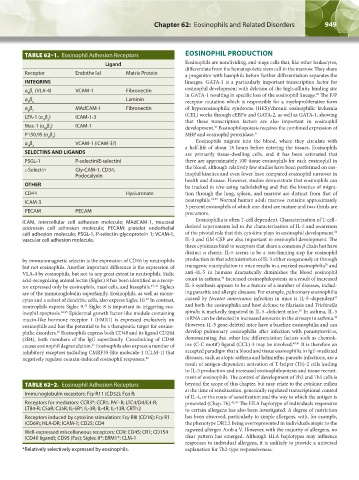
                   TABLE 62–1.  Eosinophil Adhesion Receptors           EOSINOPHIL PRODUCTION
                                              Ligand                    Eosinophils are nondividing, end-stage cells that, like other leukocytes,
                                                                        differentiate from the hematopoietic stem cell in the marrow. They share
                   Receptor         Endothelial      Matrix Protein     a progenitor with basophils before further differentiation separates the
                   INTEGRINS                                            lineages.  GATA-1 is a particularly important transcription factor for
                   α β  (VLA-4)     VCAM-1           Fibronectin        eosinophil development with deletion of the high-affinity binding site
                    4 1
                                                                        in GATA-1 resulting in specific loss of the eosinophil lineage.  The F/P
                                                                                                                    29
                   α β                               Laminin
                    4 6                                                 receptor mutation which is responsible for a myeloproliferative form
                   α β              MAdCAM-1         Fibronectin        of hypereosinophilic syndrome (HES)/chronic eosinophilic leukemia
                    4 7
                   LFA-1 (α β )     ICAM-1-3                            (CEL) works through cEBPα and GATA-2, as well as GATA-1, showing
                         Λ 2                                            that these transcription factors are also important in eosinophil
                   Mac-1 (α β )     ICAM-1                              development.  Eosinophilopoiesis requires the combined expression of
                                                                                  30
                         M 2
                   P150,95 (α β )                                       MBP and eosinophil peroxidase. 31
                          x 2
                   α β              VCAM-1 (ICAM-3?)                        Eosinophils migrate into the blood, where they circulate with
                    d 2                                                 a half-life of about 18 hours before entering the tissues. Eosinophils
                   SELECTINS AND LIGANDS                                are primarily tissue-dwelling cells, and it has been estimated that
                   PSGL-1           P-selectin(E-selectin)              there are approximately 100 tissue eosinophils for each eosinophil in
                                                                        the blood, although relatively few studies have been performed on eos-
                   l-Selectin       Gly-CAM-1, CD34,
                                    Podocalyxin                         inophil kinetics and even fewer have compared eosinophil turnover in
                                                                        health and disease. However, studies demonstrate that eosinophils can
                   OTHER                                                be tracked in vivo using radiolabeling and that the kinetics of migra-
                   CD44                              Hyaluronate        tion through the lung, spleen, and marrow are distinct from that of
                   ICAM-3                                               neutrophils. 32,33  Normal human adult marrow contains approximately
                                                                        3 percent eosinophils of which one-third are mature and two-thirds are
                   PECAM            PECAM                               precursors.
                  ICAM, intercellular cell adhesion molecule; MAdCAM-1, mucosal   Eosinophilia is often T-cell dependent. Characterization of T-cell–
                  addressin cell adhesion molecule; PECAM: platelet endothelial     derived supernatants led to the characterization of IL-5 and awareness
                                                                                                                          34
                  cell adhesion molecule; PSGL-1, P-selectin glycoprotein 1; VCAM-1,   of the pivotal role that this cytokine plays in eosinophil development.
                  vascular cell adhesion molecule.                      IL-3 and GM-CSF are also important in eosinophil development. The
                                                                        three cytokines bind to receptors that share a common β chain but have
                                                                        distinct α chains. IL-5 seems to be a rate-limiting step for eosinophil
                  by immunomagnetic selectin is the expression of CD16 by neutrophils   production in that administration of IL-5 either exogenously or through
                                                                                                                       35
                  but not eosinophils. Another important difference is the expression of   transgenic manipulation in mice results in a marked eosinophilia  and
                  VLA-4 by eosinophils, but not to any great extent in neutrophils. Sialic   anti–IL-5 in humans dramatically diminishes the blood eosinophil
                                                                                    36
                  acid-recognizing animal lectin (Siglec) 8 has been identified as a recep-  count in asthma.  Increased eosinophilopoiesis as a result of increased
                  tor expressed only by eosinophils, mast cells, and basophils. 19–21  Siglecs   IL-5 synthesis appears to be a feature of a number of diseases, includ-
                  are of the immunoglobulin superfamily. Eosinophils, as well as mono-  ing parasitic and allergic diseases. For example, pulmonary eosinophilia
                                                                                                                          37
                                                           22
                  cytes and a subset of dendritic cells, also express Siglec 10.  In contrast,   caused  by  Necator americanus  infection  in  mice  is  IL-5–dependent
                                       23
                  neutrophils express Siglec 9.  Siglec 8 is important in triggering eos-  and both the eosinophilia and host defense to filariasis and Trichinella
                                                                                                               38
                  inophil apoptosis. 24,25  Epidermal growth factor-like module containing   spiralis is markedly impaired in IL-5–deficient mice.  In asthma, IL-5
                                                                                                                          39
                  mucin-like  hormone  receptor  1  (EMR1)  is  expressed  exclusively  on   mRNA can be detected in increased amounts in the airways in asthma.
                  eosinophils and has the potential to be a therapeutic target for eosino-  However, IL-5 gene-deleted mice have a baseline eosinophilia and can
                  philic disorders.  Eosinophils express both CD48 and its ligand CD244   develop pulmonary eosinophilia after infection with paramyxovirus,
                             26
                  (2B4), both members of the IgG superfamily. Crosslinking of CD48   demonstrating that other late differentiation factors such as chemok-
                                         27
                  causes eosinophil degranulation.  Eosinophils also express a number of   ine (C-C motif) ligand (CCL)-3 may be involved. 40,41  It is therefore an
                  inhibitory receptors including CMRF35-like molecule-1 (CLM-1) that   accepted paradigm that a blood and tissue eosinophilia in IgE-mediated
                  negatively regulate eotaxin-induced eosinophil responses. 28  diseases, such as atopic asthma and helminthic parasite infections, are a
                                                                        result of antigen-dependent activation of T-helper (Th)-2 cells leading
                                                                        to IL-5 production and increased eosinophilopoiesis and tissue recruit-
                                                                        ment of eosinophils. The control of development of Th2 and Th1 cells is
                   TABLE 62–2.  Eosinophil Adhesion Receptors           beyond the scope of this chapter, but may relate to the cytokine milieu
                                                                        at the time of sensitization, genetically regulated transcriptional control
                   Immunoglobulin receptors: Fcγ R11 (CD32); Fcα R;
                                                                        of IL-4, or the route of sensitization and the way in which the antigen is
                   Receptors for mediators: CCR3*; CCR1; PAF-R; LTC4/D4/E4-R;   presented (Chap. 76). 42,43  The HLA haplotype of individuals responsive
                   LTB4-R; C5aR; C3aR; IL-5R*; IL-3R; IL-4R; IL-13R; CRTh2  to certain allergens has also been investigated. A degree of restriction
                   Receptors induced by cytokine stimulation: Fcγ RIII (CD16); Fcγ R1   has been observed, particularly to simple allergens, with, for example,
                   (CD69); HLA-DR; ICAM-1; CD25; CD4                    the phenotype DR2.2 being overrepresented in individuals atopic to the
                   Well-expressed miscellaneous receptors: CD9; CD45; CR1; CD154   ragweed allergen Amb a V. However, with the majority of allergens, no
                   (CD40 ligand); CD95 (Fas); Siglec 8*; ERM1*; CLM-1   clear  pattern  has  emerged.  Although  HLA  haplotypes  may  influence
                                                                        responses to individual allergens, it is unlikely to provide a universal
                  *Relatively selectively expressed by eosinophils.     explanation for Th2-type responsiveness.


          Kaushansky_chapter 62_p0947-0964.indd   949                                                                   9/21/15   10:56 AM

