


Page 982 - Williams Hematology ( PDFDrive )
P. 982
956  Part VII:  Neutrophils, Eosinophils, Basophils, and Mast Cells  Chapter 62:  Eosinophils and Related Disorders   957


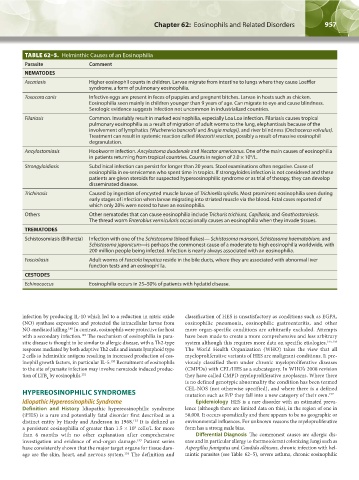
                   TABLE 62–5.  Helminthic Causes of an Eosinophilia
                   Parasite             Comment
                   NEMATODES
                   Ascariasis           Higher eosinophil counts in children. Larvae migrate from intestine to lungs where they cause Loeffler
                                          syndrome, a form of pulmonary eosinophilia.
                   Toxocara canis       Infective eggs are present in feces of puppies and pregnant bitches. Larvae in hosts such as chicken.
                                          Eosinophilia seen mainly in children younger than 9 years of age. Can migrate to eye and cause blindness.
                                        Serologic evidence suggests infection not uncommon in industrialized countries.
                   Filariasis           Common. Invariably result in marked eosinophilia, especially Loa Loa infection. Filariasis causes tropical
                                        pulmonary eosinophilia as a result of migration of adult worms to the lung, elephantiasis because of the
                                        involvement of lymphatics (Wuchereria bancrofti and Brugia malayi), and river blindness (Onchocerca volvulus).

                                        Treatment can result in systemic reaction called Mazzotti reaction, possibly a result of massive eosinophil
                                        degranulation.
                   Ancylostomiasis      Hookworm infection. Ancylostoma duodenale and Necator americanus. One of the main causes of eosinophilia
                                                                                              9
                                        in patients returning from tropical countries. Counts in region of 2.0 × 10 /L.
                   Strongyloidiasis     Subclinical infection can persist for longer than 20 years. Stool examinations often negative. Cause of
                                          eosinophilia in ex-servicemen who spent time in tropics. If strongyloides infection is not considered and these
                                        patients are given steroids for suspected hypereosinophilic syndrome or as trial of therapy, they can develop
                                        disseminated disease.
                   Trichinosis          Caused by ingestion of encysted muscle larvae of Trichinella spiralis. Most prominent eosinophilia seen  during
                                        early stages of infection when larvae migrating into striated muscle via the blood. Fatal cases reported of
                                        which only 20% were noted to have an eosinophilia.
                   Others               Other nematodes that can cause eosinophilia include Trichuris trichiura, Capillaria, and Gnathostomiasis.
                                        The thread worm Enterobius vermicularis occasionally causes an eosinophilia when they invade tissues.
                   TREMATODES
                   Schistosomiasis (Bilharzia)  Infection with one of the Schistosoma (blood flukes)— Schistosoma mansoni, Schistosoma haematobium, and
                                        Schistosoma japonicum—is perhaps the commonest cause of a moderate to high eosinophilia worldwide, with
                                        200 million people being infected. Infection is nearly always associated with an eosinophilia.
                   Fascioliasis         Adult worms of Fasciola hepatica reside in the bile ducts, where they are associated with abnormal liver
                                          function tests and an eosinophilia.
                   CESTODES
                   Echinococcus         Eosinophilia occurs in 25–50% of patients with hydatid disease.


                  infection by producing IL-10 which led to a reduction in nitric oxide   classification of HES is unsatisfactory as conditions such as EGPA,
                  (NO) synthase expression and protected the intracellular larvae from   eosinophilic pneumonia, eosinophilic gastroenteritis, and other
                  NO-mediated killing.  In contrast, eosinophils were protective for host   more organ-specific conditions are arbitrarily excluded. Attempts
                                 148
                  with a secondary infection.  The mechanism of eosinophilia in para-  have been made to create a more comprehensive and less arbitrary
                                      149
                  sitic disease is thought to be similar to allergic disease, with a Th2-type   system although this requires more data on specific etiologies. 155,156
                  response mediated by both adaptive Th2 cells and innate lymphoid type   The World Health Organization (WHO) takes the view that all
                  2 cells to helminthic antigens resulting in increased production of eos-  myeloproliferative variants of HES are malignant conditions. It pre-
                  inophil growth factors, in particular IL-5.  Recruitment of eosinophils   viously classified them under chronic myeloproliferative diseases
                                               150
                  to the site of parasite infection may involve nematode induced produc-  (CMPDs) with CEL/HES as a subcategory. In WHO’s 2008 revision
                  tion of LTB  by eosinophils. 151                      they have called CMPD myeloproliferative neoplasms. Where there
                          4
                                                                        is no defined genotypic abnormality the condition has been termed
                                                                        CEL-NOS (not otherwise specified), and where there is a defined
                  HYPEREOSINOPHILIC SYNDROMES                           mutation such as F/P they fall into a new category of their own. 157
                  Idiopathic Hypereosinophilic Syndrome                     Epidemiology  HES is a rare disorder with an estimated preva-
                  Definition and History  Idiopathic hypereosinophilic syndrome   lence (although there are limited data on this), in the region of one in
                  (iHES) is a rare and potentially fatal disorder first described as a   50,000. It occurs sporadically and there appears to be no geographic or
                                                       152
                  distinct entity by Hardy and Anderson in 1968.  It is defined as   environmental influences. For unknown reasons the myeloproliferative
                                                       9
                  a persistent eosinophilia of greater than 1.5 × 10  cells/L for more   form has a strong male bias.
                  than 6 months with no other explanation after comprehensive   Differential Diagnosis  The commonest causes are allergic dis-
                                                        153
                  investigation and evidence of end-organ damage.  Patient series   ease and in particular allergy to thermotolerant colonizing fungi such as
                  have consistently shown that the major target organs for tissue dam-  Aspergillus fumigatus and Candida albicans, chronic infection with hel-
                  age are the skin, heart, and nervous system.  The definition and   mintic parasites (see Table  62–5), severe asthma, chronic eosinophilic
                                                    154


          Kaushansky_chapter 62_p0947-0964.indd   957                                                                   9/21/15   10:56 AM

