


Page 980 - Williams Hematology ( PDFDrive )
P. 980
954  Part VII:  Neutrophils, Eosinophils, Basophils, and Mast Cells  Chapter 62:  Eosinophils and Related Disorders   955


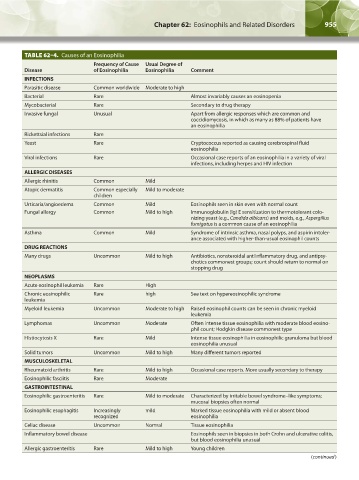
                   TABLE 62–4.  Causes of an Eosinophilia
                                          Frequency of Cause   Usual Degree of
                   Disease                of Eosinophilia  Eosinophilia   Comment
                   INFECTIONS
                   Parasitic disease      Common worldwide  Moderate to high
                   Bacterial              Rare                            Almost invariably causes an eosinopenia
                   Mycobacterial          Rare                            Secondary to drug therapy
                   Invasive fungal        Unusual                         Apart from allergic responses which are common and
                                                                          coccidiomycosis, in which as many as 88% of patients have
                                                                          an eosinophilia
                   Rickettsial infections  Rare
                   Yeast                  Rare                            Cryptococcus reported as causing cerebrospinal fluid
                                                                          eosinophilia
                   Viral infections       Rare                            Occasional case reports of an eosinophilia in a variety of viral
                                                                          infections, including herpes and HIV infection
                   ALLERGIC DISEASES
                   Allergic rhinitis      Common           Mild
                   Atopic dermatitis      Common especially   Mild to moderate
                                          children
                   Urticaria/angioedema   Common           Mild           Eosinophils seen in skin even with normal count
                   Fungal allergy         Common           Mild to high   Immunoglobulin (Ig) E sensitization to thermotolerant colo-
                                                                          nizing yeast (e.g., Candida albicans) and molds, e.g., Aspergillus
                                                                          fumigatus is a common cause of an eosinophilia
                   Asthma                 Common           Mild           Syndrome of intrinsic asthma, nasal polyps, and aspirin intoler-
                                                                          ance associated with higher-than-usual eosinophil counts
                   DRUG REACTIONS
                   Many drugs             Uncommon         Mild to high   Antibiotics, nonsteroidal antiinflammatory drug, and antipsy-
                                                                          chotics commonest groups; count should return to normal on
                                                                          stopping drug
                   NEOPLASMS
                   Acute eosinophil leukemia  Rare         High
                   Chronic eosinophilic   Rare             high           See text on hypereosinophilic syndrome
                   leukemia
                   Myeloid leukemia       Uncommon         Moderate to high  Raised eosinophil counts can be seen in chronic myeloid
                                                                          leukemia
                   Lymphomas              Uncommon         Moderate       Often intense tissue eosinophilia with moderate blood eosino-
                                                                          phil count; Hodgkin disease commonest type
                   Histiocytosis X        Rare             Mild           Intense tissue eosinophilia in eosinophilic granuloma but blood
                                                                          eosinophilia unusual
                   Solid tumors           Uncommon         Mild to high   Many different tumors reported
                   MUSCULOSKELETAL
                   Rheumatoid arthritis   Rare             Mild to high   Occasional case reports. More usually secondary to therapy
                   Eosinophilic fasciitis  Rare            Moderate
                   GASTROINTESTINAL
                   Eosinophilic gastroenteritis  Rare      Mild to moderate  Characterized by irritable bowel syndrome–like symptoms;
                                                                          mucosal biopsies often normal
                   Eosinophilic esophagitis  Increasingly   mild          Marked tissue eosinophilia with mild or absent blood
                                          recognized                      eosinophilia
                   Celiac disease         Uncommon         Normal         Tissue eosinophilia
                   Inflammatory bowel disease                             Eosinophils seen in biopsies in both Crohn and ulcerative colitis,
                                                                          but blood eosinophilia unusual
                   Allergic gastroenteritis  Rare          Mild to high   Young children
                                                                                                                   (continued )


          Kaushansky_chapter 62_p0947-0964.indd   955                                                                   9/21/15   10:56 AM

