


Page 1237 - Clinical Immunology_ Principles and Practice ( PDFDrive )
P. 1237
CHaPTEr 89  Biological Modifiers of Inflammatory Diseases              1199


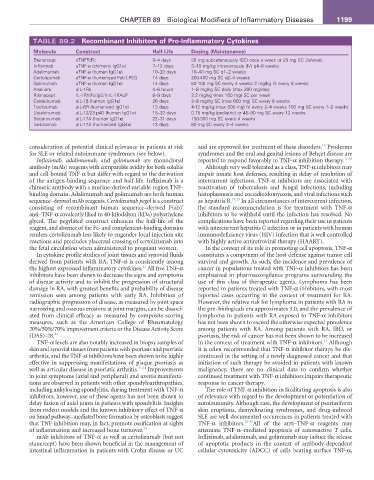
            TABLE 89.2  recombinant Inhibitors of Pro-Inflammatory Cytokines
            Molecule      Construct                Half-Life    Dosing (Maintenance)
            Etanercept    sTNFR:Fc                 3–4 days     50 mg subcutaneously (SC) once a week or 25 mg SC 2x/week
            Infliximab    aTNF-α (chimeric IgG1κ)  7–12 days    3–10 mg/kg intravenously (IV) q4–8 weeks
            Adalimumab    aTNF-α (human IgG1κ)     10–20 days   10–40 mg SC q1–2 weeks
            Certolizumab  aTNF-α (humanized Fab’)-PEG  14 days  200-400 mg SC q2–4 weeks
            Golimumab     aTNF-α (human IgG1κ)     14 days      50-100 mg SC every 4 weeks 2 mg/kg IV every 8 weeks
            Anakinra      sIL-1Ra                  4–6 hours    1–8 mg/kg SC daily (max 200 mg/day)
            Rilonacept    IL-1R1:Fc(IgG1):IL-1RAcP  8–9 days    2.2 mg/kg (max 160 mg) SC per week
            Canakinumab   aIL-1β (human IgG1κ)     26 days      2–8 mg/kg SC (max 600 mg) SC every 8 weeks
            Tocilizumab   aIL-6R (humanized IgG1κ)  13 days     4-12 mg/kg (max 800 mg) IV every 2–4 weeks 160 mg SC every 1–2 weeks
            Ustekinumab   aIL-12/23 p40 (human IgG1κ)  15–32 days  0.75 mg/kg (pediatric) or 45–90 mg SC every 12 weeks
            Secukinumab   aIL-17A (human IgG1κ)    22–31 days   150-300 mg SC every 4 weeks
            Ixekizumab    aIL-17A (humanized IgG4κ)  13 days    80 mg SC every 2–4 weeks


                                                                                                          16
           consideration of potential clinical relevance in patients at risk   and are approved for treatment of these disorders.  Pyoderma
           for SLE or related autoimmune syndromes (see below).   syndromes and the oral and genital lesions of Behçet disease are
             Infliximab, adalimumab, and  golimumab are monoclonal   reported to respond favorably to TNF-α inhibition therapy. 17,18
           antibody (mAb) reagents with comparable avidity for both soluble   Although very well tolerated as a class, TNF-α inhibitors may
           and cell-bound TNF-α but differ with regard to the derivation   impair innate host defenses, resulting in delay of resolution of
           of the antigen-binding sequence and half-life. Infliximab is a   intercurrent infections. TNF-α inhibitors are associated with
           chimeric antibody with a murine-derived variable-region TNF-  reactivation of tuberculosis and fungal infections, including
           binding domain. Adalimumab and golimumab are both human   histoplasmosis and coccidioidomycosis, and viral infections such
           sequence–derived mAb reagents. Certolizumab pegol is a construct   as hepatitis B. 19,20  In all circumstances of intercurrent infection,
           consisting of recombinant human sequence–derived F(ab)’   the standard recommendation is for treatment with  TNF-α
           anti–TNF-α covalently liked to 40-kilodalton (kDa) polyethylene   inhibitors to be withheld until the infection has resolved. No
           glycol. The pegylated construct enhances the half-life of the   complications have been reported regarding their use in patients
           reagent, and absence of the Fc- and complement-binding domains   with intercurrent hepatitis C infection or in patients with human
           renders certolizumab less likely to engender local injection site   immunodeficiency virus (HIV) infection that is well controlled
           reactions and precludes placental crossing of certolizumab into   with highly active antiretroviral therapy (HAART).
           the fetal circulation when administered to pregnant women.  In the context of its role in promoting cell apoptosis, TNF-α
             In cytokine profile studies of joint tissues and synovial fluids   constitutes a component of the host defense against tumor cell
           derived from patients with RA, TNF-α is consistently among   survival and growth. As such, the incidence and prevalence of
                                                11
           the highest expressed inflammatory cytokines.  All five TNF-α   cancer in populations treated with TNF-α inhibitors has been
           inhibitors have been shown to decrease the signs and symptoms   emphasized in pharmacovigilance programs surrounding the
           of disease activity and to inhibit the progression of structural   use of this class of therapeutic agents. Lymphoma has been
           damage in RA, with greatest benefits and probability of disease   reported in patients treated with TNF-α inhibitors, with most
           remission seen among patients with early RA. Inhibition of   reported cases occurring in the context of treatment for RA.
           radiographic progression of disease, as measured by joint space   However, the relative risk for lymphoma in patients with RA in
           narrowing and osseous erosions at joint margins, can be dissoci-  the pre–biologicals era approximates 3.0, and the prevalence of
           ated from clinical efficacy as measured by composite scoring   lymphoma in patients with RA exposed to TNF-α inhibitors
           measures, such as the  American College of Rheumatology   has not been shown to exceed the otherwise expected prevalence
           20%/50%/70% improvement criteria or the Disease Activity Score   among patients with RA.  Among patients with RA, IBD, or
           (DAS)-28. 12                                           psoriasis, the risk of cancer has not been shown to be increased
                                                                                                           21
             TNF-α levels are also notably increased in biopsy samples of   in the context of treatment with TNF-α inhibitors.  Although
           skin and synovial tissues from patients with psoriasis and psoriatic   it is often recommended that TNF-α inhibitor therapy be dis-
           arthritis, and the TNF-α inhibitors have been shown to be highly   continued in the setting of a newly diagnosed cancer and that
           effective in suppressing manifestations of plaque psoriasis as   initiation of such therapy be avoided in patients with known
           well as articular disease in psoriatic arthritis. 13,14  Improvements   malignancy, there are no clinical data to confirm whether
           in joint symptoms (axial and peripheral) and uveitis manifesta-  continued treatment with TNF-α inhibitors impairs therapeutic
           tions are observed in patients with other spondyloarthropathies,   response to cancer therapy.
           including ankylosing spondylitis, during treatment with TNF-α   The role of TNF-α inhibition in facilitating apoptosis is also
           inhibitors; however, use of these agents has not been shown to   of relevance with regard to the development or potentiation of
           delay fusion of axial joints in patients with spondylitis. Insights   autoimmunity. Although rare, the development of psoriasiform
           from rodent models and the known inhibitory effect of TNF-α   skin  eruptions,  demyelinating  syndromes,  and  drug-induced
           on Smad pathway–mediated bone formation by osteoblasts suggest   SLE are well documented occurrences in patients treated with
           that TNF inhibition may, in fact, promote ossification at sights   TNF-α inhibitors. 22-24 All  of the  anti–TNF-α  reagents may
           of inflammation and increased bone turnover. 15        attenuate TNF-α–mediated apoptosis of autoreactive T cells.
             mAb inhibitors of TNF-α as well as certolizumab (but not   Infliximab, adalimumab, and golimumab may induce the release
           etanercept) have been shown beneficial in the management of   of apoptotic products in the context of antibody-dependent
           intestinal inflammation in patients with Crohn disease or UC   cellular cytotoxicity (ADCC) of cells bearing surface TNF-α,

