


Page 1269 - Clinical Immunology_ Principles and Practice ( PDFDrive )
P. 1269
CHaPtEr 91  Immunotherapy of Allergic Disease              1229


           there are group effects, there is no direct relationship to clinical   factors to consider are the potential risks of emergency treat-
           efficacy in individuals.                               ment with epinephrine and medical contraindications to VIT
                                                                  (see below). Large local reactions to stings are not regarded as
           SIT for Venom Anaphylaxis                              indications for VIT, as they are not life-threatening and do not
           Anaphylaxis to Hymenoptera venom is relatively rare but can   predict future problems, but there is some evidence they can be
           be fatal. Venom-specific IgE antibodies can be found in 30–40%   attenuated by VIT. 6
           of adults for a few months following a sting, but usually these   VIT accelerates the process of risk reduction and confers rapid
           disappear subsequently. Some individuals develop high concentra-  protection against field and laboratory stings. There is a low risk
           tions of venom-specific antibodies, which may persist for many   of systemic reaction (≈10%) for many years after discontinuing
           years without further stings. This group of patients is at risk of   VIT. Although most reactions to stings after completing VIT are
           anaphylaxis to subsequent stings: a small number die of ana-  mild, fatalities have been reported in patients with other risk
           phylaxis each year. Fatality rates are hard to estimate, perhaps   factors (mastocytosis, severe historical reactions, systemic reaction
           10–20 deaths/year in the United States.                during VIT). This raises the question whether VIT should be
             Before embarking on venom immunotherapy (VIT), the   life long, although lifelong treatment would alter the cost–benefit
           patient needs to be carefully assessed, and some account should   analysis. In children, the chance of systemic sting reactions remains
                                                     5
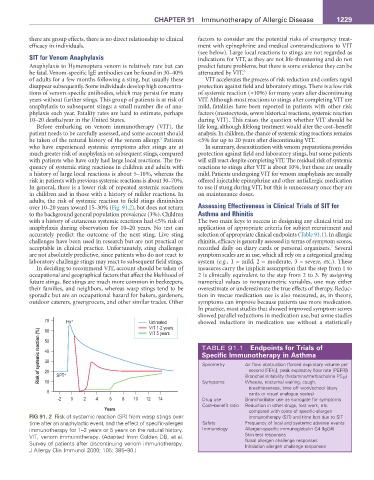
           be taken of the natural history of the venom allergy.  Patients   <5% for up to 20 years after discontinuing VIT.
           who  have  experienced  systemic  symptoms  after  stings  are  at   In summary, desensitization with venom preparations provides
           much greater risk of anaphylaxis on subsequent stings, compared   protection against field and laboratory stings, but some patients
           with patients who have only had large local reactions. The fre-  will still react despite completing VIT. The residual risk of systemic
           quency of systemic sting reactions in children and adults with   reactions to stings after VIT is about 10%, but these are usually
           a history of large local reactions is about 5–10%, whereas the   mild. Patients undergoing VIT for venom anaphylaxis are usually
           risk in patients with previous systemic reactions is about 30–70%.   offered injectable epinephrine and other antiallergic medication
           In general, there is a lower risk of repeated systemic reactions   to use if stung during VIT, but this is unnecessary once they are
           in children and in those with a history of milder reactions. In   on maintenance doses.
           adults, the risk of systemic reaction to field stings diminishes
           over 10–20 years toward 15–30% (Fig. 91.2), but does not return   Assessing Effectiveness in Clinical Trials of SIT for
           to the background general population prevalence (3%). Children   Asthma and Rhinitis
           with a history of cutaneous systemic reactions had <5% risk of   The two main keys to success in designing any clinical trial are
           anaphylaxis during observation for 10–20 years. No test can   application of appropriate criteria for subject recruitment and
           accurately predict the outcome of the next sting. Live sting   selection of appropriate clinical endpoints (Table 91.1). In allergic
           challenges have been used in research but are not practical or   rhinitis, efficacy is generally assessed in terms of symptom scores,
                                                                                                             7
           acceptable in clinical practice. Unfortunately, sting challenges   recorded daily on diary cards or personal organizers.  Several
           are not absolutely predictive, since patients who do not react to   symptom scales are in use, which all rely on a categorical grading
           laboratory challenge stings may react to subsequent field stings.  system (e.g., 1 = mild, 2 = moderate, 3 = severe, etc.). These
             In deciding to recommend VIT, account should be taken of   measures carry the implicit assumption that the step from 1 to
           occupational and geographical factors that affect the likelihood of   2 is clinically equivalent to the step from 2 to 3. By assigning
           future stings. Bee stings are much more common in beekeepers,   numerical values to nonparametric variables, one may either
           their families, and neighbors, whereas wasp stings tend to be   overestimate or underestimate the true effects of therapy. Reduc-
           sporadic but are an occupational hazard for bakers, gardeners,   tion in rescue medication use is also measured, as, in theory,
           outdoor caterers, greengrocers, and other similar trades. Other   symptoms can improve because patients use more medication.
                                                                  In practice, most studies that showed improved symptom scores
                                                                  showed parallel reductions in medication use, but some studies
                70     Hx +                       Untreated       showed reductions in medication use without a statistically
                                                  VIT 1-2 years
              Risk of systemic reaction (%)  40                    TABLE 91.1  Endpoints for trials of
                60
                                                  VIT 5 years
                50
                                                                   Specific Immunotherapy in asthma
                30
                                                                   Spirometry
                                                                                 Air flow obstruction (forced expiratory volume per
                                                                                  second [FEV 1 ], peak expiratory flow rate [PEFR])
                20
                      +
                   SPT
                                                                                 Bronchial irritability (histamine/methacholine PC 20 )
                10
                                                                                 Wheeze, nocturnal waking, cough,
                                                                   Symptoms
                                                                                  breathlessness, time off work/school (diary
                0                                                                 cards or visual analogue scales)
                    -2  0   2   4    6   8   10  12  14            Drug use      Bronchodilator use as surrogate for symptoms
                                                                   Cost–benefit ratio  Reduction in other drugs, lost work, etc.
                                   Years                                          compared with costs of specific-allergen
           FIG 91. 2  Risk of systemic reaction (SR) from wasp stings over        immunotherapy (SIT) and time lost due to SIT
           time after an anaphylactic event, and the effect of specific-allergen   Safety  Frequency of local and systemic adverse events
           immunotherapy for 1–2 years or 5 years on the natural history.   Immunology  Allergen-specific immunoglobulin G4 (IgG4)
           VIT, venom immunotherapy. (Adapted from Golden DB, et al.             Skin test responses
           Survey of patients after discontinuing venom immunotherapy.           Nasal allergen challenge responses
           J Allergy Clin Immunol 2000; 105: 385–90.)                            Inhalation allergen challenge responses

