


Page 1268 - Clinical Immunology_ Principles and Practice ( PDFDrive )
P. 1268
1228         Part tEN  Prevention and Therapy of Immunological Diseases


        MECHANISMS OF SIT                                      specific  immunoglobulin  G (IgG)  antibodies, which increase
                                                               progressively during treatment. This led to suggestions that SIT
                                                               might work by inducing antibodies that intercept the allergen
            KEY CONCEPtS                                       and “block” the allergic response. In patients treated for venom
                                                               anaphylaxis, the development of allergen-specific IgG antibody
         Possible Mechanisms of Immunotherapy                  correlates with clinical efficacy, but for other allergens, the
                                                               magnitude of the IgG response is not closely related to the degree
          •  Induction of immunoglobulin G (IgG) (blocking) antibodies  of efficacy. Moreover, the rise in IgG follows, rather than precedes,
          •  Reduction in specific IgE (long-term)
          •  Reduced recruitment of effector cells             onset of clinical benefit. Allergen-specific IgE antibodies increase
                                                                                                       3
          •  Altered T-cell cytokine balance (shift to T-helper cell-1 [Th1] from Th2)  initially, but the usual seasonal rise in IgE is blunted.  Over several
          •  T-cell anergy                                     years, the amount of allergen-specific IgE declines but does not
          •  B-cell suppression                                disappear. In keeping with this, there is little effect on immediate
                                                               skin test responses to allergen. In contrast, the late-phase skin
                                                               test response is virtually abolished after successful SIT. Similar
                                                               patterns are observed for late-phase nasal and airway responses. 4
        The primary reason for studying the mechanisms of SIT is to   SIT also affects allergen-specific T cells. In both skin and the
        identify features that are biologically important and thus to devise   nose, successful SIT is accompanied by a reduction in T-cell
        new forms of immunotherapy that may improve efficacy, increase   and eosinophil recruitment in response to allergen challenge. In
        safety margins, shorten treatment courses, or achieve more durable   parallel, the balance of T-helper cell-1 (Th1) and Th2 cytokine
        results from SIT. At least three distinct phases can be identified   expression (Chapter 16) alters at allergen-challenged sites. Th2
                                                   2
        in SIT, each with distinct immunological mechanisms.  Initially,   cytokine expression is not affected, but an increased proportion
        there is pharmacological desensitization, in which basophils and   of the recruited T cells express the Th1 cytokines interleukin-2
        mast cells are rendered tolerant of the allergen. This is achieved   (IL-2), interferon-γ (IFN-γ), and IL-12. In addition, there is induc-
        quickly, within a few days if the rush protocol is followed. Clini-  tion of allergen-specific CD4 Tregs that express CD25, FOXP3,
                                                                        2
        cally, this not only allows the patient to tolerate the maintenance   and IL-10.  IL-10 is induced within a few days of starting SIT
        dose of allergen but also protects against acute exposure to allergen   and has a number of biological effects that could explain the
        (e.g., a wasp sting). This state of pharmacological tolerance is   beneficial effects of immunotherapy. These include modulation of
        not permanent and rapidly disappears if SIT is stopped. During   IL-4–induced B-cell IgE production in favor of IgG4, inhibition of
        the first year of maintenance SIT, T-cell tolerance is achieved,   IgE-dependent mast cell activation, inhibition of human eosino-
        with abrogation of late-phase responses to allergen exposure   phil cytokine production and survival, suppression of IL-5, and
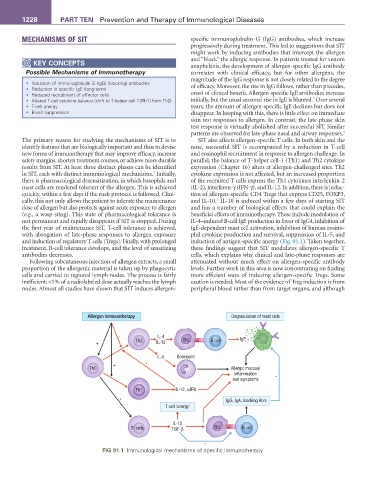
        and induction of regulatory T cells (Tregs). Finally, with prolonged   induction of antigen-specific anergy (Fig. 91.1). Taken together,
        treatment, B-cell tolerance develops, and the level of sensitizing   these findings suggest that SIT modulates allergen-specific T
        antibodies decreases.                                  cells, which explains why clinical and late-phase responses are
           Following subcutaneous injection of allergen extracts, a small   attenuated without much effect on allergen-specific antibody
        proportion of the allergenic material is taken up by phagocytic   levels. Further work in this area is now concentrating on finding
        cells and carried to regional lymph nodes. The process is fairly   more efficient ways of inducing allergen-specific Tregs. Some
        inefficient: <1% of a radiolabeled dose actually reaches the lymph   caution is needed: Most of the evidence of Treg induction is from
        nodes. Almost all studies have shown that SIT induces allergen-  peripheral blood rather than from target organs, and although


                              Allergen immunotherapy                         Degranulation of mast cells


                                        -           IL-4
                                             Th2    IL-13    Th2      B cell    IgE
                                +
                                                    IL-5   Eosinophil
                                                 -
                                      +
                              Th0                                            Allergic mucosal
                                                                              inflammation  -
                                                                      -      and symptoms
                                             Th1          IL-12, αIFN
                                                                       -
                                        +                                  IgG, IgA, blocking Ab’s
                                                       T cell ‘anergy’


                                                          IL-10
                                            Tr cells     TGF-β         Th2      B cell

                                                                    -
                                  FIG 91.1  Immunological mechanisms of specific immunotherapy.

