


Page 1328 - Clinical Immunology_ Principles and Practice ( PDFDrive )
P. 1328
CHaPtEr 95  Assessment of Human Allergic Diseases                1289


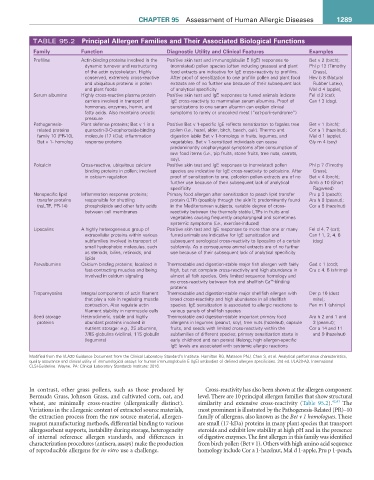
            TABLE 95.2  Principal allergen Families and their associated Biological Functions
            Family          Function                    Diagnostic Utility and Clinical Features      Examples
            Profilins       Actin-binding proteins involved in the   Positive skin test and immunoglobulin E (IgE) responses to   Bet v 2 (birch);
                             dynamic turnover and restructuring   (nonrelated) pollen species (often including grasses) and plant   Phl p 12 (Timothy
                             of the actin cytoskeleton. Highly   food extracts are indicative for IgE cross-reactivity to profilins.   Grass),
                             conserved, extremely cross-reactive   After proof of sensitization to one profilin pollen and plant food   Hev b 8 (Natural
                             and ubiquitous proteins in pollen   extracts are of no further use because of their subsequent lack   Rubber Latex),
                             and plant foods             of analytical specificity                    Mal d 4 (apple),
            Serum albumins  Highly cross-reactive plasma protein   Positive skin test and IgE responses to furred animals indicate   Fel d 2 (cat);
                             carriers involved in transport of   IgE cross-reactivity to mammalian serum albumins. Proof of   Can f 3 (dog),
                             hormones, enzymes, hemin, and   sensitizations to one serum albumin can explain clinical
                             fatty acids. Also maintains oncotic   symptoms to rarely or uncooked meat (“cat-pork-syndrome”)
                             pressure
            Pathogenesis-   Plant defense proteins; Bet v 1 is a   Positive Bet v 1-specific IgE reflects sensitization to fagales tree   Bet v 1 (birch);
             related proteins   quercetin-3-O-sophoroside-binding   pollen (i.e., hazel, alder, birch, beech, oak). Thermo and   Cor a 1 (hazelnut);
             family 10 (PR-10),   molecule (17 kDa); inflammation   digestion labile Bet v 1-homologs in fruits, legumes, and   Mal d 1 (apple);
             Bet v 1- homolog  response proteins         vegetables. Bet v 1-sensitized individuals can cause   Gly m 4 (soy)
                                                         predominantly oropharyngeal symptoms after consumption of
                                                         raw food items (i.e., pip fruits, stone fruits, tree nuts, carrots,
                                                         soy).
            Polcalcin       Cross-reactive, ubiquitous calcium   Positive skin test and IgE responses to (nonrelated) pollen   Phl p 7 (Timothy
                             binding proteins in pollen; involved   species are indicative for IgE cross-reactivity to polcalcins. After   Grass);
                             in calcium regulation       proof of sensitization to one, polcalcin pollen extracts are of no   Bet v 4 (birch);
                                                         further use because of their subsequent lack of analytical   Amb a 10 (Short
                                                         specificity                                   Ragweed)
            Nonspecific lipid   Inflammation response proteins;   Primary food allergen after sensitization to peach lipid transfer   Pru p 3 (peach);
             transfer proteins   responsible for shuttling   protein (LTP) (possibly through the skin?); predominantly found   Ara h 9 (peanut);
             (nsLTP, PR-14)  phospholipids and other fatty acids   in the Mediterranean subjects; variable degree of cross-  Cor a 8 (hazelnut)
                             between cell membranes      reactivity between the thermally stable LTPs in fruits and
                                                         vegetables causing frequently oropharyngeal and sometimes
                                                         systemic symptoms (i.e., exercise-induced)
            Lipocalins      A highly heterogeneous group of   Positive skin test and IgE responses to more than one or many   Fel d 4, 7 (cat);
                             extracellular proteins within various   furred animals are indicative for IgE sensitization and   Can f 1, 2, 4, 6
                             subfamilies involved in transport of   subsequent serological cross-reactivity to lipocalins of a certain   (dog)
                             small hydrophobic molecules, such   subfamily. As a consequence animal extracts are of no further
                             as steroids, bilins, retinoids, and   use because of their subsequent lack of analytical specificity
                             lipids
            Parvalbumins    Calcium binding proteins; localized in   Thermostable and digestion-stable major fish allergen with fairly   Gad c 1 (cod);
                             fast-contracting muscles and being   high, but not complete cross-reactivity and high abundance in   Cra c 4, 6 (shrimp)
                             involved in calcium signaling  almost all fish species. Only limited sequence homology and
                                                                                         ++
                                                         no cross-reactivity between fish and shellfish Ca -binding
                                                         proteins
            Tropomyosins    Integral components of actin filament   Thermostable and digestion-stable major shellfish allergen with   Der p 10 (dust
                             that play a role in regulating muscle   broad cross-reactivity and high abundance in all shellfish   mite);
                             contraction. Also regulate actin   species. IgE sensitization is associated to allergic reactions to   Pen m 1 (shrimp)
                             filament stability in nonmuscle cells  various panels of shellfish species
            Seed storage    Heterodimeric, stable and highly   Thermostable and digestion-stable important primary food   Ara h 2 and 1 and
             proteins        abundant proteins involved in   allergens in legumes (peanut, soy), tree nuts (hazelnut), capsule   3 (peanut);
                             nutrient storage: e.g., 2S albumins,   fruits, and seeds with limited cross-reactivity within the   Cor a 14 and 11
                             7/8S globulins (vicilins), 11S globulin   subfamilies of different species; primary sensitization starts in   and 9 (hazelnut)
                             (legumins)                  early childhood and can persist lifelong; high allergen-specific
                                                         IgE levels are associated with systemic allergic reactions
           Modified from the I/LA20 Guidance Document from the Clinical Laboratory Standard’s Institute. Hamilton RG, Matsson PNJ, Chan S, et al. Analytical performance characteristics,
           quality assurance and clinical utility of immunological assays for human immunoglobulin E (IgE) antibodies of defined allergen specificities. 3rd ed. I/LA20-A3, International
           CLSI-Guideline. Wayne, PA: Clinical Laboratory Standards Institute; 2016.


           In contrast, other grass pollens, such  as those  produced  by   Cross-reactivity has also been shown at the allergen component
           Bermuda Grass, Johnson Grass, and cultivated corn, oat, and   level. There are 10 principal allergen families that show structural
           wheat, are minimally cross-reactive (allergenically distinct).   similarity and extensive cross-reactivity (Table 95.2). 42,43  The
           Variations in the allergenic content of extracted source materials,   most prominent is illustrated by the Pathogenesis-Related (PR)–10
           the extraction process from the raw source material, allergen-  family of allergens, also known as the Bet v 1 homologues. These
           reagent manufacturing methods, differential binding to various   are small (17-kDa) proteins in many plant species that transport
           allergosorbent supports, instability during storage, heterogeneity   steroids and exhibit low stability at high pH and in the presence
           of internal reference allergen standards, and differences in   of digestive enzymes. The first allergen in this family was identified
           characterization procedures (antisera, assays) make the production   from birch pollen (Bet v 1). Others with high amino acid sequence
           of reproducible allergens for in vitro use a challenge.  homology include Cor a 1-hazelnut, Mal d 1-apple, Pru p 1-peach,

