


Page 1325 - Clinical Immunology_ Principles and Practice ( PDFDrive )
P. 1325
1286         Part ElEvEn  Diagnostic Immunology


             1000                                                    12


                                                                     10


            IgE anti-Dpt (ng/ml) 100                               Puncture skin test (wheal. mm)  8


              10                                                      6

                                                                      4


               1                                                      2
                0.1     1      10      100    1000  10 000             0.1     1      10     100    1000   10 000
                           Intradermal skin test titration                        Intradermal skin test titration
                        (ng/ml Dpt at midpoint of 8-mm wheal)                  (ng/ml Dpt at midpoint of 8-mm wheal)
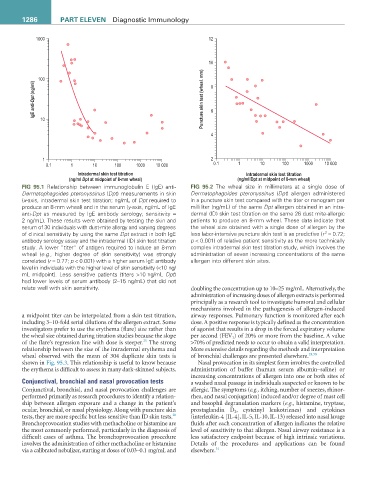
        FIG 95.1  Relationship between immunoglobulin E (IgE) anti-   FIG 95.2  The wheal size in millimeters at a single dose of
        Dermatophagoides pteronyssinus (Dpt) measurements in skin   Dermatophagoides  pteronyssinus (Dpt) allergen  administered
        (x-axis, intradermal skin test titration; ng/mL of Dpt required to   in a puncture skin test compared with the titer or nanogram per
        produce an 8-mm wheal) and in the serum (y-axis, ng/mL of IgE   milliliter (ng/mL) of the same Dpt allergen obtained in an intra-
        anti-Dpt  as  measured  by IgE  antibody  serology;  sensitivity  =   dermal (ID) skin test titration on the same 26 dust mite-allergic
        2 ng/mL). These results were obtained by testing the skin and   patients to produce an 8-mm wheal. These data indicate that
        serum of 30 individuals with dust-mite allergy and varying degrees   the wheal size obtained with a single dose of allergen by the
        of clinical sensitivity by using the same Dpt extract in both IgE   less labor-intensive puncture skin test is as predictive (r  = 0.72;
                                                                                                           2
        antibody serology assay and the intradermal (ID) skin test titration   p < 0.001) of relative patient sensitivity as the more technically
        study. A lower “titer” of antigen required to induce an 8-mm   complex intradermal skin test titration study, which involves the
        wheal (e.g., higher degree of skin sensitivity) was strongly   administration of seven increasing concentrations of the same
        correlated (r = 0.77; p < 0.001) with a higher serum IgE antibody   allergen into different skin sites.
        level in individuals with the higher level of skin sensitivity (<10 ng/
        mL midpoint). Less sensitive patients (titers  >10 ng/mL  Dpt)
        had lower levels of serum antibody (2–15 ng/mL) that did not
        relate well with skin sensitivity.                     doubling the concentration up to 10–25 mg/mL. Alternatively, the
                                                               administration of increasing doses of allergen extracts is performed
                                                               principally as a research tool to investigate humoral and cellular
                                                               mechanisms involved in the pathogenesis of allergen-induced
        a midpoint titer can be interpolated from a skin test titration,   airway responses. Pulmonary function is monitored after each
        including 3–10-fold serial dilutions of the allergen extract. Some   dose. A positive response is typically defined as the concentration
        investigators prefer to use the erythema (flare) size rather than   of agonist that results in a drop in the forced expiratory volume
        the wheal size obtained during titration studies because the slope   per second (FEV 1 ) of 20% or more from the baseline. A value
                                                25
        of the flare’s regression line with dose is steeper.  The strong   >70% of predicted needs to occur to obtain a valid interpretation.
        relationship between the size of the intradermal erythema and   More extensive details regarding the methods and interpretation
        wheal observed with the mean of 304 duplicate skin tests is   of bronchial challenges are presented elsewhere. 29,30
        shown in Fig. 95.3. This relationship is useful to know because   Nasal provocation in its simplest form involves the controlled
        the erythema is difficult to assess in many dark-skinned subjects.  administration of buffer (human serum albumin–saline) or
                                                               increasing concentrations of allergen into one or both sites of
        Conjunctival, bronchial and nasal provocation tests    a washed nasal passage in individuals suspected or known to be
        Conjunctival, bronchial, and nasal provocation challenges are   allergic. The symptoms (e.g., itching, number of sneezes, rhinor-
        performed primarily as research procedures to identify a relation-  rhea, and nasal conjugation) induced and/or degree of mast cell
        ship between allergen exposure and a change in the patient’s   and basophil degranulation markers (e.g., histamine, tryptase,
        ocular, bronchial, or nasal physiology. Along with puncture skin   prostaglandin D 2 , cysteinyl leukotrienes) and cytokines
                                                         28
        tests, they are more specific but less sensitive than ID skin tests.    (interleukin-4 [IL-4], IL-5, IL-10, IL-13) released into nasal lavage
        Bronchoprovocation studies with methacholine or histamine are   fluids after each concentration of allergen indicates the relative
        the most commonly performed, particularly in the diagnosis of   level of sensitivity to that allergen. Nasal airway resistance is a
        difficult cases of asthma. The bronchoprovocation procedure   less satisfactory endpoint because of high intrinsic variations.
        involves the administration of either methacholine or histamine   Details of the procedures and applications can be found
        via a calibrated nebulizer, starting at doses of 0.03–0.1 mg/mL and   elsewhere. 31

