


Page 1326 - Clinical Immunology_ Principles and Practice ( PDFDrive )
P. 1326
CHaPtEr 95  Assessment of Human Allergic Diseases                1287


            TABLE 95.1  Grading System for Puncture               Oral Food Challenge Tests
            and Intradermal Skin testing Using
            Histamine as a reference   a                          Oral food challenges remain the definitive test for food hyper-
                                                                  sensitivity, since in vitro and other in vivo diagnostic methods
                                                                                                    32
                                                Erythema Size     suffer from suboptimal diagnostic specificity.  They are performed
            Grade or Class  Wheal Size (mm)     (mm)              to establish an accurate diagnosis of food allergy or when skin
            Skin testing Grading System                           tests are not possible because of atopic dermatitis or allergic GI
                  0        No discernible wheal                   disease or to assess the development of tolerance to a food. Passing
                 1+        ≤3 histamine wheal                     a direct food challenge ideally permits reintroduction of the
                 2+        >3 histamine and <13                   food into the patient’s diet. Food-induced GI reactions (e.g.,
                            histamine wheal                       nausea, colic, vomiting, and diarrhea) can occur minutes to hours
                 3+        = size of histamine wheal              after the consumption of food allergens by a sensitized indi-
                            ± 1 mm                                     33
                 4+        >13 histamine wheal and                vidual.  Commonly eaten foods that contain potent allergens
                            <23 histamine wheal                   include cow milk (caseins,  β-lactoglobulin,  α-lactalbumin,
                 5+        >23 histamine wheal                    lactoferrin, and bovine serum albumin), chicken egg white
                                                                  (ovalbumin, ovomucoid, ovotransferrin), cereal grains (wheat,
            alternative Skin test Grading System for Intradermal   rye, barley, oats), legumes (peanut, soybean, white bean), and
            Skin testing Only Involving Interpretation of Wheal   fish and seafood (shrimp, crab, lobster, oyster).
            and Erythema responses †                                Diagnosis of a food allergy begins with a medical history,
                  0        <5                        <5           which includes an assessment of diet diaries and elimination
                 +/−       5–10                     5–10
                 1+        5–10                     11–20         diets, as necessary. Skin tests and serological tests for IgE antibody
                 2+        5–10                     21–30         to extracted food allergens and open food challenges with fresh
                 3+        10–15                    31–40         and cooked foods can be used to confirm sensitization to suspected
                 4+        >15 with pseudopods      41–50         foods. No evidence is available to indicate that food-specific IgG
                                                                                                         34
                                                                  or IgG4 antibody levels have any diagnostic value.  The double-
           a Prick/puncture histamine (3–10 mg/mL); ID histamine (100 µg/mL).
           (Modified from Norman PS. Skin testing. In: Middleton E, Ellis EF, Reed CE, editors.   blind placebo-controlled food challenge (DBPCFC) is considered
                                                                                                      32
           Allergy: principles and practice. 2nd ed. St. Louis: CV Mosby; 1982, with permission   the definitive diagnostic test for food allergy.  The open food
           from Elsevier.)                                        challenge has its utility in clinical practice as a first-line challenge
                                                                  procedure as it is easier than DBPCFCs. Moreover, they are
                                                                  especially useful when the probability of a negative challenge is
                                                                  high, since a negative open challenge result can obviate the need
                60                                                for a DBPCFC and it reduces anxiety and thus reduces the risk
                     n = 304 duplicate skin tests
                55   Norman Grading Scheme                        of bias in infants and young adults. An extensive discussion of
                50                                                open challenges, DBPCFCs, and variables that influence their
                                                                                            32,33
                                                                  outcome is presented elsewhere.
                                                                    In 2001, prospectively collected sera from 100 children and
                45   4+                                           adolescents who had been previously evaluated by a skin test
              Intradermal erythema (mm)  35  3+                   (Thermo Fisher Scientific/Phadia, Uppsala, Sweden) for food-
                40
                                                                  and DBPCFC were analyzed in the ImmunoCAP autoanalyzer
                                                                                  35
                                                                  specific IgE antibody.  A diagnostic level of IgE antibody specific
                30
                                                                  for egg (7 kU/L), milk (17 kU/L), peanut (14 kU/L), and fish
                                                                  (20 kU/L) was identified, above which clinical reactivity could
                25
                     2+
                                                                  be predicted with more than 95% certainty. The study concluded
                20
                                                                  with the ImmunoCAP system, a subset of children who were
                15   1+                                           that by measuring the concentration of food-specific IgE antibody
                                                                  highly likely (>95% probability) to experience a clinical reaction
                10
                     +/–                                          to egg, milk, peanut, or fish could be identified. Importantly, this
                 5                                                study and others subsequently have shown that judicious use
                    0 +/–   1+    2+      3+        4+            of quantitative serological measurements for food-specific IgE
                 0                                                antibody as measured by ImmunoCAP may be able to eliminate
                   0   2   4   6   8  10  12  14  16  18  20      the need for time-consuming DBPCFCs in a significant number
                               Intradermal wheal (mm)             of children who are suspected of having food allergy. The relation-
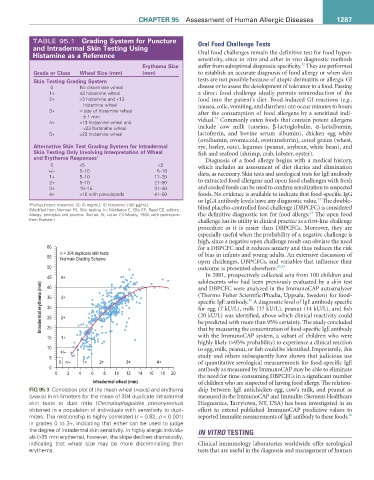
           FIG 95.3  Correlation plot of the mean wheal (x-axis) and erythema   ship between IgE antichicken egg, cow’s milk, and peanut as
           (y-axis) in millimeters for the mean of 304 duplicate intradermal   measured in the ImmunoCAP and Immulite (Siemens Healthcare
           skin  tests  to  dust mite  (Dermatophagoides  pteronyssinus)   Diagnostics, Tarrytown, NY, USA) has been investigated in an
           obtained in a population of individuals with sensitivity to dust-  effort to extend published ImmunoCAP predictive values to
           mites. The relationship is highly correlated (r = 0.82; p < 0.001)   reported Immulite measurements of IgE antibody to these foods. 36
           in grades 0 to 3+, indicating that either can be used to judge
           the degree of intradermal skin sensitivity. In highly allergic individu-  IN VITRO TESTING
           als (>35 mm erythema), however, the slope declines dramatically,
           indicating that wheal size may be more discriminating than   Clinical immunology laboratories worldwide offer serological
           erythema.                                              tests that are useful in the diagnosis and management of human

