


Page 154 - Clinical Immunology_ Principles and Practice ( PDFDrive )
P. 154
136          ParT ONE  Principles of Immune Response


                 22
        infections.  A monoclonal anti-IFN-γ antibody, fontolizumab,
        is being studied in the treatment of autoimmune diseases.
           Interleukin-10 and related cytokines.  The major function
        of IL-10 is to serve as an antiinflammatory and immunosup-                  JAK    JAK
        pressive cytokine. Unlike other cytokines in this family, it is a          P  P   P    P
        disulfide-linked dimer. A single IL-10R has been cloned, but the            STAT
        receptor may have additional components. IL-10R is expressed on
        macrophages, mast cells, and most other hematopoietic cells. It is
        also inducible in nonhematopoietic cells by stimuli, such as LPS.
           IL-10 strongly inhibits the production of proinflammatory                          STAT
        cytokines. It inhibits macrophage antigen presentation and                            P  P
        decreases expression of MHC class II, adhesion molecules, and                         STAT
        the costimulatory molecules CD80 (B7.1) and CD86 (B7.2). The
        importance of IL-10 as an endogenous inhibitor of cell-mediated
        immunity is emphasized by the finding that IL-10–deficient mice
        develop autoimmune disease, which manifests with severe IBD                  P
        and exaggerated inflammatory responses. Humans with mutations               STAT  P  STAT  Target genes
        of the IL10 and IL10R genes suffer from IBD.
           IL-10 is made by T cells, B cells, macrophages, keratinocytes,
        bronchial  epithelial  cells,  and  other  cells.  LPS  and  TNF  are
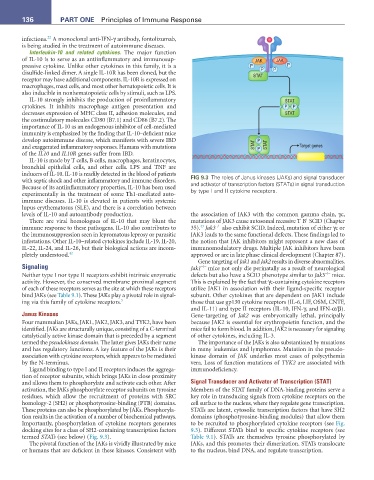
        inducers of IL-10. IL-10 is readily detected in the blood of patients   FIG 9.3  The roles of Janus kinases (JAKs) and signal transducer
        with septic shock and other inflammatory and immune disorders.   and activator of transcription factors (STATs) in signal transduction
        Because of its antiinflammatory properties, IL-10 has been used   by type I and II cytokine receptors.
        experimentally in the treatment of some Th1-mediated auto-
        immune diseases. IL-10 is elevated in patients with systemic
        lupus erythematosus (SLE), and there is a correlation between
        levels of IL-10 and autoantibody production.           the association of JAK3 with the common gamma chain,  γc,
                                                                                                   − +
           There are viral homologues of IL-10 that may blunt the   mutations of JAK3 cause autosomal recessive T B  SCID (Chapter
                                                                        −/−
                                                                   43
        immune response to these pathogens. IL-10 also contributes to   35).  Jak3  also exhibit SCID. Indeed, mutation of either γc or
        the immunosuppression seen in lepromatous leprosy or parasitic   JAK3 leads to the same functional defects. These findings led to
        infestations. Other IL-10–related cytokines include IL-19, IL-20,   the notion that JAK inhibitors might represent a new class of
        IL-22, IL-24, and IL-26, but their biological actions are incom-  immunomodulatory drugs. Multiple JAK inhibitors have been
        pletely understood. 42                                 approved or are in late phase clinical development (Chapter 87).
                                                                  Gene targeting of Jak1 and Jak2 results in diverse abnormalities.
        Signaling                                              Jak1  mice not only die perinatally as a result of neurological
                                                                   −/−
                                                                                                           −/−
        Neither type I nor type II receptors exhibit intrinsic enzymatic   defects but also have a SCID phenotype similar to Jak3  mice.
        activity. However, the conserved membrane proximal segment   This is explained by the fact that γc-containing cytokine receptors
        of each of these receptors serves as the site at which these receptors   utilize JAK1 in association with their ligand-specific receptor
        bind JAKs (see Table 9.1). These JAKs play a pivotal role in signal-  subunit. Other cytokines that are dependent on JAK1 include
        ing via this family of cytokine receptors. 5           those that use gp130 cytokine receptors (IL-6, LIF, OSM, CNTF,
                                                               and IL-11) and type II receptors (IL-10, IFN-γ, and IFN-α/β).
        Janus Kinases                                          Gene-targeting of  Jak2 was embryonically lethal, principally
        Four mammalian JAKs, JAK1, JAK2, JAK3, and TYK2, have been   because JAK2 is essential for erythropoietin function, and the
        identified. JAKs are structurally unique, consisting of a C-terminal   mice fail to form blood. In addition, JAK2 is necessary for signaling
        catalytically active kinase domain that is preceded by a segment   of other cytokines, including IL-3.
        termed the pseudokinase domain. The latter gives JAKs their name   The importance of the JAKs is also substantiated by mutations
        and has regulatory functions. A key feature of the JAKs is their   in many leukemias and lymphomas. Mutation in the pseudo-
        association with cytokine receptors, which appears to be mediated   kinase domain of  JAK underlies most cases of polycythemia
        by the N-terminus.                                     vera. Loss of function mutations of TYK2 are associated with
           Ligand binding to type I and II receptors induces the aggrega-  immunodeficiency.
        tion of receptor subunits, which brings JAKs in close proximity
        and allows them to phosphorylate and activate each other. After   Signal Transducer and Activator of Transcription (STAT)
        activation, the JAKs phosphorylate receptor subunits on tyrosine   Members of the STAT family of DNA-binding proteins serve a
        residues, which allow the recruitment of proteins with SRC   key role in transducing signals from cytokine receptors on the
        homology-2 (SH2) or phosphotyrosine-binding (PTB) domains.   cell surface to the nucleus, where they regulate gene transcription.
        These proteins can also be phosphorylated by JAKs. Phosphoryla-  STATs are latent, cytosolic transcription factors that have SH2
        tion results in the activation of a number of biochemical pathways.   domains (phosphotyrosine-binding modules) that allow them
        Importantly, phosphorylation of cytokine receptors generates   to be recruited to phosphorylated cytokine receptors (see Fig.
        docking sites for a class of SH2-containing transcription factors   9.3). Different STATs bind to specific cytokine receptors (see
        termed STATs (see below) (Fig. 9.3).                   Table 9.1). STATs are themselves tyrosine phosphorylated by
           The pivotal function of the JAKs is vividly illustrated by mice   JAKs, and this promotes their dimerization. STATs translocate
        or humans that are deficient in these kinases. Consistent with   to the nucleus, bind DNA, and regulate transcription.

