


Page 156 - Clinical Immunology_ Principles and Practice ( PDFDrive )
P. 156
138          ParT ONE  Principles of Immune Response


                   Receptor                    Ligand          membrane protein termed LTβ. The LTα 1 β 2  heterotrimer, also
                            TNFR1      TNF, LTα                known as mLT, is not cleaved by TACE and is thought to exist
                               FAS        FAS L                exclusively as a membrane-bound complex. mLT does not bind
                            (CD95, Apo-1)  (Apo-1L)            either of the two TNF receptors, but rather exerts its effects
                                                               on another member of the TNF receptor superfamily, the
                              NGFR                             lymphotoxin β receptor (LTβR). TNF and the two LT subunits
                               (p75)
                                                               are encoded by closely linked single-copy genes situated in
                                                               the MHC class III locus, at chromosome 6p21.3 in humans
                               DR3        TL1A
                                                               (Chapter 5).
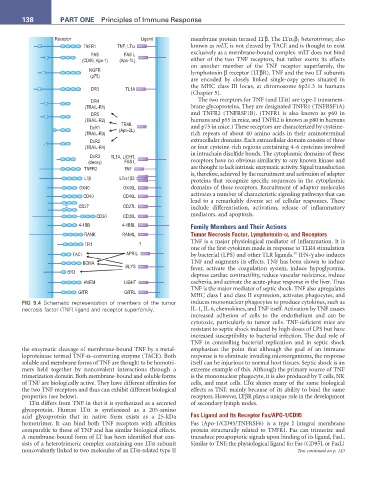
                               DR4                                The two receptors for TNF (and LTα) are type-I transmem-
                             (TRAIL-R1)                        brane glycoproteins. They are designated TNFR1 (TNFRSF1A)
                               DR5                             and TNFR2 (TNFRSF1B). (TNFR1 is also known as p60 in
                             (TRAIL-R2)                        humans and p55 in mice, and TNFR2 is known as p80 in humans
                                         TRAIL
                              DcR1      (Apo-2L)               and p75 in mice.) These receptors are characterized by cysteine-
                             (TRAIL-R3)                        rich repeats of about 40 amino acids in their aminoterminal
                              DcR2                             extracellular domains. Each extracellular domain consists of three
                             (TRAIL-R4)                        or four cysteine-rich regions containing 4–6 cysteines involved
                              DcR3   TL1A, LIGHT,              in intrachain disulfide bonds. The cytoplasmic domains of these
                              (decoy)     FAS L                receptors have no obvious similarity to any known kinase and
                             TNFR2        TNF                  are thought to lack intrinsic enzymatic activity. Signal transduction
                                                               is, therefore, achieved by the recruitment and activation of adaptor
                             LTβ        LTα1β2
                                                               proteins that recognize specific sequences in the cytoplasmic
                           OX40          OX40L                 domains of these receptors. Recruitment of adaptor molecules
                            CD40         CD40L                 activates a number of characteristic signaling pathways that can
                                                               lead to a remarkably diverse set of cellular responses. These
                       S-S  CD27         CD27L                 include differentiation, activation, release of inflammatory
                                 CD30    CD30L                 mediators, and apoptosis.
                           4-1BB         4-1BBL                Family Members and Their Actions
                             RANK        RANKL                 Tumor Necrosis Factor, Lymphotoxin-α, and Receptors
                                                               TNF is a major physiological mediator of inflammation. It is
                             TR1               ?
                                                               one of the first cytokines made in response to TLR4 stimulation
                         TACI             APRIL                by bacterial (LPS) and other TLR ligands.  IFN-γ also induces
                                                                                                 48
                            BCMA                               TNF and augments its effects. TNF has been shown to induce
                                          BLYS                 fever, activate the coagulation system, induce hypoglycemia,
                       BR3
                                                               depress cardiac contractility, reduce vascular resistance, induce
                            HVEM          LIGHT                cachexia, and activate the acute-phase response in the liver. Thus
                                                               TNF is the major mediator of septic shock. TNF also upregulates
                           GITR           GITRL
                                                               MHC class I and class II expression, activates phagocytes, and
        FIG  9.4  Schematic  representation  of  members  of  the  tumor   induces mononuclear phagocytes to produce cytokines, such as
        necrosis factor (TNF) ligand and receptor superfamily.   IL-1, IL-6, chemokines, and TNF itself. Activation by TNF causes
                                                               increased  adhesion of cells  to the endothelium  and can  be
                                                               cytotoxic, particularly to tumor cells. TNF-deficient mice are
                                                               resistant to septic shock induced by high doses of LPS but have
                                                               increased susceptibility to bacterial infection. The dual role of
                                                               TNF in controlling bacterial replication and in septic shock
        the enzymatic cleavage of membrane-bound TNF by a metal-  emphasizes the point that although the goal of an immune
        loproteinase termed TNF-α–converting enzyme (TACE). Both   response is to eliminate invading microorganisms, the response
        soluble and membrane forms of TNF are thought to be homotri-  itself can be injurious to normal host tissues. Septic shock is an
        mers held together by noncovalent interactions through a   extreme example of this. Although the primary source of TNF
        trimerization domain. Both membrane-bound and soluble forms   is the mononuclear phagocyte, it is also produced by T cells, NK
        of TNF are biologically active. They have different affinities for   cells, and mast cells. LTα shares many of the same biological
        the two TNF receptors and thus can exhibit different biological   effects as TNF, mainly because of its ability to bind the same
        properties (see below).                                receptors. However, LTβR plays a unique role in the development
           LTα differs from TNF in that it is synthesized as a secreted   of secondary lymph nodes.
        glycoprotein. Human LTα is synthesized as a 205-amino
        acid glycoprotein  that in  native form  exists as  a 25-kDa   Fas Ligand and Its Receptor Fas/APO-1/CD95
        homotrimer. It can bind both TNF receptors with affinities   Fas (Apo-1/CD95/TNFRSF6) is a type I integral membrane
        comparable to those of TNF and has similar biological effects.   protein structurally related to TNFR1. Fas can trimerize and
        A membrane-bound form of LT has been identified that con-  transduce proapoptotic signals upon binding of its ligand, FasL.
        sists of a heterotrimeric complex containing one LTα subunit   Similar to TNF, the physiological ligand for Fas (CD95L or FasL)
        noncovalently linked to two molecules of an LTα-related type II                           Text continued on p. 143

