


Page 157 - Clinical Immunology_ Principles and Practice ( PDFDrive )
P. 157
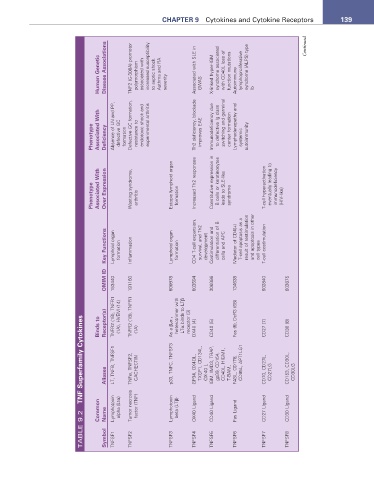
CHaPTEr 9  Cytokines and Cytokine Receptors               139


                                                                                                     Continued


                                 Human Genetic   Disease associations  TNF2 (G-308A) promotor   polymorphism   associated with   increased susceptibility   to septic shock.   Asthma and RA   severity  Associated with SLE in   GWAS  X-linked hyper-IGM   syndrome associated   with CD40L loss of   function mutations  Autoimmune   lymphoproliferative   syndrome (ALPS) type   Ib


                               Phenotype   associated With   Deficiency  Absence of LN and PP,   defective GC   formation Defective GC formation,   resistance to   endotoxic shock and   experimental arthritis  Th2 deficiency, blockade   improves EAE  Immunodeficiency due   to defective Ig class   switching and germinal   center formation  Lymphadenopathy and   systemic  autoimmunity


                               Phenotype   associated With   Over Expression  Wasting syndrome,   arthritis  Ectopic lymphoid organ   formation  Increased Th2 responses  Constitutive expression in   B cells or keratinocytes   leads to SLE-like   syndrome  T-cell hyperactivation   eventually leading to   immunodeficiency   (HIV-like)


                                    Key Functions  Lymphoid organ   formation  Inflammation  Lymphoid organ   formation  CD4 T-cell expansion,   survival, and Th2   development  Costimulation and   differentiation of B   cells and APC  Mediator of CD4(+)   T-cell apoptosis as a   result of restimulation   and apoptosis in other   cell types  T-cell costimulation


                                    OMIM ID  153440 TNFR2 (1B), TNFR1   (1A), HVEM (14)  191160 TNFR2 (1B), TNFR1   600978  heterotrimer with   LTα binds to LTβ   603594  300386  134638 Fas (6), DcR3 (6B)  602840  603875


                            TNF Superfamily Cytokines  Binds to   receptor(s)  aliases  LT, TNFB, TNFSF1  TNFα, TNFSF2,   (1A) CACHECTIN  As a β 2 α  1   p33, TNFC, TNFSF3  receptor (3)  OX40 (4) GP34, OX4OL,   TXGP1, CD134L,   OX-40 L  CD40 (5) IGM, IMD3, TRAP,   gp39, CD154,   CD40L, HIGM1,   T-BAM,  FASL, CD178,   CD95L, APT1LG1  CD27 (7) CD70, CD27L,   CD27LG  CD30 (8) CD153, CD30L,   CD30LG


                            TABLE 9.2   Common   Name  Symbol  Lymphotoxin   TNFSF1  alpha (Ltα)  Tumor necrosis   TNFSF2  factor (TNF)  Lymphotoxin   TNFSF3  beta (LTβ)  OX40 Ligand  TNFSF4  CD40 Ligand  TNFSF5  Fas Ligand  TNFSF6  CD27 Ligand  TNFSF7  CD30 Ligand  TNFSF8

