


Page 162 - Clinical Immunology_ Principles and Practice ( PDFDrive )
P. 162
144          ParT ONE  Principles of Immune Response


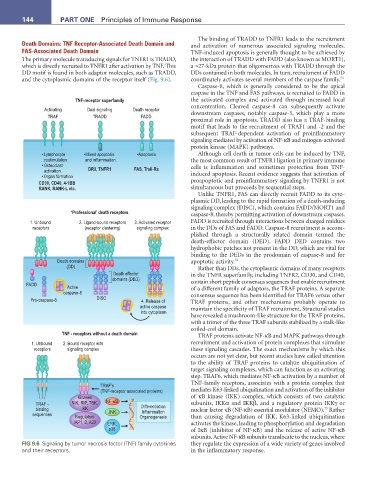
                                                                  The binding of TRADD to TNFR1 leads to the recruitment
        Death Domains: TNF Receptor-Associated Death Domain and   and activation of numerous associated signaling molecules.
        FAS-Associated Death Domain                            TNF-induced apoptosis is generally thought to be achieved by
        The primary molecule transducing signals for TNFR1 is TRADD,   the interaction of TRADD with FADD (also known as MORT1),
        which is directly recruited to TNFR1 after activation by TNF. This   a ≈27-kDa protein that oligomerizes with TRADD through the
        DD motif is found in both adaptor molecules, such as TRADD,   DDs contained in both molecules. In turn, recruitment of FADD
        and the cytoplasmic domains of the receptor itself (Fig. 9.6).  coordinately activates several members of the caspase family. 54
                                                                  Caspase-8, which is generally considered to be the apical
                                                               caspase in the TNF and FAS pathways, is recruited to FADD in
                          TNF-receptor superfamily             the activated complex and activated through increased local
                Activating    Dual signaling  Death receptor   concentration. Cleaved caspase-8 can subsequently activate
                 TRAF          TRADD           FADD            downstream caspases, notably caspase-3, which play a more
                                                               proximal role in apoptosis. TRADD also has a TRAF-binding
                                                               motif that leads to the recruitment of TRAF1 and -2 and the
                                                               subsequent TRAF-dependent activation of proinflammatory
                                                               signaling mediated by activation of NF-κB and mitogen-activated
                                                               protein kinase (MAPK) pathways.
               • Lymphocyte  •Mixed apoptosis   •Apoptosis        Although cell death in tumor cells can be induced by TNF,
                 costimulation   and inflammation              the most common result of TNFR1 ligation in primary immune
               • Osteoclast                                    cells is inflammation and sometimes protection from TNF-
                 activation   DR3, TNFR1     FAS, Trail-Rs
               • Organ formation                               induced apoptosis. Recent evidence suggests that activation of
              CD30, CD40, 4-1BB                                proapoptotic and proinflammatory signaling by TNFR1 is not
              RANK, RANK-L etc.                                simultaneous but proceeds by sequential steps.
                                                                  Unlike TNFR1, FAS can directly recruit FADD to its cyto-
                                                               plasmic DD, leading to the rapid formation of a death-inducing
                                                               signaling complex (DISC), which contains FADD/MORT1 and
                        ‘Professional’ death receptors         caspase-8, thereby permitting activation of downstream caspases.
           1. Unbound      2. Ligand-bound receptors  3. Activated receptor  FADD is recruited through interactions between charged residues
            receptors        (receptor clustering)  signaling complex  in the DDs of FAS and FADD. Caspase-8 recruitment is accom-
                                                               plished through a structurally related domain termed the
                                                               death-effector domain (DED). FADD DED contains two
                                                               hydrophobic patches not present in the DD, which are vital for
                                                               binding to the DEDs in the prodomain of caspase-8 and for
                    Death domains                              apoptotic activity. 54
                       (DD)                                       Rather than DDs, the cytoplasmic domains of many receptors
                                      Death effector           in the TNFR superfamily, including TNFR2, CD30, and CD40,
                                      domains (DED)
          FADD         Active                                  contain short peptide consensus sequences that enable recruitment
                      caspase-8                                of a different family of adaptors, the TRAF proteins. A separate
                                                               consensus sequence has been identified for TRAF6 versus other
           Pro-caspase-8         DISC          4. Release of   TRAF proteins, and other mechanisms probably operate to
                                               active caspase
                                               into cytoplasm  maintain the specificity of TRAF recruitment. Structural studies
                                                               have revealed a mushroom-like structure for the TRAF proteins,
                                                               with a trimer of the three TRAF subunits stabilized by a stalk-like
                                                               coiled-coil domain.
                     TNF - receptors without a death domain       TRAF proteins activate NF-κB and MAPK pathways through
           1. Unbound   2. Bound receptor with                 recruitment and activation of protein complexes that stimulate
            receptors  signaling complex                       these signaling cascades. The exact mechanisms by which this
                                                               occurs are not yet clear, but recent studies have called attention
                                                               to  the  ability  of  TRAF  proteins  to  catalyze  ubiquitination  of
                                                               target signaling complexes, which can function as an activating
                                                               step. TRAF6, which mediates NF-κB activation by a number of
                                  TRAF’s                       TNF-family receptors, associates with a protein complex that
                                  (TNF-receptor associated proteins)  mediates K63-linked ubiquitination and activation of the inhibitor
                          Kinases                              of  κB kinase (IKK) complex, which consists of two catalytic
             TRAF -     NIK, RIP, TBK,  NF-κB  Differentiation  subunits, IKKα and IKKβ, and a regulatory protein IKKγ or
             binding        IKK                                nuclear factor κB (NF-κB) essential modulator (NEMO).  Rather
                                                                                                           55
                                               Inflammation
            sequences     Regulators  JNK      Organogenesis   than causing degradation of IKK, K63-linked ubiquitination
                         IAP1, 2, A20  ERK,                    activates the kinase, leading to phosphorylation and degradation
                                     p38                       of IκB (inhibitor of NF-κB) and the release of active NF-κB
                                                               subunits. Active NF-κB subunits translocate to the nucleus, where
        FIG 9.6  Signaling by tumor necrosis factor (TNF) family cytokines   they regulate the expression of a wide variety of genes involved
        and their receptors.                                   in the inflammatory response.

