


Page 161 - Clinical Immunology_ Principles and Practice ( PDFDrive )
P. 161
CHaPTEr 9  Cytokines and Cytokine Receptors               143


           is synthesized as a type II membrane protein and is expressed   antibodies against CD40 with possible applications to treat
           on activated B cells, T cells, and NK cells. Fas-induced apoptosis   transplantation and autoimmune diseases have been developed. 52
           can play an essential role in the termination of T-cell responses,
           particularly in the peripheral immune system. Fas can also play   Other TNF-Family Cytokines
           a key role in the induction of cell death by cytotoxic T cells   Other members of the TNFR family play various roles in the
           (CTLs) and NK cells (Chapter 17), where it functions in conjunc-  development and function of the immune system. OX-40, CD27,
           tion with perforin. Nonapoptotic functions of FasL include   CD30, and 4-1BB can mediate costimulation of T-cell activation.
           lymphocyte costimulation and T-cell differentiation into short-  The TNF family ligand BAFF (BlyS/TALL1/TNFSF13B) promotes
           lived effector memory cells. 49,50                     B-cell maturation and antibody secretion and can bind three
                                                                  distinct receptors, TACI (TNFRSF13B), BADD-R (TNFRSF13C),
           CD40 Ligand and CD40                                   and BCMA (TNFRSF17).
           CD40 is expressed by a variety of cell types, including B cells,
           DCs, monocytes, macrophages, and endothelial cells. It plays a   Signaling
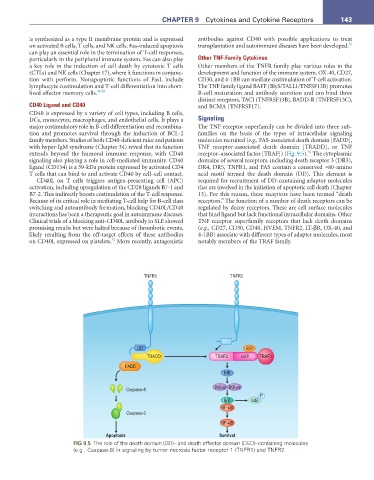
           major costimulatory role in B-cell differentiation and recombina-  The TNF receptor superfamily can be divided into three sub-
           tion and promotes survival through the induction of BCL-2   families  on  the  basis  of  the  types  of  intracellular  signaling
           family members. Studies of both CD40-deficient mice and patients   molecules recruited (e.g., FAS-associated death domain [FADD],
           with hyper-IgM syndrome (Chapter 34) reveal that its function   TNF receptor-associated death domain [TRADD], or TNF
                                                                                                      53
           extends beyond the humoral immune response, with CD40   receptor–associated factor [TRAF]) (Fig. 9.5).  The cytoplasmic
           signaling also playing a role in cell-mediated immunity. CD40   domains of several receptors, including death receptor 3 (DR3),
           ligand (CD154) is a 39-kDa protein expressed by activated CD4   DR4, DR5, TNFR1, and FAS contain a conserved ≈80-amino
           T cells that can bind to and activate CD40 by cell–cell contact.  acid motif termed the death domain (DD). This element is
             CD40L on T cells triggers antigen-presenting cell (APC)   required for recruitment of DD-containing adaptor molecules
           activation, including upregulation of the CD28 ligands B7-1 and   that are involved in the initiation of apoptotic cell death (Chapter
           B7-2. This indirectly boosts costimulation of the T-cell response.   13). For this reason, these receptors have been termed “death
           Because of its critical role in mediating T-cell help for B-cell class   receptors.” The function of a number of death receptors can be
           switching and autoantibody formation, blocking CD40L/CD40   regulated by decoy receptors. These are cell surface molecules
           interactions has been a therapeutic goal in autoimmune diseases.   that bind ligand but lack functional intracellular domains. Other
           Clinical trials of a blocking anti-CD40L antibody in SLE showed   TNF receptor superfamily receptors that lack death domains
           promising results but were halted because of thrombotic events,   (e.g., CD27, CD30, CD40, HVEM, TNFR2, LT-βR, OX-40, and
           likely resulting from the off-target effects of these antibodies   4-1BB) associate with different types of adapter molecules, most
                                      51
           on CD40L expressed on platelets.  More recently, antagonistic   notably members of the TRAF family.


                                                TNFR1                       TNFR2


                                              DD                                 RIP
                                                 TRADD                 TRAF2    cIAP  TRAF1
                                          FADD
                                                                          NIK

                                                                       IKK-α IKK-α
                                          Caspase-8
                                                                                      P
                                                                          IκB      IκB
                                                                         NF-κB
                                          Caspase-3
                                                                         NF-κB
                                    Apoptosis                            Survival
                         FIG 9.5  The role of the death domain (DD)– and death effector domain (DED)–containing molecules
                         (e.g., Caspase-8) in signaling by tumor necrosis factor receptor 1 (TNFR1) and TNFR2.

