


Page 333 - Clinical Immunology_ Principles and Practice ( PDFDrive )
P. 333
CHaPtEr 21  The Human Complement System: Basic Concepts and Clinical Relevance                     313


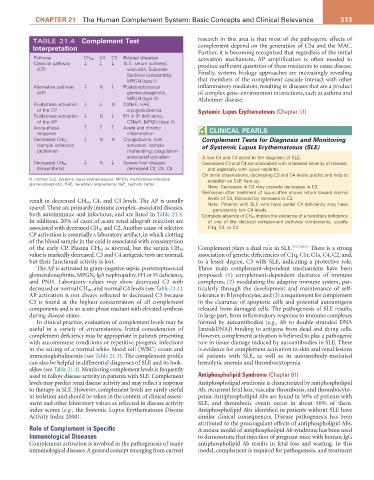
            TABLE 21.4  Complement test                           research in this area is that most of the pathogenic effects of
            Interpretation                                        complement depend on the generation of C5a and the MAC.
                                                                  Further, it is becoming recognized that regardless of the initial
            Pathway          CH 50  C4  C3  Related diseases      activation mechanism,  AP amplification is often needed to
            Classical pathway   ↓  ↓  ↓  SLE, serum sickness,     produce sufficient quantities of these mediators to cause disease.
             (CP)                          vasculitis, Subacute
                                           Bacterial Endocarditis,   Finally, systems biology approaches are increasingly revealing
                                           MPGN (type I)          that members of the complement cascade interact with other
            Alternative pathway   ↓  N  ↓  Poststreptococcal      inflammatory mediators, resulting in diseases that are a product
             (AP)                          glomerulonephritis,    of complex gene–environment interactions, such as asthma and
                                           MPGN (type II)         Alzheimer disease.
            Fluid-phase activation   ↓  ↓  N  C4NeF, HAE,
             of the CP                     cryoglobulinemia       Systemic Lupus Erythematosus (Chapter 51)
            Fluid-phase activation   ↓  N  ↓  FH or FI deficiency,
             of the AP                     C3NeF, MPGN (type II)
            Acute-phase     ↑     ↑  ↑   Acute and chronic            CLINICaL PEarLS
             response                      inflammation
            Decreased CH 50    ↓  N  N   Cryoglobulins, cold       Complement Tests for Diagnosis and Monitoring
             (sample collection            activation, sample      of Systemic Lupus Erythematosus (SLE)
             problems)                     mishandling; coagulation-
                                           associated activation   A low C4 and C3 assist in the diagnosis of SLE.
            Decreased CH 50    ↓  N  ↓   Severe liver disease;     Decreased C3 and C4 are associated with increased severity of disease,
             (biosynthetic)                decreased C3, C6, C9      and especially with lupus nephritis.
                                                                   On serial observations, decreasing C3 and C4 levels predict and help to
           N, normal; SLE, systemic lupus erythematosus; MPGN, membranoproliferative   establish an SLE flare-up.
           glomerulonephritis; HAE, hereditary angioedema; NeF, nephritic factor.
                                                                     Note: Decreases in C4 may precede decreases in C3.
                                                                   Remission after treatment of lupus often shows return toward normal
                                                                     levels of C4, followed by increases in C3.
           result in decreased CH 50 , C4, and C3 levels. The AP is usually   Note: Patients with SLE who have partial C4 deficiency may have
           spared. These are primarily immune complex–associated diseases,   persistently low C4 levels.
           both autoimmune and infectious, and are listed in Table 21.4.   Complete absence of CH 50  implies the existence of a hereditary deficiency
           In addition, 20% of cases of acute renal allograft rejection are   of one of the classical complement pathway components, usually
           associated with decreased CH 50  and C2. Another cause of selective   C1q, C4, or C2.
           CP activation is essentially a laboratory artifact, in which clotting
           of the blood sample in the cold is associated with consumption
           of the early CP. Plasma CH 50  is normal, but the serum CH 50    Complement plays a dual role in SLE. 56,57,66,67  There is a strong
           value is markedly decreased. C3 and C4 antigenic tests are normal,   association of genetic deficiencies of C1q, C1r, C1s, C4, C2, and,
           but their functional activity is lost.                 to a lesser degree, C3 with SLE, indicating a protective role.
             The AP is activated in gram-negative sepsis, poststreptococcal   Three main complement-dependent mechanisms have been
           glomerulonephritis, MPGN, IgA nephropathy, FH or FI deficiency,   proposed: (1) complement-dependent clearance of immune
           and PNH. Laboratory values may show decreased C3 with   complexes; (2) modulating the adaptive immune system, par-
           decreased or normal CH 50 , and normal C4 levels (see Table 21.4).   ticularly through the development and  maintenance of self-
           AP activation is not always reflected in decreased C3 because   tolerance in B lymphocytes; and (3) a requirement for complement
           C3 is found at the highest concentration of all complement   in the clearance of apoptotic cells and potential autoantigens
           components and is an acute-phase reactant with elevated synthesis   released from damaged cells. The pathogenesis of SLE results,
           during disease states.                                 in large part, from inflammatory response to immune complexes
             In clinical practice, evaluation of complement levels may be   formed by autoantibodies (e.g., Ab to double-stranded DNA
           useful in a variety of circumstances. Initial consideration of   [antidsDNA]) binding to antigens from dead and dying cells.
           complement deficiency may be appropriate in patients presenting   However, complement activation is believed to play a pathogenic
           with autoimmune conditions or repetitive pyogenic infections   role in tissue damage induced by autoantibodies in SLE. There
           in the setting of a normal white blood cell (WBC) count and   is evidence for complement activation in skin and renal lesions
           immunoglobulinemia (see Table 21.3). The complement profile   of  patients  with  SLE,  as  well  as in  autoantibody-mediated
           can also be helpful in differential diagnoses of SLE and its look-  hemolytic anemia and thrombocytopenia.
           alikes (see Table 21.4). Monitoring complement levels is frequently
           used to follow disease activity in patients with SLE. Complement   Antiphospholipid Syndrome (Chapter 61)
           levels may predict renal disease activity and may reflect a response   Antiphospholipid syndrome is characterized by antiphospholipid
           to therapy in SLE. However, complement levels are rarely useful   Ab, recurrent fetal loss, vascular thrombosis, and thrombocyto-
           in isolation and should be taken in the context of clinical assess-  penia. Antiphospholipid Abs are found in 50% of patients with
           ment and other laboratory values as reflected in disease activity   SLE, and thrombotic events occur in about 50% of them.
           index scores (e.g., the Systemic Lupus Erythematosus Disease   Antiphospholipid Abs identified in patients without SLE have
           Activity Index 2000).                                  similar  clinical  consequences.  Disease  pathogenesis  has  been
                                                                  attributed to the procoagulant effects of antiphospholipid Abs.
           Role of Complement in Specific                         A mouse model of antiphospholipid Ab syndrome has been used
           Immunological Diseases                                 to demonstrate that injection of pregnant mice with human IgG
           Complement activation is involved in the pathogenesis of many   antiphospholipid Ab results in fetal loss and wasting. In this
           immunological diseases. A general concept emerging from current   model, complement is required for pathogenesis, and treatment

