


Page 330 - Clinical Immunology_ Principles and Practice ( PDFDrive )
P. 330
310          Part two  Host Defense Mechanisms and Inflammation


         TABLE 21.3  Clinical Effects of Genetic Complement Deficiency
          Deficient Component    resulting Defect                     Clinical associations
          C1q, C1r, C1s, C4 or C2  Inability to activate the CP       Systemic lupus erythematosus
          Factor D, P            Inability to activate the AP         Infections, Neisseria meningitidis
          MBL, MASP-2            Decreased or absent ability to activate the LP  Recurrent childhood infections, pyogenic bacteria
          C3                     Opsonization. No MAC. No activation of AP.   Recurrent childhood infections, N. meningitidis, Streptococcus
                                  Decreased inflammation (no C3a).      pneumoniae, other encapsulated bacteria; autoimmune
                                                                        disease (uncommon)
          FH, FI, C4 and C3NeFs  Lack of regulation of fluid-phase C3 convertases,   Infections, membranoproliferative glomerulonephritis
                                  severe acquired C3 deficiency
          C5, C6, C7, C8, C9     Inability to form the MAC            Infection—recurrent, disseminated Neisserial
          Serum carboxypeptidase-N  Failure to control C3a, C5a, bradykinin  Recurrent angioedema
          C1-INH                 Loss of regulation of C1 and bradykinin  Recurrent angioedema (HAE)
          FH, FI, CD46           Decreased regulation of C3 convertases  Atypical hemolytic–uremic syndrome, age-related macular
           (haploinsufficiency)                                         degeneration*
          DAF, CD59              Failure to regulate complement activation on   Paroxysmal nocturnal hemoglobinuria (PNH)
                                  autologous cells (especially red blood cells)

        C1 INH, C1 esterase inhibitor; DAF, decay-accelerating factor; MAC, membrane attack complex; MASP, MBL-associated serine protease; MBL, mannan-binding lectin; NeF,
        nephritic factor (stabilizing autoAb to convertase); HAE, hereditary angioedema.
        *Heterozygous C3 variants that lead to a gain of function cause atypical hemolytic–uremic syndrome (aHUS), age-related macular degeneration (ARMD), and C3G.

                                                               Absence of C1q is highly associated with the development of
                       Inherited complement deficiency                                   56-59
                                                               SLE, with an incidence of 90%.   It has been proposed that
                                                               this  association  is  related to  defective  clearance of  apoptotic
                         Recurrent pyogenic infections         cells.  Apoptotic cells may be opsonized by IgM, or pentraxins,
                                                                   61
                           Autoimmune disease
                        Disseminated nesserial infections      leading to activation of the CP, which may be initiated by IgM
                             Family history                    or pentraxin (CRP and SAP). Cells can also be cleared by direct
                                                               C1q binding, leading to attachment and uptake through other
                                                                                                            52
                                                               phagocytic receptors (e.g., phosphatidylserine receptor).  Other
                                                               proposed mechanisms to account for the strong association
                  CH50 Normal             CH50 <5%
                                                               between C1 and C4 deficiency (see below) and SLE include
                                                               defective immune complex clearance and defective development
                                                               and maintenance of B-cell tolerance.
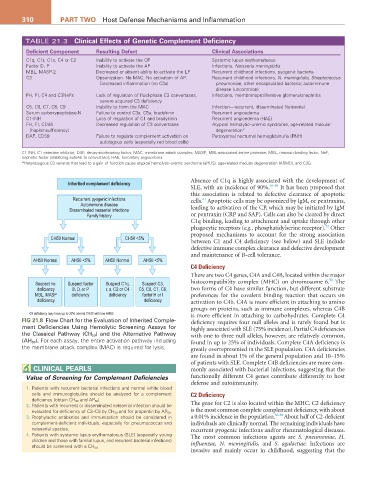
            AH50 Normal  AH50 <5%  AH50 Normal  AH50 <5%
                                                               C4 Deficiency
                                                               There are two C4 genes, C4A and C4B, located within the major
                                                                                                             58
             Suspect no   Suspect factor  Suspect C1q,  Suspect C3,  histocompatibility complex (MHC) on chromosome 6.  The
             deficiency  B, D, or P  r, s, C2 or C4  C5, C6, C7, C8,  two forms of C4 have similar function, but different substrate
            MBL, MASP   deficiency   deficiency  factor H or I  preferences for the covalent binding reaction that occurs on
             deficiency                         deficiency     activation to C4b. C4A is more efficient in attaching to amino
                                                               groups on proteins, such as immune complexes, whereas C4B
           C9 deficiency may have up to 30% normal CH50 with low AH50  is more efficient in attaching to carbohydrates. Complete C4
        FIG 21.8  Flow Chart for the Evaluation of Inherited Comple-  deficiency requires four null alleles and is rarely found but is
        ment Deficiencies Using Hemolytic Screening Assays for   highly associated with SLE (75% incidence). Partial C4 deficiencies
        the Classical Pathway (CH 50) and the Alternative Pathway   with one to three null alleles, however, are relatively common,
        (AH 50 ). For each assay, the entire activation pathway including   found in up to 25% of individuals. Complete C4A deficiency is
        the membrane attack complex (MAC) is required for lysis.   greatly overrepresented in the SLE population. C4A deficiencies
                                                               are found in about 1% of the general population and 10–15%
                                                               of patients with SLE. Complete C4B deficiencies are more com-
            CLINICaL PEarLS                                    monly associated with bacterial infections, suggesting that the
         Value of Screening for Complement Deficiencies        functionally different C4 genes contribute differently to host
                                                               defense and autoimmunity.
          1. Patients with recurrent bacterial infections and normal white blood
           cells and immunoglobulins should be analyzed for a complement   C2 Deficiency
           deficiency (obtain CH 50  and AP 50 ).
          2. Patients with recurrent or disseminated neisserial infection should be   The gene for C2 is also located within the MHC. C2 deficiency
           evaluated for deficiency of C3–C9 by CH 50  and for properdin by AP 50 .  is the most common complete complement deficiency, with about
          3. Prophylactic antibiotics and immunization should be considered in   a 0.01% incidence in the population. 56-58  About half of C2-deficient
           complement-deficient individuals, especially for pneumococcus and   individuals are clinically normal. The remaining individuals have
           neisserial species.                                 recurrent pyogenic infections and/or rheumatological diseases.
          4. Patients with systemic lupus erythematosus (SLE) (especially young   The most common infectious agents are  S. pneumoniae, H.
           children and those with familial lupus, and recurrent bacterial infections)
                                                               influenzae, N. meningitidis, and  S. agalactiae. Infections are
           should be screened with a CH 50.
                                                               invasive and mainly occur in childhood, suggesting that the

