


Page 459 - Clinical Immunology_ Principles and Practice ( PDFDrive )
P. 459
438          ParT ThrEE  Host Defenses to Infectious Agents


        ability to “autoinfect,” can maintain its lifecycle for decades.   the infection, helminths appear to reflect a harmonious host–
        Chronic infections certainly reflect an adaptation that leads to   parasite interface such that relatively asymptomatic carriers are
        “parasitism,” as mortality induced in the host would prevent   available as reservoirs for ongoing transmission. Of course, failure
        parasite transmission if the host died before larval release or egg   to establish this harmonious coexistence does occur, leading to
        production could occur. In addition to the long-lived nature of   pathological conditions exemplified by cirrhosis and portal
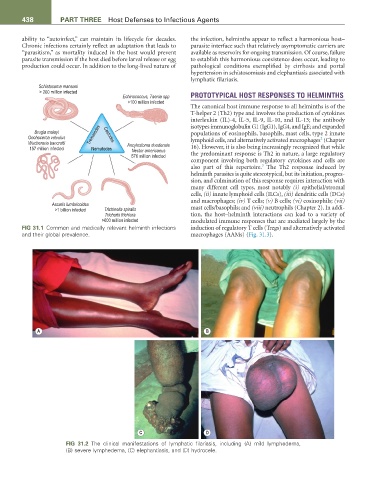
                                                               hypertension in schistosomiasis and elephantiasis associated with
                                                               lymphatic filariasis.
              Schistosoma mansoni
              > 200 million infected
                                         Echinococcus, Taenia spp  PROTOTYPICAL HOST RESPONSES TO HELMINTHS
                                           >100 million infected
                                                               The canonical host immune response to all helminths is of the
                                                               T-helper 2 (Th2) type and involves the production of cytokines
                                                               interleukin (IL)-4, IL-5, IL-9, IL-10, and IL-13; the antibody
            Brugia malayi     Trematodes  Cestodes             isotypes immunoglobulin G1 (IgG1), IgG4, and IgE; and expanded
                                                               populations of eosinophils, basophils, mast cells, type 2 innate
          Onchocerca volvulus                                  lymphoid cells, and alternatively activated macrophages  (Chapter
                                                                                                          2
          Wuchereria bancrofti             Ancylostoma duodenale
           157 million infected  Nematodes  Nector americanus  16). However, it is also being increasingly recognized that while
                                            576 million infected  the predominant response is Th2 in nature, a large regulatory
                                                               component involving both regulatory cytokines and cells are
                                                                                       3
                                                               also part of this repertoire.  The Th2 response induced by
                                                               helminth parasites is quite stereotypical, but its initiation, progres-
                                                               sion, and culmination of this response requires interaction with
                                                               many different cell types, most notably  (i) epithelial/stromal
                                                               cells, (ii) innate lymphoid cells (ILCs), (iii) dendritic cells (DCs)
                                                               and macrophages; (iv) T cells; (v) B cells; (vi) eosinophils; (vii)
                  Ascaris lumbricoides
                   >1 billion infected  Trichinella spiralis   mast cells/basophils; and (viii) neutrophils (Chapter 2). In addi-
                                   Trichuris trichiura         tion, the host–helminth interactions can lead to a variety of
                                  >600 million infected        modulated immune responses that are mediated largely by the
        FIG 31.1  Common and medically relevant helminth infections   induction of regulatory T cells (Tregs) and alternatively activated
        and their global prevalence.                           macrophages (AAMs) (Fig. 31.3).


             A                                                      B


                                               C                    D
                       FIG  31.2  The  clinical  manifestations  of  lymphatic  filariasis,  including  (A)  mild  lymphedema,
                       (B) severe lymphedema, (C) elephantiasis, and (D) hydrocele.

