


Page 626 - Clinical Immunology_ Principles and Practice ( PDFDrive )
P. 626
602          Part FIVE  Allergic Diseases


             Order                                      +\PHQRSWHUD


            Suborder                                      $SRFULWD

             Legion                                       $FXOHDWD


           Superfamily    $SRLGHD                        9HVSRLGHD                            6FROLRLGHD


             Family        $SLGDH                         9HVSLGDH                 0\UPLFLQDH           )RUPLFLGDH


            Subfamily  $SLQDH  %RPELQDH         9HVSLQDH          3ROLVWLQDH       0\UPLFLQDH           )RUPLFLQDH


             Genus     $SLV   %RPEXV   9HVSXOD  'ROLFKRYHVSXOD  9HVSD  3ROLVWHV  0\UPHFLD  6ROHQRSVLV  3RJRQRP\UPH[  )RUPLFD


             Species  $SLV    %RPEXV   9HVSXOD  '  PHGLD  9  FUDEUR  3  GRPLQXOXV  0  SLORVXOD  6  LQYLFWD  3  UXJRVXV  )  UXID
                      PHOOLIHUD  WHUUHVWULV  JHUPDQLFD  '  VD[RQLFD  9  RULHQWDOLV  3  JDOOLFXV  DQG RWKHUV  DQG RWKHUV  DQG RWKHUV  DQG RWKHUV
                      DQG RWKHUV  DQG RWKHUV  YXOJDULV  '  PDFXODWD  3  H[FODPDQV
                                       PDFXOLIURQV  '  DUHQDULD   3  IXVFDWXV
                                       DQG RWKHUV  '  V\OYHVWULV  DQG RWKHUV
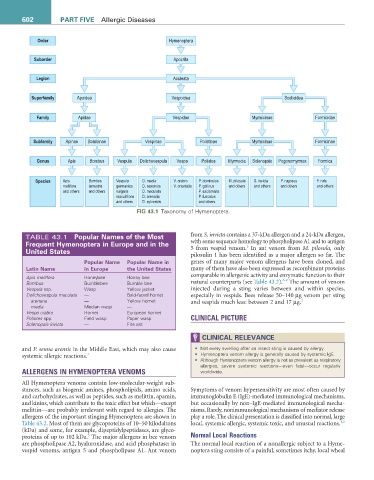
                                              FIG 43.1  Taxonomy of Hymenoptera.


         TABLE 43.1  Popular Names of the Most                 from S. invicta contains a 37-kDa allergen and a 24-kDa allergen,
         Frequent Hymenoptera in Europe and in the             with some sequence homology to phospholipase A1 and to antigen
                                                                                  3
         United States                                         5 from vespid venom.  In ant venom from  M. pilosula, only
                                                               pilosulin 1 has been identified as a major allergen so far. The
                             Popular Name   Popular Name in    genes of many major venom allergens have been cloned, and
          Latin Name         in Europe     the United States   many of them have also been expressed as recombinant proteins
          Apis mellifera     Honeybee      Honey bee           comparable in allergenic activity and enzymatic function to their
                                                                                             6-9
          Bombus             Bumblebee     Bumble bee          natural counterparts (see Table 43.2).  The amount of venom
          Vespula ssp.       Wasp          Yellow jacket       injected  during a  sting  varies  between  and  within  species,
          Dolichovespula maculata  —       Bald-faced hornet   especially in vespids. Bees release 50–140 µg venom per sting
            arenaria         —             Yellow hornet       and vespids much less: between 2 and 17 µg. 2
            media            Median wasp   —
          Vespa crabro       Hornet        European hornet
          Polistes spp.      Field wasp    Paper wasp          CLINICAL PICTURE
          Solenopsis invicta  —            Fire ant
                                                                   CLINICaL rELEVaNCE

        and P. senna arensis in the Middle East, which may also cause   •  Not every swelling after an insect sting is caused by allergy.
        systemic allergic reactions. 3                           •  Hymenoptera venom allergy is generally caused by systemic IgE.
                                                                 •  Although Hymenoptera venom allergy is not as prevalent as respiratory
                                                                   allergies,  severe systemic  reactions—even  fatal—occur  regularly
        ALLERGENS IN HYMENOPTERA VENOMS                            worldwide.

        All Hymenoptera venoms contain low-molecular-weight sub-
        stances, such as biogenic amines, phospholipids, amino acids,   Symptoms of venom hypersensitivity are most often caused by
        and carbohydrates, as well as peptides, such as melittin, apamin,   immunoglobulin E (IgE)-mediated immunological mechanisms,
        and kinins, which contribute to the toxic effect but which—except   but occasionally by non–IgE-mediated immunological mecha-
        melittin—are probably irrelevant with regard to allergies. The   nisms. Rarely, nonimmunological mechanisms of mediator release
        allergens of the important stinging Hymenoptera are shown in   play a role. The clinical presentation is classified into normal, large
        Table 43.2. Most of them are glycoproteins of 10–50 kilodaltons   local, systemic allergic, systemic toxic, and unusual reactions. 1,2
        (kDa) and some, for example, dipeptidylpeptidases, are glyco-
                              5
        proteins of up to 102 kDa.  The major allergens in bee venom   Normal Local Reactions
        are phospholipase A2, hyaluronidase, and acid phosphatase; in   The normal local reaction of a nonallergic subject to a Hyme-
        vespid venoms, antigen 5 and phospholipase A1. Ant venom   noptera sting consists of a painful, sometimes itchy, local wheal

