


Page 630 - Clinical Immunology_ Principles and Practice ( PDFDrive )
P. 630
606          Part FIVE  Allergic Diseases


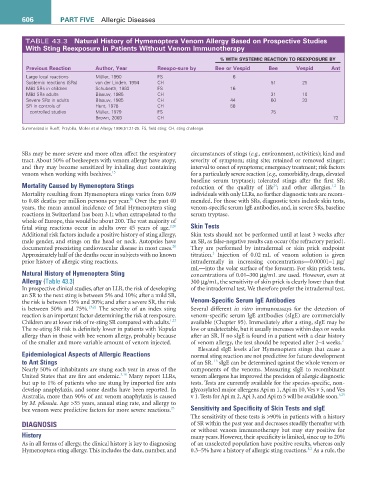
         TABLE 43.3  Natural History of Hymenoptera Venom allergy Based on Prospective Studies
         With Sting reexposure in Patients Without Venom Immunotherapy

                                                                         % WItH SYStEMIC rEaCtION tO rEEXPOSUrE BY
          Previous reaction     author, Year         reexpo-sure by    Bee or Vespid     Bee      Vespid     ant
          Large local reactions  Müller, 1990        FS                      6
          Systemic reactions (SRs)  van der Linden, 1994  CH                              51        25
          Mild SRs in children  Schuberth, 1983      FS                     16
          Mild SRs adults       Blaauw, 1985         CH                                   31        10
          Severe SRs in adults  Blaauw, 1985         CH                     44            60        33
          SR in controls of     Hunt, 1978           CH                     58
           controlled studies   Müller, 1979         FS                                   75
                                Brown, 2003          CH                                                       72

        Summarized in Rueff, Przybilla, Müller et al Allergy 1996;51:21-25. FS, field sting; CH, sting challenge.


        SRs may be more severe and more often affect the respiratory   circumstances of stings (e.g., environment, activities); kind and
        tract. About 50% of beekeepers with venom allergy have atopy,   severity of symptom; sting site; retained or removed stinger;
        and they may become sensitized by inhaling dust containing   interval to onset of symptoms; emergency treatment; risk factors
        venom when working with beehives. 15                   for a particularly severe reaction (e.g., comorbidity, drugs, elevated
                                                               baseline  serum  tryptase); tolerated  stings after  the  first SR;
        Mortality Caused by Hymenoptera Stings                 reduction  of the quality of life ; and  other allergies.  In
                                                                                                              1,2
                                                                                          24
        Mortality resulting from Hymenoptera stings varies from 0.09   individuals with only LLRs, no further diagnostic tests are recom-
                                           20
        to 0.48 deaths per million persons per year.  Over the past 40   mended. For those with SRs, diagnostic tests include skin tests,
        years, the mean annual incidence of fatal Hymenoptera sting   venom-specific serum IgE antibodies, and, in severe SRs, baseline
        reactions in Switzerland has been 3.1; when extrapolated to the   serum tryptase.
        whole of Europe, this would be about 200. The vast majority of
        fatal sting reactions occur in adults over 45 years of age. 2,20    Skin Tests
        Additional risk factors include a positive history of sting allergy,   Skin tests should not be performed until at least 3 weeks after
        male gender, and stings on the head or neck. Autopsies have   an SR, as false-negative results can occur (the refractory period).
                                                         20
        documented preexisting cardiovascular disease in most cases.    They are performed by intradermal or skin prick endpoint
                                                                       2
        Approximately half of the deaths occur in subjects with no known   titration.   Injection  of  0.02 mL  of  venom solution  is  given
        prior history of allergic sting reactions.             intradermally in increasing concentrations—0.00001–1 µg/
                                                               mL—into the volar surface of the forearm. For skin prick tests,
        Natural History of Hymenoptera Sting                   concentrations of 0.01–300 µg/mL are used. However, even at
        Allergy (Table 43.3)                                   300 µg/mL, the sensitivity of skin prick is clearly lower than that
        In prospective clinical studies, after an LLR, the risk of developing   of the intradermal test. We therefore prefer the intradermal test.
        an SR to the next sting is between 5% and 10%; after a mild SR,
        the risk is between 15% and 30%; and after a severe SR, the risk   Venom-Specific Serum IgE Antibodies
        is between 50% and 75%. 13,21  The severity of an index sting   Several different  in vitro immunoassays for the detection of
        reaction is an important factor determining the risk at reexposure.   venom-specific serum IgE antibodies (sIgE) are commercially
                                                         1,22
        Children are at lower risk of re-sting SR compared with adults.    available (Chapter 95). Immediately after a sting, sIgE may be
        The re-sting SR risk is definitely lower in patients with Vespula   low or undetectable, but it usually increases within days or weeks
        allergy than in those with bee venom allergy, probably because   after an SR. If no sIgE is found in a patient with a clear history
        of the smaller and more variable amount of venom injected.  of venom allergy, the test should be repeated after 2–4 weeks. 2
                                                                  Elevated sIgE levels after Hymenoptera stings that cause a
        Epidemiological Aspects of Allergic Reactions          normal sting reaction are not predictive for future development
        to Ant Stings                                          of an SR.   sIgE can be determined against the whole venom or
                                                                       13
        Nearly 50% of inhabitants are stung each year in areas of the   components of the venoms. Measuring sIgE to recombinant
        United States that are fire ant endemic. 3,10  Many report LLRs,   venom allergens has improved the precision of allergic diagnostic
        but up to 1% of patients who are stung by imported fire ants   tests. Tests are currently available for the species-specific, non-
        develop anaphylaxis, and some deaths have been reported. In   glycosylated major allergens Api m 1, Api m 10, Ves v 5, and Ves
        Australia, more than 90% of ant venom anaphylaxis is caused   v 1. Tests for Api m 2, Api 3, and Api m 5 will be available soon. 6,25
        by M. pilosula. Age >35 years, annual sting rate, and allergy to
        bee venom were predictive factors for more severe reactions. 23  Sensitivity and Specificity of Skin Tests and sIgE
                                                               The sensitivity of these tests is >90% in patients with a history
        DIAGNOSIS                                              of SR within the past year and decreases steadily thereafter with
                                                               or without venom immunotherapy but may stay positive for
        History                                                many years. However, their specificity is limited, since up to 20%
        As in all forms of allergy, the clinical history is key to diagnosing   of an unselected population have positive results, whereas only
                                                                                                      1,2
        Hymenoptera sting allergy. This includes the date, number, and   0.3–5% have a history of allergic sting reactions.  As a rule, the

