


Page 646 - Clinical Immunology_ Principles and Practice ( PDFDrive )
P. 646
CHaPter 44  Atopic and Contact Dermatitis              621


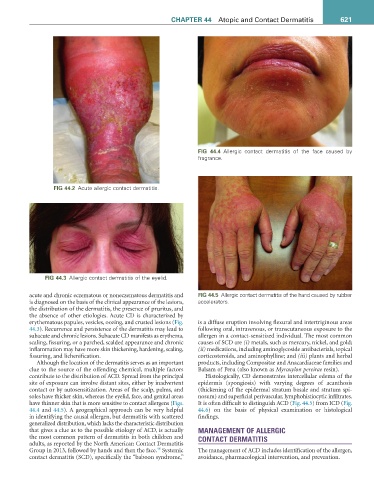
                                                                  fiG 44.4  Allergic contact dermatitis of the face caused by
                                                                  fragrance.


                   fiG 44.2  Acute allergic contact dermatitis.


                fiG 44.3  Allergic contact dermatitis of the eyelid.


           acute and chronic eczematous or noneczematous dermatitis and   fiG 44.5  Allergic contact dermatitis of the hand caused by rubber
           is diagnosed on the basis of the clinical appearance of the lesions,   accelerators.
           the distribution of the dermatitis, the presence of pruritus, and
           the absence of other etiologies. Acute CD is characterized by
           erythematous papules, vesicles, oozing, and crusted lesions (Fig.   is a diffuse eruption involving flexural and intertriginous areas
           44.3). Recurrence and persistence of the dermatitis may lead to   following oral, intravenous, or transcutaneous exposure to the
           subacute and chronic lesions. Subacute CD manifests as erythema,   allergen in a contact-sensitized individual. The most common
           scaling, fissuring, or a parched, scalded appearance and chronic   causes of SCD are (i) metals, such as mercury, nickel, and gold;
           inflammation may have more skin thickening, hardening, scaling,   (ii) medications, including aminoglycoside antibacterials, topical
           fissuring, and lichenification.                        corticosteroids, and aminophylline; and (iii) plants and herbal
             Although the location of the dermatitis serves as an important   products, including Compositae and Anacardiaceae families and
           clue to the source of the offending chemical, multiple factors   Balsam of Peru (also known as Myroxylon pereirae resin).
           contribute to the distribution of ACD. Spread from the principal   Histologically, CD demonstrates intercellular edema of the
           site of exposure can involve distant sites, either by inadvertent   epidermis (spongiosis) with varying degrees of acanthosis
           contact or by autosensitization. Areas of the scalp, palms, and   (thickening of the epidermal stratum basale and stratum spi-
           soles have thicker skin, whereas the eyelid, face, and genital areas   nosum) and superficial perivascular, lymphohistiocytic infiltrates.
           have thinner skin that is more sensitive to contact allergens (Figs.   It is often difficult to distinguish ACD (Fig. 44.5) from ICD (Fig.
           44.4 and  44.5). A geographical approach can be very helpful   44.6) on the basis of physical examination or histological
           in identifying the causal allergen, but dermatitis with scattered   findings.
           generalized distribution, which lacks the characteristic distribution
           that gives a clue as to the possible etiology of ACD, is actually   MANAGEMENT OF ALLERGIC
           the most common pattern of dermatitis in both children and   CONTACT DERMATITIS
           adults, as reported by the North American Contact Dermatitis
                                                    48
           Group in 2013, followed by hands and then the face.  Systemic   The management of ACD includes identification of the allergen,
           contact dermatitis (SCD), specifically the “baboon syndrome,”   avoidance, pharmacological intervention, and prevention.

