


Page 704 - Clinical Immunology_ Principles and Practice ( PDFDrive )
P. 704
678          ParT Six  Systemic Immune Diseases


        around the time of onset of symptoms—these included anti-Sm,   Susceptibility  Initiation  Propagation  (Resolution)
        anti-RNP, and to a lesser extent anti-DNA. The observation that               B             D
        one group of autoantibodies precedes symptoms in SLE and that
        another group appears coincident with the phenotype strongly          A
        suggests that the groups mark distinct events in the development                       Normal host
        of autoimmune disease. Members of the first group are likely
        markers of disease initiation; members of the second group are
        likely markers of disease propagation. The antigens targeted by
        the  immune  system  in  this  latter  phase  (i.e.,  associated  with
        clinical disease) are more likely to have some function in disease
                                                                   ‘Free energy’
        propagation, possibly through their possession of proinflamma-
        tory or adjuvant functions (see below). 6                                            Autoimmune host

            KEY CONCEPTS
         Barriers to Defining Mechanisms of Human
         Autoimmune Disease

          •  Genetic and phenotypic complexity
          •  Interval  between  initiating  events  and  development  of  diagnostic
           phenotype
          •  Challenges in quantifying human immune responses
                                                                                           C
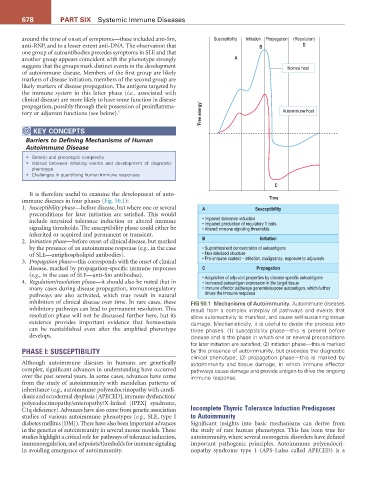
           It is therefore useful to examine the development of auto-
        immune diseases in four phases (Fig. 50.1):                                      Time
        1.  Susceptibility phase—before disease, but where one or several   A       Susceptibility
           preconditions for later initiation are satisfied. This would
           include impaired tolerance induction or altered immune   • Impaired tolerance induction
                                                                   • Impaired production of regulatory T cells
           signaling thresholds. The susceptibility phase could either be   • Altered immune signaling thresholds
           inherited or acquired and permanent or transient.
        2.  Initiation phase—before onset of clinical disease, but marked   B         Initiation
           by the presence of an autoimmune response (e.g., in the case   • Suprathreshold concentration of autoantigens
           of SLE—antiphospholipid antibodies).                    • Non-tolerized structure
        3.  Propagation phase—this corresponds with the onset of clinical   • Pro-immune context – infection, malignancy, exposure to adjuvants
           disease, marked by propagation-specific immune responses   C              Propagation
           (e.g., in the case of SLE—anti-Sm antibodies).          • Acquisition of adjuvant properties by disease specific autoantigens
        4.  Regulation/resolution phase—it should also be noted that in   • Increased autoantigen expression in the target tissue
           many cases during disease propagation, immunoregulatory   • Immune effector pathways generate/expose autoantigen, which further
           pathways are also activated, which may result in natural     drives the immune response
           inhibition of clinical disease over time. In rare cases, these   FiG 50.1  Mechanisms of Autoimmunity. Autoimmune diseases
           inhibitory pathways can lead to permanent resolution. This   result from a complex interplay of pathways and events that
           resolution phase will not be discussed further here, but its   allow autoreactivity to manifest, and cause self-sustaining tissue
           existence provides important evidence that homeostasis   damage. Mechanistically, it is useful to divide the process into
           can be reestablished even after the amplified phenotype     three phases: (1) susceptibility  phase—this  is present before
           develops.                                           disease and is the phase in which one or several preconditions
                                                               for later initiation are satisfied; (2) initiation phase—this is marked
        PHASE I: SUSCEPTIBILITY                                by the presence of autoimmunity, but precedes the diagnostic
                                                               clinical phenotype; (3) propagation phase—this is marked by
        Although autoimmune diseases in humans are genetically   autoimmunity  and tissue  damage, in which immune effector
        complex, significant advances in understanding have occurred   pathways cause damage and provide antigen to drive the ongoing
        over the past several years. In some cases, advances have come   immune response.
        from the study of autoimmunity with mendelian patterns of
        inheritance (e.g., autoimmune polyendocrinopathy with candi-
        diasis and ectodermal dysplasia [APECED], immune dysfunction/
        polyendocrinopathy/enteropathy/X-linked [IPEX] syndrome,
        C1q deficiency). Advances have also come from genetic association   Incomplete Thymic Tolerance Induction Predisposes
        studies of various autoimmune phenotypes (e.g., SLE, type I   to Autoimmunity
        diabetes mellitus [DM]). There have also been important advances   Significant insights into basic mechanisms can derive from
        in the genetics of autoimmunity in several mouse models. These   the study of rare human phenotypes. This has been true for
        studies highlight a critical role for pathways of tolerance induction,   autoimmunity, where several monogenic disorders have defined
        immunoregulation, and setpoints/thresholds for immune signaling   important pathogenic principles.  Autoimmune polyendocri-
        in avoiding emergence of autoimmunity.                 nopathy  syndrome  type  1  (APS-1;also  called  APECED)  is  a

