


Page 700 - Clinical Immunology_ Principles and Practice ( PDFDrive )
P. 700
CHaPTEr 49  Occupational Respiratory Allergies              673


                       Work and clinical history compatible with OA  the suspected occupational agent has a specificity of 97% for a
                                                                               20
                                                                  diagnosis of OA.  Although fractional concentration of expired
                                                                  nitric oxide (FeNO) levels are correlated with eosinophilic airway
                          Confirmation of asthma diagnosis        inflammation, the sensitivity of FeNO measured 24 hours after
                 (Reversible airflowlimitation and/or airway hyperresponsiveness)  exposure appears to be too low (37%) to be useful in clinical
                                                                  practice. 21

                                                                  MANAGEMENT OF OCCUPATIONAL ASTHMA
                 No evidence of asthma       Asthma
              Diagnosis of OA highly unlikely, if                 Workers with sensitizer-induced OA who continue to be exposed
                  patient still working.                          to their causal agent are at a high risk of deterioration of asthma
                                                                  symptoms, airway obstruction, and nonspecific AHR. Complete
                                                                  and definitive avoidance of exposure to the causal agent is the
                        Assessment of the relationship between asthma and work  optimal treatment for immunological OA. However, complete
                          Skin-prick tests to the suspected agent (if possible)  elimination of exposure or reassignment of affected workers to jobs
                                                                  that avoid exposure is not always possible. Reduction of exposure
                                                                  to the agent causing OA has been assessed as an alternative option
                                                                  to total avoidance. Unfortunately, this option is associated with
                      Patient off work             Patient at work  a lower likelihood of asthma improvement and a higher risk
                                                                  of worsening. Therefore this management approach should
                                                                  be restricted to selected patients and requires careful medical
                                                                  monitoring to ensure early identification of asthma worsening.
                    Consider return to work
                                                                    Small uncontrolled studies suggest that immunotherapy
                                                                  may be effective in some cases of OA caused by HMW agents.
                                                                  However, some safety concerns remain. Further studies need to
                                                                  be conducted before immunotherapy can be recommended for
               Impossible        Possible                         OA to HMW agents.
                                                                    Anti-IgE (omalizumab) may improve asthma control in
                                                                  subjects  with  flour-induced OA  who  remain  exposed  to  the
            SIC in the laboratory if  Serial monitoring of PEF ± methacholine  work environment, although further prospective investigations
                available         challenge ±, sputum eosinophil counts at  are required in subjects who choose to remain in an environment
                                    and off from work and/or SIC in the  of exposure.
                                    laboratory and/or at the workplace if
                                            available               Even in spite of complete removal from exposure to the
                                                                  offending agent, asthma symptoms and AHR to methacholine
                                                                  persist in approximately 70% of the patients with OA several
                                                                  years after removal from the offending environment. Besides
                                                                  environmental interventions, pharmacological treatment of OA
              Negative            Positive          Negative      should follow standard clinical practice guidelines for asthma.


                                Occupational      Non-work-related
                                  asthma             asthma           ON THE HOriZON
                                                                   •  Identification of new genetic markers may allow the identification of
                            Sensitizer-induced OA unlikely           subgroups with high or low risks of developing occupational asthma
                                                                     (OA).
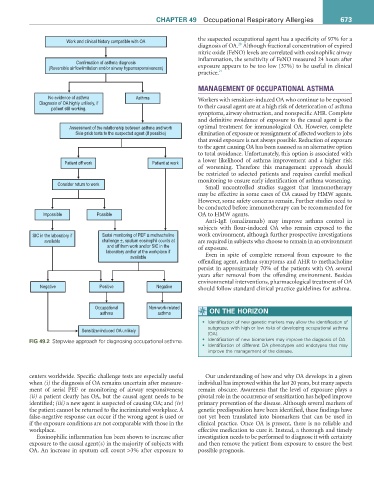
           fiG 49.2  Stepwise approach for diagnosing occupational asthma.   •  Identification of new biomarkers may improve the diagnosis of OA.
                                                                   •  Identification  of different OA  phenotypes and  endotypes that  may
                                                                     improve the management of the disease.


           centers worldwide. Specific challenge tests are especially useful   Our understanding of how and why OA develops in a given
           when (i) the diagnosis of OA remains uncertain after measure-  individual has improved within the last 20 years, but many aspects
           ment of serial PEF or monitoring of airway responsiveness;   remain obscure. Awareness that the level of exposure plays a
           (ii) a patient clearly has OA, but the causal agent needs to be   pivotal role in the occurrence of sensitization has helped improve
           identified; (iii) a new agent is suspected of causing OA; and (iv)   primary prevention of the disease. Although several markers of
           the patient cannot be returned to the incriminated workplace. A   genetic predisposition have been identified, these findings have
           false-negative response can occur if the wrong agent is used or   not yet been translated into biomarkers that can be used in
           if the exposure conditions are not comparable with those in the    clinical practice. Once OA is present, there is no reliable and
           workplace.                                             effective medication to cure it. Instead, a thorough and timely
             Eosinophilic inflammation has been shown to increase after   investigation needs to be performed to diagnose it with certainty
           exposure to the causal agent(s) in the majority of subjects with   and then remove the patient from exposure to ensure the best
           OA. An increase in sputum cell count >3% after exposure to   possible prognosis.

