


Page 727 - Clinical Immunology_ Principles and Practice ( PDFDrive )
P. 727
700          Part SIX  Systemic Immune Diseases


        This distinction between focal and diffuse CNS NPSLE and potential   for the diagnosis of CNS NPSLE syndromes that can also be
        mechanisms is essential for the development of treatment strategies.   used to monitor therapy.
        Thrombotic events associated with APL antibodies are treated   PNS NPSLE events are recognized on the basis of clinical
        with anticoagulation, whereas high-dose corticosteroids and   presentation with diagnostic studies such as electromyography
        immunosuppression in combination with neuroleptic and anti-  and peripheral nerve biopsy.
        seizure medications are generally required for treatment of diffuse   Antiphospholipid antibody syndrome is described in detail
        CNS events. Because there is no intervening BBB, peripheral nerves   in Chapter 61.
        are more accessible to circulating complement, autoantibodies,
        and inflammatory molecules, and vasculitis of epineural arteries   Drug-Induced Lupus
        is  a  common  finding  in  PNS  NPSLE.  Treatment  consists  of   Until recently, drug-induced lupus referred to a clinical syndrome
        corticosteroids and immunosuppression or intravenous immu-  characterized by constitutional, musculoskeletal symptoms and
        noglobulin (IVIG).                                     serositis that resembles mild lupus and occurs after exposure to
                                                               a number of drugs (most notably procainamide, hydralazine,
        NPSLE Assessment and Attribution                       chlorpromazine, and methyldopa). Drug-induced lupus has been
        The diagnosis of diffuse CNS NPSLE is frequently difficult, and   associated with ANA and antihistone antibodies, whereas genera-
        the clinical evaluation of a patient with presumed CNS NPSLE   tion of more specific autoantibodies such as anti-DNA antibodies
        mandates an exhaustive search for other potential causes. CSF   has been rare. Symptoms generally begin weeks to months after
        examination is useful for excluding infection or malignant cells.   initiation of the inciting therapeutic agent and resolve within
        Although CSF in NPSLE can be characterized by a lymphocytosis   weeks after the drug is discontinued; autoantibodies can persist
        and increased immunoglobulin with elevated total protein, IgG   for up to 12 months. Host factors affecting drug metabolization
        index,  and  oligoclonal  bands,  these  abnormalities  are  not   (e.g., slow acetylation of procainamide and hydralazine) contribute
        consistently present. Numerous autoantibodies (ANA, anti-  to the risk of developing drug-induced lupus. Multiple potential
        dsDNA, anticardiolipin, antiribosomal P, anti–N-methyl   mechanisms resulting in the loss of self-tolerance have been
        D-aspartate receptor [NMDAR], antineuronal, anti-RNP,   suggested for this classic model. One of the most extensively
        anti-Sm) and various cytokines have been identified in the CSF   explored is inhibition of DNA methylation with TLR activation,
        of patients with SLE; however, none is specific for active NPSLE   resulting in overexpression of costimulatory molecules such as
        or individual CNS NPSLE syndromes, and routine testing is   leukocyte function–associated antigen-1 (LFA-1) on T cells and
        not recommended. MRI is extremely sensitive for detection of   enhanced T-cell help. 74
        structural lesions and new ischemic lesions associated with focal   Since the introduction of anti-TNF agents, a different variant
        CNS NPSLE, but it is frequently not helpful in diagnosing active   of drug-induced lupus has been recognized. Up to 30% of patients
        diffuse CNS NPSLE, as MRI studies may be normal in patients   receiving  TNF  blockade  develop autoantibodies,  including  a
                                                         72
        with  psychiatric syndromes  and global CNS  dysfunction.    positive ANA and antibodies to dsDNA. A minority of patients
        Imaging studies of neuronal function, positron emission   develop anti-DNA antibodies, nephritis, and vasculitis. The
        tomography (PET), and single-photon emission computed   pathogenesis of this immunological deregulation is not known.
        tomography (SPECT) scans measuring cerebral glucose uptake
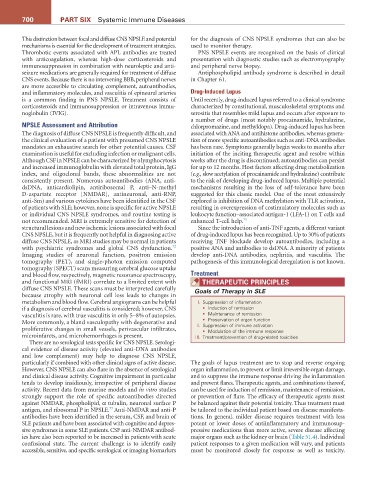
        and blood flow, respectively, magnetic resonance spectroscopy,   Treatment
        and functional MRI (fMRI) correlate to a limited extent with    tHEraPEUtIC PrINCIPLES
        diffuse CNS NPSLE. These scans must be interpreted carefully   Goals of Therapy in SLE
        because atrophy with neuronal cell loss leads to changes in
        metabolism and blood flow. Cerebral angiograms can be helpful     I.  Suppression of inflammation
        if a diagnosis of cerebral vasculitis is considered; however, CNS   •  Induction of remission
        vasculitis is rare, with true vasculitis in only 5–8% of autopsies.   •  Maintenance of remission
                                                                   •  Preservation of organ function
        More commonly, a bland vasculopathy with degenerative and    II.  Suppression of immune activation
        proliferative changes in small vessels, perivascular infiltrates,   •  Modulation of the immune response
        microinfarcts, and microhemorrhages is present.           III.  Treatment/prevention of drug-related toxicities
           There are no serological tests specific for CNS NPSLE. Serologi-
        cal evidence of disease activity (elevated anti-DNA antibodies
        and low complement) may help to diagnose CNS NPSLE,
        particularly if combined with other clinical signs of active disease.   The goals of lupus treatment are to stop and reverse ongoing
        However, CNS NPSLE can also flare in the absence of serological   organ inflammation, to prevent or limit irreversible organ damage,
        and clinical disease activity. Cognitive impairment in particular   and to suppress the immune response driving the inflammation
        tends to develop insidiously, irrespective of peripheral disease   and prevent flares. Therapeutic agents, and combinations thereof,
        activity. Recent data from murine models and in vitro studies   can be used for induction of remission, maintenance of remission,
        strongly  support  the  role  of  specific  autoantibodies  directed   or prevention of flare. The efficacy of therapeutic agents must
        against NMDAR, phospholipid, α tubulin, neuronal surface P   be balanced against their potential toxicity. Thus treatment must
                                     73
        antigen, and ribosomal P in NPSLE.  Anti-NMDAR and anti-P   be tailored to the individual patient based on disease manifesta-
        antibodies have been identified in the serum, CSF, and brain of   tions. In general, milder disease requires treatment with less
        SLE patients and have been associated with cognitive and depres-  potent or lower doses of antiinflammatory and immunosup-
        sive syndromes in some SLE patients. CSF anti-NMDAR antibod-  pressive medications than more active, severe disease affecting
        ies have also been reported to be increased in patients with acute   major organs such as the kidney or brain (Table 51.4). Individual
        confusional state. The current challenge is to identify easily   patient responses to a given medication will vary, and patients
        accessible, sensitive, and specific serological or imaging biomarkers   must be monitored closely for response as well as toxicity.

