


Page 726 - Clinical Immunology_ Principles and Practice ( PDFDrive )
P. 726
CHaPtEr 51  Systemic Lupus Erythematosus                 699


           Leukopenia                                             NPSLE Nomenclature
           Leukopenia, either neutropenia or lymphopenia, occurs in   In 1999 a consensus committee established by the ACR developed
                                                            3
                          64
           20–40% of patients.  Lymphopenia (lymphocytes <1500/mm )   reporting standards, case definitions, and recommendations for
           has a reported prevalence of 15–80%, whereas severe lympho-  laboratory and imaging studies for 19 neurological, psychiatric,
                         3
           penia (<500/mm ) occurs in 4–10% of SLE patients. The   and cognitive syndromes. Diagnosis  of NPSLE requires the
           prevalence of neutropenia, variably defined in the literature as   exclusion of infections, metabolic disturbances, bleeding disorders,
                           3
           <1800 to <2500/mm , is 20–40%, whereas severe neutropenia   malignancy, and medication toxicities. Using this nomenclature,
                    3
           (<1000/mm ) is rare (1–4% prevalence). Both neutropenia and   NPSLE is common overall, with a prevalence of 57–95%. Individu-
           lymphopenia can reflect disease activity; however, associations   ally, headache, mood disorders, cerebrovascular events, cognitive
           with infection remain controversial. Carli et al. found that   dysfunction, and seizures are frequent; polyneuropathy, demy-
           associations between leukopenia and major infection lost   elinating disease, mononeuritis, myasthenia gravis, chorea, cranial
           significance in half of published studies after controlling for   neuropathy, myelopathy, and Guillain–Barré syndrome are
           confounding factors. 64                                uncommon. NPSLE can be further subdivided into syndromes
             Autoantibodies are the pathogenic mechanism generally   occurring in the anatomically distinct central (CNS NPSLE) and
           implicated in the leukopenias. Antineutrophil antibodies directed   peripheral (PNS NPSLE) nervous systems.
           against membrane components of mature and progenitor cells,   Manifestations of CNS NPSLE include focal neurological
           resulting in decreased phagocytosis and accelerated apoptosis, are   syndromes (stroke, seizures, aseptic meningitis, movement
           implicated, as are antibodies against granulocyte–colony-stimulating   disorder, myelopathy, demyelinating syndrome) and diffuse
           factor (G-CSF) and hyposensitivity of myeloid cells to G-CSF.   psychiatric/neuropsychological syndromes (mood and anxiety
           Binding of TNF-related apoptosis-inducing ligand (TRAIL) to   disorders, psychosis, acute confusional state, cognitive dysfunction,
                                                            65
           TRAIL receptors on neutrophils accelerates neutrophil apoptosis.    headaches). PNS NPSLE syndromes include cranial neuropathy,
           One of four known TRAIL receptors is unable to transduce the   polyneuropathy, mononeuropathy, myasthenia gravis, Guillain–
           death signal and functions as a decoy receptor; this receptor is   Barre syndrome, plexopathy, and autonomic neuropathy
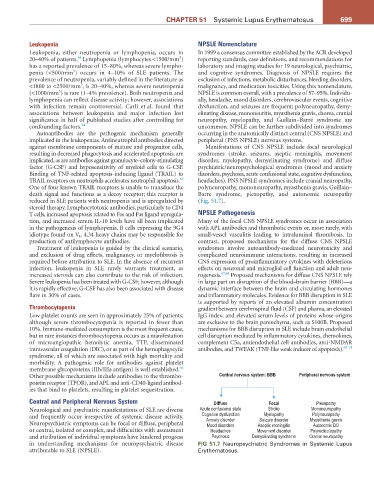
           reduced in SLE patients with neutropenia and is upregulated by   (Fig. 51.7).
           steroid therapy. Lymphocytotoxic antibodies, particularly to CD4
           T cells, increased apoptosis related to Fas and Fas ligand upregula-  NPSLE Pathogenesis
           tion, and increased serum IL-10 levels have all been implicated   Many of the focal CNS NPSLE syndromes occur in association
           in the pathogenesis of lymphopenia. B cells expressing the 9G4   with APL antibodies and thrombotic events or, more rarely, with
           idiotype found on V H  4.34 heavy chains may be responsible for   small-vessel vasculitis leading to intraluminal thrombosis. In
           production of antilymphocyte antibodies.               contrast,  proposed  mechanisms  for  the  diffuse  CNS  NPSLE
             Treatment of leukopenia is guided by the clinical scenario,   syndromes involve autoantibody-mediated neurotoxicity and
           and exclusion of drug effects, malignancy, or myelofibrosis is   complicated neuroimmune interactions, resulting in increased
           required before attribution to SLE. In the absence of recurrent   CNS expression of proinflammatory cytokines with deleterious
           infection,  leukopenia  in  SLE  rarely  warrants  treatment,  as   effects on neuronal and microglial cell function and adult neu-
           increased steroids can also contribute to the risk of infection.   rogenesis. 67,68  Proposed mechanisms for diffuse CNS NPSLE rely
           Severe leukopenia has been treated with G-CSF; however, although   in large part on disruption of the blood–brain barrier (BBB)—a
           it is rapidly effective, G-CSF has also been associated with disease   dynamic interface between the brain and circulating hormones
           flare in 30% of cases.                                 and inflammatory molecules. Evidence for BBB disruption in SLE
                                                                  is supported by reports of an elevated albumin concentration
           Thrombocytopenia                                       gradient between cerebrospinal fluid (CSF) and plasma, an elevated
           Low platelet counts are seen in approximately 25% of patients,   IgG index, and elevated serum levels of proteins whose origins
           although severe thrombocytopenia is reported in fewer than   are exclusive to the brain parenchyma, such as S100B. Proposed
           10%. Immune-mediated consumption is the most frequent cause,   mechanisms for BBB disruption in SLE include brain endothelial
           but in rare instances thrombocytopenia occurs as a manifestation   cell disruption mediated by inflammatory cytokines, chemokines,
           of microangiopathic hemolytic anemia, TTP, disseminated   complement C5a, antiendothelial cell antibodies, anti-NMDAR
           intravascular coagulation (DIC), or as part of the hemophagocytic   antibodies, and TWEAK (TNF-like weak inducer of apoptosis). 69–71
           syndrome, all of which are associated with high mortality and
           morbidity.  A pathogenic role for antibodies against platelet
                                                            66
           membrane glycoproteins (IIb/IIIa antigen) is well established.
           Other possible mechanisms include antibodies to the thrombo-  Central nervous system: BBB  Peripheral nervous system
           poietin receptor (TPOR), and APL and anti-CD40-ligand antibod-
           ies that bind to platelets, resulting in platelet sequestration.
           Central and Peripheral Nervous System                       Diffuse           Focal          Plexopathy
           Neurological and psychiatric manifestations of SLE are diverse   Acute confusional state  Stroke  Mononeuropathy
                                                                                       Myelopathy
                                                                                                       Polyneuropathy
           and frequently occur irrespective of systemic disease activity.   Cognitive dysfunction  Seizure disorder  Myasthenia gravis
                                                                    Anxiety disorder
           Neuropsychiatric symptoms can be focal or diffuse, peripheral   Mood disorders  Aseptic meningitis  Autonomic DO
           or central, isolated or complex, and difficulties with assessment   Headaches  Movement disorder  Polyradiculopathy
           and attribution of individual symptoms have hindered progress   Psychosis  Demyelinating syndrome  Cranial neuropathy
           in understanding mechanisms for neuropsychiatric disease   FIG 51.7  Neuropsychiatric Syndromes in Systemic Lupus
           attributable to SLE (NPSLE).                           Erythematosus.

