


Page 746 - Clinical Immunology_ Principles and Practice ( PDFDrive )
P. 746
718          Part SIX  Systemic Immune Diseases


        genetic markers, such as HLA-DRB1 SE, have not contributed   that intensive treatment when combined with intensive control
        dramatically to risk estimates.                        most convincingly influences outcome measures, including clinical
                                                               response, retention, functional status, and radiographic progres-
        TREATMENT                                              sion. The benefits of tight control have been substantiated in
                                                               many subsequent clinical trials as well as in “real life” clinical
        Disease-Modifying Antirheumatic Drugs                  practice. 45,46
            tHEraPEUtIC PrINCIPLES
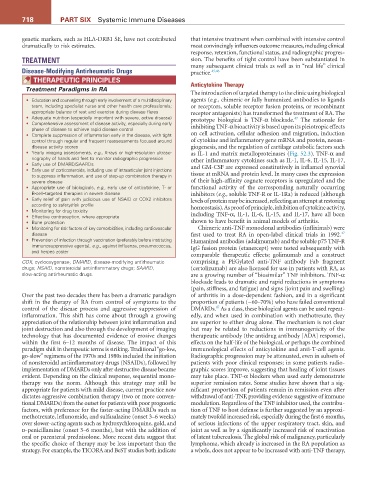
         Treatment Paradigms in RA                             Anticytokine Therapy
                                                               The introduction of targeted therapy to the clinic using biological
          •  Education and counseling through early involvement of a multidisciplinary   agents (e.g., chimeric or fully humanized antibodies to ligands
           team, including specialist nurse and other health care professionals;   or receptors, soluble receptor fusion proteins, or recombinant
           appropriate balance of rest and exercise during disease flares  receptor antagonists) has transformed the treatment of RA. The
          •  Adequate nutrition (especially important with severe, active disease)  prototype biological is TNF-α blockade.  The rationale for
                                                                                                 47
          •  Comprehensive assessment of disease activity, especially during early
           phase of disease to achieve rapid disease control   inhibiting TNF-α bioactivity is based upon its pleiotropic effects
          •  Complete suppression of inflammation early in the disease, with tight   on cell activation, cellular adhesion and migration, induction
           control through regular and frequent reassessments focused around   of cytokine and inflammatory gene mRNA and protein, neoan-
           disease activity scores                             giogenesis, and the regulation of cartilage catabolic factors such
          •  Yearly imaging assessments, e.g., X-rays or high-resolution ultraso-  as IL-1 and matrix metalloproteinases (Fig. 52.3). TNF-α and
           nography of hands and feet to monitor radiographic progression  other inflammatory cytokines such as IL-1, IL-6, IL-15, IL-17,
          •  Early use of DMARD/SAARDs                         and GM-CSF are expressed constitutively in inflamed synovial
          •  Early use of corticosteroids, including use of intraarticular joint injections
           to suppress inflammation, and use of step-up combination therapy in   tissue at mRNA and protein level. In many cases the expression
           severe disease                                      of their high-affinity cognate receptors is upregulated and the
          •  Appropriate use of biologicals, e.g., early use of anticytokine, T- or   functional activity of  the corresponding  naturally occurring
           B-cell–targeted therapies in severe disease         inhibitors (e.g., soluble TNF-R or IL-1Ra) is reduced (although
          •  Early relief of pain with judicious use of NSAID or COX2 inhibitors   levels of protein may be increased, reflecting an attempt at restoring
           according to safety/risk profile                    homeostasis). As proof of principle, inhibition of cytokine activity,
          •  Monitoring for drug toxicity
          •  Effective contraception, where appropriate        including  TNF-α, IL-1, IL-6, IL-15,  and IL-17,  have all  been
          •  Bone protection                                   shown to have benefit in animal models of arthritis.
          •  Monitoring for risk factors of key comorbidities, including cardiovascular   Chimeric anti-TNF monoclonal antibodies (infliximab) were
                                                                                                                 47
           disease                                             first used to treat RA in open-label clinical trials in 1992.
          •  Prevention of infection through vaccination (preferably before instituting   Humanized antibodies (adalimumab) and the soluble p75 TNF-R
           immunosuppressive agents), e.g., against influenza, pneumococcus,   IgG fusion protein (etanercept) were tested subsequently with
           and herpes zoster
                                                               comparable therapeutic effects; golimumab and a construct
        COX, cyclooxygenase; DMARD, disease-modifying antirheumatic   comprising a PEGylated anti-TNF antibody Fab fragment
        drugs; NSAID, nonsteroidal antiinflammatory drugs; SAARD,   (certolizumab) are also licensed for use in patients with RA, as
        slow-acting antirheumatic drugs.                       are a growing number of “biosimilar” TNF inhibitors. TNF-α
                                                               blockade leads to dramatic and rapid reductions in symptoms
                                                               (pain, stiffness, and fatigue) and signs (joint pain and swelling)
        Over the past two decades there has been a dramatic paradigm   of arthritis in a dose-dependent fashion, and in a significant
        shift  in  the  therapy  of  RA  from  control  of  symptoms  to  the   proportion of patients (~60–70%) who have failed conventional
                                                                        47
        control of the disease process and aggressive suppression of   DMARDs.  As a class, these biological agents can be used repeat-
        inflammation. This shift has come about through a growing   edly, and when used in combination with methotrexate, they
        appreciation of the relationship between joint inflammation and   are superior to either drug alone. The mechanism is not clear
        joint destruction and also through the development of imaging   but  may  be  related  to  reductions  in  immunogenicity  of  the
        technology that has documented evidence of erosive changes   therapeutic antibody (the antidrug antibody [ADA] response),
        within the first 6–12 months of disease. The impact of this   effects on the half-life of the biological, or perhaps the combined
        paradigm shift in therapeutic terms is striking. Traditional “go-low,   immunological effects of anticytokine and anti-T-cell agents.
        go-slow” regimens of the 1970s and 1980s included the initiation   Radiographic progression may be attenuated, even in subsets of
        of nonsteroidal antiinflammatory drugs (NSAIDs), followed by   patients with poor clinical responses; in some patients radio-
        implementation of DMARDs only after destructive disease became   graphic scores improve, suggesting that healing of joint tissues
        evident. Depending on the clinical response, sequential mono-  may take place. TNF-α blockers when used early demonstrate
        therapy was the norm.  Although this strategy may still be   superior remission rates. Some studies have shown that a sig-
        appropriate for patients with mild disease, current practice now   nificant proportion of patients remain in remission even after
        dictates aggressive combination therapy (two or more conven-  withdrawal of anti-TNF, providing evidence suggestive of immune
        tional DMARDs) from the outset for patients with poor prognostic   modulation. Regardless of the TNF inhibitor used, the contribu-
        factors, with preference for the faster-acting DMARDs such as   tion of TNF to host defense is further suggested by an approxi-
        methotrexate, leflunomide, and sulfasalazine (onset 3–6 weeks)   mately twofold increased risk, especially during the first 6 months,
        over slower-acting agents such as hydroxychloroquine, gold, and   of serious infections of the upper respiratory tract, skin, and
        d-penicillamine (onset 3–6 months), but with the addition of   joint as well as by a significantly increased risk of reactivation
        oral or parenteral prednisolone. More recent data suggest that   of latent tuberculosis. The global risk of malignancy, particularly
        the specific choice of therapy may be less important than the   lymphoma, which already is increased in the RA population as
        strategy. For example, the TICORA and BeST studies both indicate   a whole, does not appear to be increased with anti-TNF therapy,

